Conference center
CastleRegenstauf
Spindlhof Castle
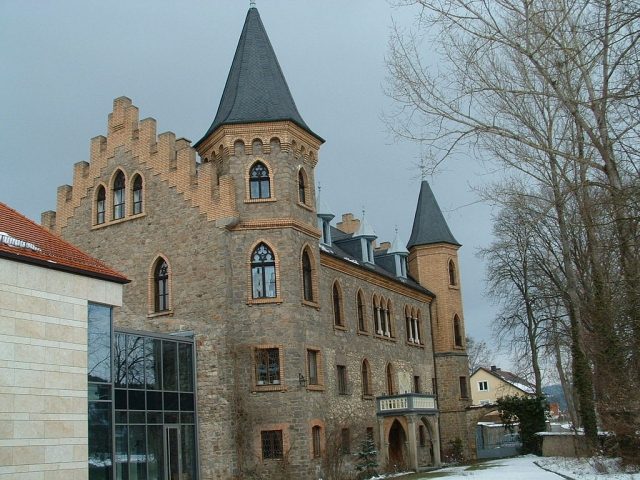
Over time, Spindlhof experienced a multitude of changes in ownership. It is particularly noteworthy that it was not a permanent family possession, but rather many noble barons coveted the building and had it expanded and altered according to their own ideas during their period of ownership. Spindlhof experienced its earliest clerical influences around the year 1800, while it was in the possession of Auxiliary Bishop Valentin Anton von Schneid, who had a chapel built adjacent to the main castle. The first pictorial representation of Spindlhof Castle also dates from this period, showing the main castle with its chapel, outbuildings, and surrounding wall.
The castle boasted its largest landholding in 1918, when it was sold, along with 400 hectares of land, to the Argentine diplomat and aircraft manufacturer Hermann von Frémery. When the Frémery family returned to Argentina in 1947, they offered Spindlhof to the then Archbishop Michael Buchberger for use, whereupon it was co-managed by the Mallersdorf Sisters until 1969. Since 1955, Spindlhof Castle has been owned by the Diocese of Regensburg.
Building+
Spindlhof Castle consists of six interconnected building complexes that frame the main castle. The Neo-Gothic main castle, rebuilt between 1894 and 1901, merges into the north wing, built in the mid-1950s, on the north side of the building. To the west, the main castle is connected to the hall building, constructed in 1999, which leads into the south wing, completed in the 1970s, housing the castle chapel (1791). Furthermore, the Albertus Magnus Church was built in 2004, which, in addition to its own access, is also connected to the castle chapel.
Building History
The present castle developed from an agricultural enterprise of the late 16th century with an associated mill on the Regen river. The first comprehensive renovation took place in 1687 under the then owner Hans Christoph von Diemantstein. In 1791, Auxiliary Bishop Valentin Anton Freiherr von Schneid had an early Classicist chapel built south of the residential buildings, dedicated to the Holy Family.
After the retired Prussian government councilor and manor owner Emil Freiherr von Zakrzewsky bought Spindlhof Castle in 1891, he began extensive renovation work in 1894, which shaped the current appearance of the castle in Tudor style. The main castle received an additional floor, the present bel étage, and was redesigned in Neo-Gothic style. In 1902, he also added an oratory to the existing chapel.
After Spindlhof Castle formally came into the possession of the Diocese of Regensburg in 1955, a comprehensive conversion into a priests' retreat began. In the same year, the current north wing was inaugurated as the first residential tract. Four years later, in 1959, the south wing, which served as the second residential tract, was completed. After another two years, the outbuilding, formerly used as stables and located between the main castle and the south wing, was demolished. The section briefly occupied by a connecting building was redesigned in 1999 into the current hall building, which connects the main castle with the south wing and forms the entrance area of Spindlhof Castle.
In 2004, the construction of the Albertus Magnus Church was completed, which also represents the most modern part of the castle in terms of construction.
Interiors
The interiors of the castle today largely serve as conference rooms. In accordance with the building history of Spindlhof Castle, both the room layout and the furnishings are highly diverse. The largest room in Spindlhof is the so-called Plenum, located in the hall building and offering space for up to 150 people. On the second floor of the main castle is the bel étage. The bel étage houses seven halls from the late Historicism period, which are largely preserved in their original state. The styles, which are also reflected in the furniture of the halls, range from Neo-Rococo to Gothic, and even include Moorish influences.
The rooms in the north and south wings have retained their purpose as guest rooms and are available to visitors of the castle.
Chapel
The castle chapel, built in 1791, is entirely dedicated to the Holy Family. The early Classicist altar structure is crowned by a painting depicting Mary and Joseph with the seven-year-old Jesus. On the altar itself are relics of Saint Emmeram and Dionysius.
The oratory, subsequently built by Emil von Zakrzewsky, is now used as a confessional and pastoral care room. The adjoining meditation room features a calligraphy by the calligrapher Hans Maierhofer.
Albertus Magnus Church
The Albertus Magnus Church, built in 2004, is named after the Dominican scholar and patron saint Albertus Magnus. The spiral-shaped (Spindlform) interior offers space for 100 people and focuses on the altar, located in the center of the spiral. This is situated under the dominant light source, a gilded ceiling opening that distributes the incoming sunlight throughout the room. Behind the altar is a large bronze crucifix of Jesus, showing Jesus both as crucified and as resurrected.
The structure of the church reflects the four elements, which are evident in the color and architectural design as well as various light plays. The specially made organ consists of two manuals, 14 speaking stops, and almost 900 pipes.
Castle Garden+
The castle garden was first mentioned in 1770 for its variety of flowers and herbs, as well as over 200 fruit trees. Today, in addition to the flower and fruit garden framing the castle, there is also a well-maintained woodland and several hectares of cultivated farmland. Outside the former enclosing walls, the adjacent Regen river and the opposite bank also belong to the castle's property.
Current Use+
Spindlhof Castle, owned by the Diocese of Regensburg, is currently used as an educational and conference center. In addition to its in-house educational program, which deals with theology, faith, culture, politics, economy, and society, the castle also offers its premises to non-church organizers. These include the historic halls and the newer guest rooms, as well as the castle's own dining hall, which seats 100 people, or the smaller "Stüberl," which accommodates 35 people.
Administration
The director of Spindlhof Castle is Prof. Dr. Sigmund Bonk, and the managing administrative director is Gerhard Haller. The Albertus Magnus Church is overseen by Prelate Prof. em. Dr. Konrad Baumgartner.
Take Mobile History with you
You are reading this text for free. Premium adds what matters on the road: descriptions read aloud, sites found through your camera, whole regions taken offline.
- Every description, including the ~17,700 Premium sites
- Audio guide: have descriptions read to you on location
- AR finder: see sites through your camera, with distance and bearing
- Unlimited saved sites
14 days free, then from €2.99 a month. Cancel anytime.
Source: Wikipedia · Licence: CC BY-SA 4.0
This description draws on the facts documented in the linked Wikipedia article; Wikipedia content is licensed under CC BY-SA 4.0. Wording and editing: Mobile History.
Location: 49.1320, 12.1327