Meditation center
CastleSchwante
Sommerswalde Castle (Schwante)
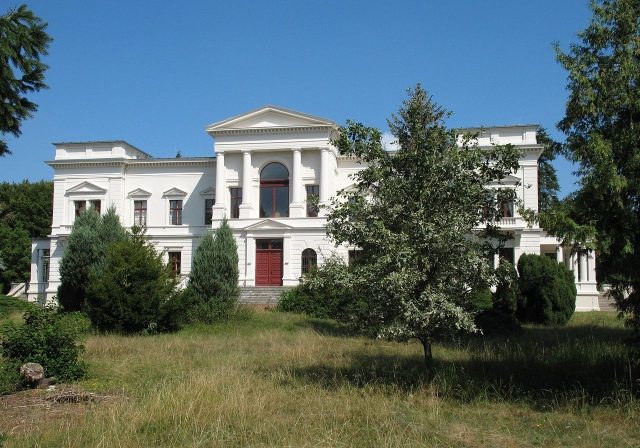
Sommerswalde Castle is located not far from Schwante (municipality of Oberkrämer) in the middle of the Schwante Forest. The entire castle complex with its outbuildings was built between 1888 and 1891 for Lieutenant (ret.) Friedrich August Richard Sommer by the Berlin architects Hans Abesser and Jürgen Kröger.
History+
Richard Sommer was the heir of the Berlin master carpenter and city councilor Carl August Heinrich Sommer (1801–1873), who owned valuable properties in the vicinity of the Brandenburg Gate. The street on which the Reichstag building was erected was named after him. By 1891, his son sold the houses and used the proceeds to establish the Sommerswalde estate and castle. The building south next to the Brandenburg Gate still bears the name Haus Sommer today. This explains the son's connection to the buildings – the father worked in the Red City Hall.
Buildings+
In Schwante, the castle rises on a semicircular square in the central axis, symmetrically framed on both sides by other buildings. To the left are a neo-Gothic residential building and an orangery in originally oriental forms. To the right stands the former forester's house – which was inhabited by Sommer's family until the completion of the main building – and next to the castle, the crenellated brick building of the stables, which was intended to evoke associations with the Red City Hall in Berlin. The castle itself shows – especially with the dome, which was removed again in the 1920s for static reasons – clear allusions to Paul Wallot's first design for the Reichstag building.
Further Use+
After Sommer's death in 1916, the eleven heirs sold the property. The agricultural cooperative Freie Scholle took over the lands, while the castle complex was acquired and renovated by the lawyer and entrepreneur Erich Lübbert as a family residence. After the Lübbert family fled from the advancing front on April 23, 1945, and the end of World War II, the Soviet military administration initially used the castle as a commandant's office. In 1949, the FDJ school Alexej Meressjew was established there, where the FDJ trained pioneer leaders until 1989. During these 40 years of use, the buildings were massively and negatively altered internally and externally from a monument preservation perspective.
After the fall of the Berlin Wall, there were initially a number of applicants for the complex, but its use was tied to monument preservation requirements. From 2000 to 2003, the Dharmakaya Schloss Sommerswalde association operated a Buddhist monastic school there. In 2006, the property was acquired by the New Kadampa Tradition – International Kadampa Buddhist Union, an international Buddhist organization, and extensively renovated in the following years under restoration guidance.
In September 2008, the Kadampa Meditation Centre Germany, located in the castle, opened its doors to the public and has since offered Buddhist study programs, weekend courses, and retreats, as well as accommodation for guests.
In September 2010, the state of Brandenburg awarded the Meditation Centre, as one of four prize winners, the Brandenburg Heritage Preservation Prize 2010 for the exemplary renovation of Sommerswalde Castle.
Take Mobile History with you
You are reading this text for free. Premium adds what matters on the road: descriptions read aloud, sites found through your camera, whole regions taken offline.
- Every description, including the ~17,700 Premium sites
- Audio guide: have descriptions read to you on location
- AR finder: see sites through your camera, with distance and bearing
- Unlimited saved sites
14 days free, then from €2.99 a month. Cancel anytime.
Source: Wikipedia · Licence: CC BY-SA 4.0
This description draws on the facts documented in the linked Wikipedia article; Wikipedia content is licensed under CC BY-SA 4.0. Wording and editing: Mobile History.
Location: 52.7487, 13.1080