To be privately owned
CastleSöllheim
Söllheim Castle
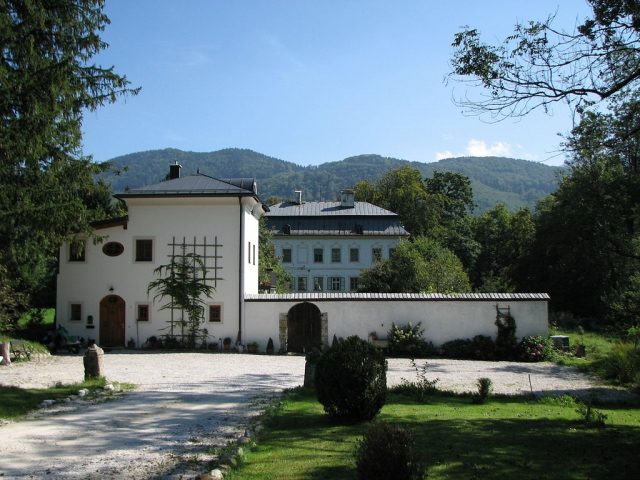
Söllheim Castle is located in the municipality of Hallwang near the city of Salzburg and is an old Baroque castle that is privately owned.
The first owner of Söllheim is said to have been Adelheid de Saldersheime in the 12th century. Söllheim came from the Tanners to the Archdiocese at the end of the 14th century. On February 23, 1455, Friedrich Gauchsperger sold the seat "zu Selhaim" to Hans I Prätzl. He was followed by Hans II as administrator of Radegg in 1565. Around 1510, Hans III owned the manor and acquired Radegg Castle. On January 3, 1539, Cardinal Matthäus Lang enfeoffed Jakob Strasser, judge of the Cathedral Provostry, with Söllheim, who had bought it from the Prätzl heirs. On June 25, 1576, the curators of the Strasser estates returned Söllheim to the Archbishop to settle outstanding debts. On October 29, 1650, the butcher Matthias Reitsamer bought Söllheim; at that time, the court chamber demanded its return to the court register, as it had been separated from the Tanner office. The widow Eva Reitsamer sold it in 1684 to Johann Kaufmann, who, according to legend, acquired a large fortune in Venice. He had the manor built in its current form (1689-1702), which had emerged from a medieval defensive and residential tower. At the same time, Kaufmann built the Antonius Chapel. In 1694, he was ennobled with the predicate "von Söllheim". His only daughter Anna Maria married Johann Christoph Pauernfeind von Eys in 1696. In 1710, Kaufmann established a fideicommiss in favor of his grandchildren, which Johann Christoph Cajetan Pauernfeind von Eys then took over as the majorat holder. He was followed by his son Johann Franz Christoph Ignaz, who died in Söllheim in 1782. Already in 1778, he had handed over the majorat to his younger brother Johann Franz Anton. After his death, the still minor son Johann Burkhart became the majorat holder. He then fought in the Austrian army, from which he retired in 1811; he left Söllheim to his sister Maria Anna Mayr, née von Eys. Under her, there was also a spa for women in this castle. The fideicommiss was abolished by the Bavarian government in 1812.
The subsequent owners of the "freehold Söllheim Castle with Mayer and Mesnerhaus" were Franz Schwarzacher (by purchase) on May 18, 1832, Georg Weikl (after auction) on August 10, 1839, Marie Countess von Thun-Hohenstein, née Baroness Mladota von Solopisk, on July 20, 1843, and Ernst Count von Thun-Hohenstein on January 27, 1879. By inheritance, it then passed to Rudolf and Mathilde von Thun-Hohenstein on October 15, 1904, and to Mathilde alone on September 8, 1941. From her, Karl Ledóchowski-Thun, deputy state office director, inherited the property on October 26, 1964. He handed over Söllheim to Eleonore Gruchmann-Bernau on December 16, 1968.
Söllheim Castle today+
The castle is a rectangular building with a plinth floor and two upper floors, topped by a mansard roof. In the plinth floor, there is a gate with a simple marble frame in both the east and west facades. The windows are barred. The floors are separated by floor-dividing fascias, the windows have fascias with ears and keystones, and on the second upper floor, they are decorated with wide volutes. Some of the windows are designed as blind windows to maintain the symmetry of the building. Inside, stucco ceilings are installed. In the western part, there are still remains of the medieval predecessor building.
Around the castle, remnants of the former park are present. At the edge of the gravel square stands a mighty marble plaque with the coat of arms of Archbishop Johann Ernst von Thun und Hohenstein. Both originate from the outermost Linz Gate, built in 1704, the so-called Ravelin Gate, and were placed here after its demolition in 1894.
Near the castle is the Antonius Chapel, today's filial church of St. Anthony of Padua, and the former sacristan's house, which is now known as the "Pfefferschiff" restaurant. The chapel was built by Anton Kaufmann. He had bought a pepper-laden ship from his employer, which was believed to be lost. He swore to St. Anthony to build a chapel if the ship should still arrive. When the ship actually arrived in Venice a little later, he built the chapel. The chapel was built in 1685/86 by Gaspari Zugalli on an oval plan with an oval dome and a roof turret. Opposite stands a statue of St. John of Nepomuk, created in 1727 by Josef Anton Pfaffinger. The plinth inscription refers to the builder Johann Christoph Pauernfeind von Eys.
The former sacristan's house next to it has a hip roof, which previously had a ridge ditch. A clock tower serves as a roof turret, whose wooden coat of arms plaque refers to Hans Kaufmann and is marked with the years 1686 and 1964.
Also part of the castle complex is the northern dairy farm, a mighty single-farmstead complex with a brick residential part, a rectangular portal, and a half-hip roof. The side walls are decorated with murals ("Adoration of the Shepherds" and "Adoration of the Kings").
Take Mobile History with you
You are reading this text for free. Premium adds what matters on the road: descriptions read aloud, sites found through your camera, whole regions taken offline.
- Every description, including the ~17,700 Premium sites
- Audio guide: have descriptions read to you on location
- AR finder: see sites through your camera, with distance and bearing
- Unlimited saved sites
14 days free, then from €2.99 a month. Cancel anytime.
Source: Wikipedia · Licence: CC BY-SA 4.0 · Image: http://commons.wikimedia.org/wiki/File:Schloss_S%C3%B6llheim_Gesamtanlage.JPG
This description draws on the facts documented in the linked Wikipedia article; Wikipedia content is licensed under CC BY-SA 4.0. Wording and editing: Mobile History.
Location: 47.8367, 13.0788