To be privately owned
CastleLoosdorf-Sitzenthal
Sitzenthal Castle
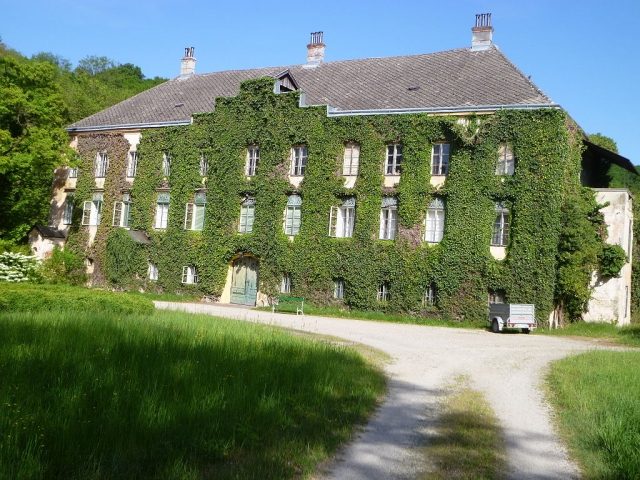
Sitzenthal Castle belongs to the market town of Loosdorf and is located approximately two kilometers northeast of Loosdorf on the Pielach river.
The name Sitzenthal refers to Count Sighard von Schalla, who was a feudal lord here in the 12th century. The short and diminutive form Sizo was transferred to the new foundation. The village and Sitzenthal Castle were first mentioned in a document in 1287, when Otto von Scheuernberg sold his estate in Sitzenthal to Hartwig von Wasen. Ownership changed hands frequently in the following centuries.
In 1843, the Imperial and Royal Chamberlain Anton Graf Ledóchowski became the castle owner. His daughter Theresia was later beatified. Another daughter, Julia Ursula, was canonized. The castle was rebuilt in the 16th century and in 1835. The former residential tower likely fell victim to Count Ledóchowski's renovations. The bricked-up moat was filled in 1899. Of the once very large hook-shaped farmstead from the first half of the 17th century, only the single-story wing on the mountain side remains. It was expanded into a four-sided complex by later additions. Several interior rooms of the castle are equipped with rib vaults. On the first floor, there is a six-bay cross-vaulted hall, whose round arches rest on columns. It was built around the turn of the 16th to the 17th century. The castle chapel, dedicated to St. Joseph, was only established in 1869 and is furnished in the style of the time. Sitzenthal Castle was known for its high-quality interior design. It is surrounded by an extensive English park that extends to the Pielach river.
Through the Counts Falkenhayn, the estate then passed to Baron Helge Hammerstein-Equord. His son Hans von Hammerstein-Equord, who became known in the interwar period, was born in the castle. After the early death of his father, his mother sold Sitzenthal Castle in 1897 to the family of the Counts Braida. This family still owns the estate today.
Since the castle is privately owned, it cannot be publicly visited. However, the state of preservation of the castle and the farm buildings is in great need of improvement. Today, however, events of the "Kinderfreunde" (Friends of Children) local group of Loosdorf are often held in the castle.
The Settlement near Sitzenthal+
Sitzenthal is one of the five cadastral communities of Loosdorf. Near the castle and manor house, there was initially no village, but only a few houses for the servants. The owners of the manor owned the land around the castle and used it for agriculture and livestock farming for self-sufficiency. Allegedly, during the time of Maria Theresia, released convicts were settled here in Sitzenthal, who worked in the castle's farmstead for resocialization. The manor had built houses for them, which they passed on to the employees with small, narrow plots of land, so-called "Bifänge," as part of their remuneration. A small linear village then developed uphill, which was expanded over time to include a second row of houses. Some Sitzenthalers were employed in the farmstead or had other "resident" professions. About ten families began to pursue various itinerant trades to make ends meet, as they had little land to cultivate. As rag collectors, scissor grinders, umbrella makers, and peddlers, they had to register these as trades and were controlled by the gendarmerie. Year after year, the itinerants traveled with their entire families in their wagons on fixed routes to specific stopping places. The bad reputation of the Sitzenthalers is due to their equation with Roma and Sinti, who were genuinely feared by the population. The Sitzenthalers had also adopted the language of the itinerants, Jenisch, which was falsely equated with Rotwelsch as a thieves' cant.
Since the fifties and sixties of the last century, there are only stories in Sitzenthal about the former conditions and circumstances. The manageable population (there are 111 inhabitants in Sitzenthal) is now active in various professions and has renovated, expanded, or newly built their houses. The feared Sitzenthaler of earlier centuries, notorious as knife-wielders, no longer exists.
Take Mobile History with you
You are reading this text for free. Premium adds what matters on the road: descriptions read aloud, sites found through your camera, whole regions taken offline.
- Every description, including the ~17,700 Premium sites
- Audio guide: have descriptions read to you on location
- AR finder: see sites through your camera, with distance and bearing
- Unlimited saved sites
14 days free, then from €2.99 a month. Cancel anytime.
Source: Wikipedia · Licence: CC BY-SA 4.0 · Image: https://commons.wikimedia.org/wiki/File:Schloss_Sitzental_1.JPG
This description draws on the facts documented in the linked Wikipedia article; Wikipedia content is licensed under CC BY-SA 4.0. Wording and editing: Mobile History.
Location: 48.2113, 15.4205