Rectory and kindergarten
CastleSiegelsbach
Siegelsbach Castle
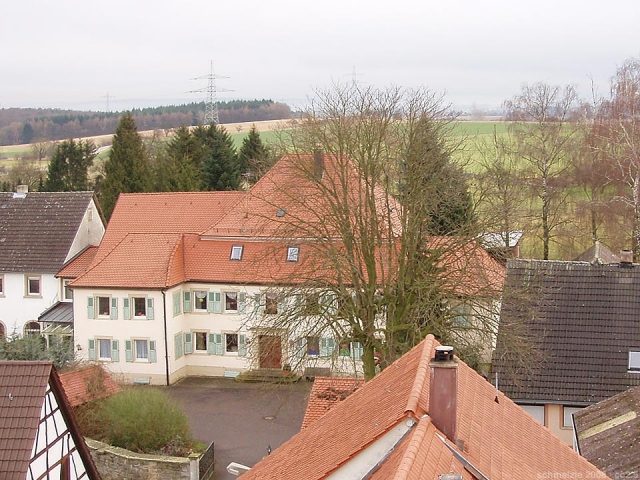
Siegelsbach Castle in Siegelsbach in the Heilbronn district in northern Baden-Württemberg dates back to the older Hirschhorner Hof and was expanded into a castle complex by the Counts of Wiser in the early 18th century. After several changes of ownership, the complex was briefly operated as an inn with a brewery from 1841, which bore the name Badischer Hof. After further changes of ownership, the complex was divided in 1862. The castle building came into the possession of the Protestant church community, which has used it as a rectory ever since and as a kindergarten since 1960.
Hirschhorner Hof
Siegelsbach had been a fief of the Lords of Hirschhorn since the 14th century, who were represented there by an official who resided in the manor house known as Hirschhorner Hof. After the extinction of the Hirschhorn family, the fief reverted to the Electoral Palatinate in 1632. In 1634, Siegelsbach was burned down by Swedish troops in the Thirty Years' War, but the Electoral Palatinate had the official buildings repaired after the end of the war. The former Hirschhorn fief came to the Electoral Court Chancellor Franz Melchior von Wiser in 1699. The castle in Friedelsheim, which belonged to his fief, had been destroyed by the French in 1694, so Wiser also took up residence in the Hirschhorner Hof in Siegelsbach, which had only recently been restored.
Castle of the Counts Wiser
After the death of Franz Melchior von Wiser in 1702, his three sons initially inherited the entailed estate jointly, but after the death of one of the brothers, the two surviving brothers divided the property among themselves in 1709, so that Siegelsbach with Friedelsheim and parts of Ober- and Untergimpern came to Franz Joseph von Wiser, who founded the Wiser-Siegelsbach line (also known as Schwarz-Wiser). The comital family did not live permanently in Siegelsbach, but also in other places, yet they expanded the manor house into a stately castle in the early 18th century. The corner buildings were covered with pointed, pyramidal roofs, and a walled castle park with a garden pavilion was created around the building. Several generations of the Counts Wiser lived in Siegelsbach at times. The Catholic local lords led to great and long-lasting tensions in the traditionally Protestant town, especially since the Counts pursued an aggressive re-Catholicization, as a result of which the church and the rectory came back into the possession of the Catholic minority. Franz Joseph von Wiser's grandson Joseph Johann sold large parts of the Wiser's land from 1814. His son Joseph Carl Georg von Wiser inhabited the castle until 1833 and then moved to Mosbach and in 1835 to the Obere Schloss in Stein am Kocher, which he had acquired. He sold the castle in Siegelsbach to the Grand Ducal Baden official and consultant to Gemmingen-Guttenberg, Karl Stein († 1834) from Wimpfen.
Change of ownership in the 19th century
Stein's son Karl Friedrich junior immediately had a brewery built on an older cellar of the property, but after the early death of his father in 1834, he and his brother sold the property in 1838 to the later Siegelsbach mayor Georg Friedrich Holoch, from whom it came to his son-in-law Johann Karl Fischer in 1841. Fischer was a cooper and brewer and operated the inn "Zum Badischen Hof" in the castle, but moved to Gaggenau as early as 1844 and emigrated from there to America, so that the property returned to Georg Friedrich Holoch. His widow sold the castle in 1849 to Johann Ott († 1852), who had been significantly involved in the construction of the Rappenau saltworks and contributed much to the preservation of Siegelsbach Castle. However, a formerly existing garden pavilion in the southeast corner of the garden and the pointed tower roofs seem to have no longer existed at this time. Ott's son, the Dürkheim saltworks director Hermann August Heinrich Ott, sold the complex in 1855 to Baroness Antonie von Schlern, widowed von Oberkamp, who married Carl Robert von Meisrimmel there in 1858. For health reasons, the couple moved to the Munich area in 1862 and put the property up for sale again.
In the possession of the Protestant church community from 1862
The property offered for sale in 1862 comprised the two-story castle building with six rooms, kitchen, pantry, and laundry room on the ground floor and eight rooms plus attics on the upper floor, as well as the brewery, various farm buildings, the castle garden, and 15 acres of land in the Siegelsbach and Rappenau districts. A consortium of the Protestant parish and school community and Siegelsbach citizens finally raised the purchase price of around 25,000 guilders, so that a purchase agreement was concluded on March 14, 1862, according to which the castle with outbuildings and a large garden went to the Protestant parish for 9045 guilders, the brewery with the garden share behind it went to the Protestant school community for 4000 guilders, and the agricultural properties went to 25 Siegelsbach citizens for a total of 11,925 guilders.
The church community made the castle the rectory of the newly founded Protestant parish. However, the brewery building quickly proved too large for use as a schoolhouse, so the church community separated the brewery from the castle in 1864 with a building breakthrough and a garden wall and sold it to Jakob Grötzinger, who set up a storage area for his oil trade there. When his sons began producing their own fats from 1885, there was a prolonged dispute with the neighboring parish due to the odor nuisance. The Grötzinger brothers therefore moved to another property by 1909 and then sold the former brewery to the farmer Gustav Hofmann. In 1912, the parish sold most of the castle garden to the municipality of Siegelsbach, which built the Siegelsbach schoolhouse there in 1923.
The castle was renovated in 1928 and received a granny flat for a nurse in 1939. Towards the end of World War II, the castle served as an alternative quarter for the already heavily damaged army ammunition depot. After the war, the castle quickly became a pure rectory again, before a major renovation took place in 1960, which saw the establishment of a kindergarten in the south wing. From 1994 to 1996, event rooms were set up in the north wing, and older farm buildings were demolished. The former brewery building, which had already been separated from the castle in 1864, has long been used for residential purposes.
Take Mobile History with you
You are reading this text for free. Premium adds what matters on the road: descriptions read aloud, sites found through your camera, whole regions taken offline.
- Every description, including the ~17,700 Premium sites
- Audio guide: have descriptions read to you on location
- AR finder: see sites through your camera, with distance and bearing
- Unlimited saved sites
14 days free, then from €2.99 a month. Cancel anytime.
Source: Wikipedia · Licence: CC BY-SA 4.0 · Image: https://commons.wikimedia.org/wiki/File:Siegelsbach-schloss08.jpg
This description draws on the facts documented in the linked Wikipedia article; Wikipedia content is licensed under CC BY-SA 4.0. Wording and editing: Mobile History.
Location: 49.2674, 9.0907