Apartments
CastleJugenheim
Seeheim Castle (Jugenheim)
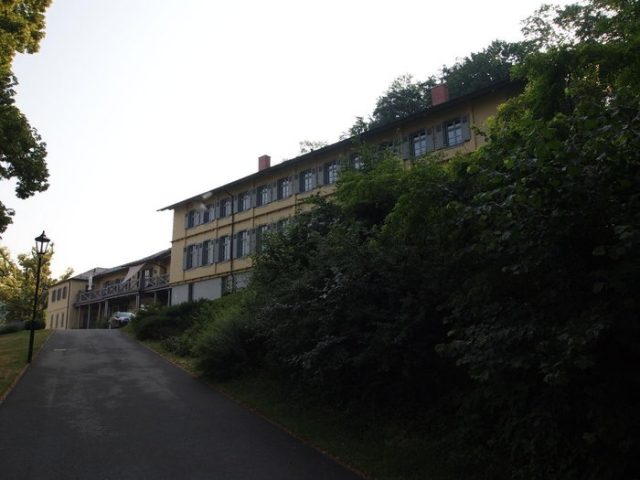
Seeheim Castle is a castle in Seeheim-Jugenheim, Hesse. Seeheim Castle is located on the northern edge of an extensive estate. To the east, it extends into the forest of the first Odenwald heights, to the south, on a steep slope on the fault line of the Upper Rhine Graben, it reaches into the town of Seeheim. To the west, towards Seeheimer Bergstraße, the landscape park stretches out.
In 1808, Ludewig I, Grand Duke of Hesse and by Rhine, acquired the manor of his bailiff Pistor, including a spacious Rococo garden on the western slope of the Odenwald on a hill near Seeheim. In the following years, the garden was transformed into an English landscape garden, whose size, form, and design are largely preserved. In the early 1830s, Crown Prince Ludwig II expanded the manor into a country estate to escape the cholera epidemic threatening from the east.
The country estate was used more or less frequently by the Grand Dukes and their families until about the turn of the 20th century. From the early 1920s, the Bergstraße and Seeheim became a popular holiday destination for guests from Germany and other European countries. The former grand ducal castle thus served as a domicile with princely furnishings until the end of World War II. In 1958, the Bergstraße Bible School, a subsidiary institution of the American "Greater-Europe-Mission," bought the property. Many hundreds of people studied here until the Bible School found a new location in the Black Forest in 1990. In the early 21st century, the relevant local and supra-local political bodies and the monument protection authorities agreed with an investor on a changed use, provided that the castle ensemble, now inhabited by a community of owners, was largely restored to its original state.
Appearance+
The building ensemble consists of the old residential house of the manor (ground floor fieldstones, upper floor half-timbered, with a risalit), an attached central part with reception rooms, and an unusually constructed, long residential wing (ground floor fieldstones, upper floor in timber construction with vertical softwood tree trunks (approx. 20 x 20 cm) and similar horizontal wooden ceilings). In addition, there are outbuildings and two guardhouses, the latter built in the same style as the residential wing.
Park
To the east, the park before the forest transition is laid out as a pleasure garden on the hillside with multi-level winding paths, pleasure ground, resting places, grotto, small fountain, tea house, sightlines to Seeheim and the Rhine plain, a lime tree avenue (as a remnant of Pistor's Rococo garden) and remains of a garden layout. To the west, on a flat circular path with sightlines to the castle, one encounters significant tree groups, meadows, and a centrally located pond. The entire park can be explored on a circular path in the western part and by walking through the eastern part.
Source Text: Wikipedia
Take Mobile History with you
You are reading this text for free. Premium adds what matters on the road: descriptions read aloud, sites found through your camera, whole regions taken offline.
- Every description, including the ~17,700 Premium sites
- Audio guide: have descriptions read to you on location
- AR finder: see sites through your camera, with distance and bearing
- Unlimited saved sites
14 days free, then from €2.99 a month. Cancel anytime.
Source: Wikipedia · Licence: CC BY-SA 4.0
This description draws on the facts documented in the linked Wikipedia article; Wikipedia content is licensed under CC BY-SA 4.0. Wording and editing: Mobile History.
Location: 49.7668, 8.6532