Hotel
CastleAerzen
Schwöbber Castle
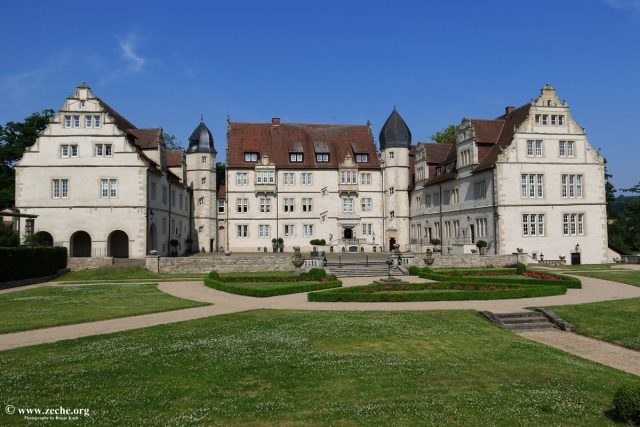
Schwöbber Castle is a three-winged moated castle built in the 1570s near Aerzen-Königsförde, close to Hameln in Lower Saxony. It is one of the most significant buildings of the Weser Renaissance and was once famous for its gardens. Today, it is used as an upscale 5-star hotel.
From about 1510 to 1919, the Schwöbber estate belonged to the well-known Lower Saxon noble family of Münchhausen, from which the famous Baron of Lies also originated. In 1510, Stacius von Münchhausen, pledgee of Aerzen Castle, and his brothers are mentioned as vassals of St. Boniface Abbey in Hameln with three farmsteads in Schwöbber. Stacius' fourth son, Hilmar von Münchhausen, a royal Spanish colonel in the service of Philip II, became one of the richest men of his time as a mercenary leader. He and his sons Statius (1555–1633) and Hilmar the Younger (1558–1617) were among the great builders of the Weser Renaissance; their main works, in addition to Schwöbber, included the castles of Leitzkau, Bevern, and Wendlinghausen.
Castle Construction
After monetizing his pledge ownership of Stolzenau Castle in 1562 (he only retained a burgmannshof there), Colonel Hilmar acquired the former Leitzkau Monastery near Magdeburg as free property in 1564 and began its conversion into a castle in the following years. Also in 1564, after long negotiations, he received the enfeoffment of Schwöbber as a newly registered knight's estate, along with the sovereign's permission to build a hereditary noble seat there. For this, four farms had to be relocated, whose owners moved a little further into the valley, taking their half-timbered houses with them. One of them was called Schwöbber, and this name was retained for the new noble estate. From about 1566, the Hameln master builder Cord Tönnies planned the castle construction, which began before Hilmar's death in 1573 with drainage, leveling, and excavation, perhaps even masonry, and was subsequently carried out by his widow Lucia von Reden from 1574–78, with the construction of the central wing. In 1570, Hilmar took over the pledge of the Hoya'schen Castle Steyerberg with the domain of Schinna Monastery, where he died in 1573. A little later, his family managed to expand the small arable land of the Schwöbber farms by about 16 1/2 hides and to acquire the village of Grupenhagen in exchange.
In the division of inheritance among the sons in 1574, the fourth son, Hilmar the Younger von Münchhausen (1558–1617), drew the Schwöbber estate and the burgmannshof in Rinteln, which Colonel Hilmar and his brothers had acquired in 1527 as a Schaumburg fief. In 1588, he built the gate wing, and from 1602 to 1607, the northern pond wing. Above the gate entrance is a double coat of arms of Münchhausen, namely that of the black line of Hilmar the Younger and that of the white line of his wife Dorothea (1568–1624), a sister of Ludolf von Münchhausen of Hessisch Oldendorf, as well as Claus of Apelern and Otto, builder of Schwedesdorf Castle in Lauenau.
The castle, including the tithe barn and surrounding moats, was originally fronted by an economic courtyard, so that the complex was enclosed on all four sides. One of Hilmar the Younger's daughters, Hedwig, married Gerhard Clamor von dem Bussche in 1607; the couple built a new castle on his Hünnefeld estate in Osnabrück, modeled after Schwöbber, but in simple Baroque forms instead of Renaissance decor.
In 1668, Schwöbber passed to Hilmar the Younger's grandsons, Otto I von Münchhausen (1643–1717) and his brother Burchard; from 1690, it belonged to Otto alone. Around 1700, a garden still rooted in the Renaissance was laid out. The garden in Schwöbber was so well-known at the time that it was described and depicted in the copperplate engraving work "Nürnbergische Hesperides" by the merchant Johann Christoph Volkamer in 1714. It is known that in 1715, the Russian Tsar Peter I, the Great, was a guest in Schwöbber, as he was interested in what was then Europe's largest plant collection and the orangery with its pineapple cultivation (see image of Pineapple Monument).
Garden Art
In 1717, Otto's son-in-law and nephew Friedrich von Münchhausen inherited Schwöbber, and consequently in 1741, his son Landdrost Otto II von Münchhausen (1716–1774), who scientifically dealt with fruit and horticulture, as the author of the then widespread horticultural-agricultural textbook "Der Hausvater"; he is considered the founder of agricultural science and was well informed about the current trends in garden art. In 1750, he transformed the castle park into one of the earliest English landscape gardens in Continental Europe (and, according to current research, probably the earliest German park of about eight hectares). Zedler's Universallexikon from 1743 reports on the "curious Münchhausen Garden," "where one can behold the most beautiful and rarest foreign plants from East and West Indies for special delight: pineapples, coffee trees, dates, mastic, two hundred kinds of oranges...". Otto von Münchhausen's nursery was one of the most important of its time; it was one of the first in Germany to possess woody plants from North America. Carl von Linné's friend already recognized that English parks could not simply be transferred to German conditions:
"One can create princely gardens in the style of English parks; but if we German noblemen were to follow them and turn our estates into parks, we would also have to raise so many thousands of pounds from our plantations in the West Indies."
Otto's daughter Sidonie married Johann Friedrich von Veltheim (1731–1800) of Destedt in Braunschweig in 1766, where from 1768 – following the example of Schwöbber Park – they expanded the small French garden there into an extensive landscape park, with the cooperation of gardener Lenke from Schwöbber. This park was taken over in 1774 by Sidonie's brother, the Hameln district administrator Otto III von Münchhausen (1753–1828), whose wife Wilhelmine von Reden from Hameln inherited the Silesian possessions around Niederschwedeldorf from her brother, the Prussian mining minister Count Reden, in 1815, which then fell to her daughter and her husband, Otto III's nephew Adolf von Münchhausen from Stolzenau.
Otto III's son – Otto IV (1786–1853) – had the castle chapel built in Schwöbber in 1840. The chapel, furnished in the Neo-Renaissance style, is one of the earliest examples of the adoption of regional Renaissance forms; about ten years before this reached a first peak in Schwerin Castle. From the mid-19th century, Schwöbber Castle was a center of regional cultural life and became a tourist destination. However, Otto IV's brother and heir August (1798–1861) allowed the famous greenhouses in Schwöbber to fall into disrepair. His son Johann (1838–1919) leased Schwöbber and bought land in Slovenia.
20th Century
In 1900, Johann ceded Schwöbber Castle to his nephew Burchard (1867–1940). In 1907, it came under forced administration of the knighthood. In 1908, the pond wing burned down due to a lightning strike, and in 1920, the estate and castle, which had been in the possession of the Münchhausen family since 1511, were sold for 126,000 gold marks (1.5 million marks in inflation value). A cousin of the last owner wrote: "I know a century of Schwöbber... I saw the great splendor of the house. 16 furniture vans full of Schwöbber ended up in a junk shop."
The purchaser, Eduard Meyer (1859–1931), tenant of a seed business in Friedrichswerth, rebuilt the burned-out pond wing and had the interior redesigned in an eclectic manner by architects Wangenheim and Lübke and painter Oscar Wichtendahl between 1920 and 1922 (with borrowings from the Middle Ages, Baroque, Rococo, Empire, Classicism, and Symbolism), as a result of which – in addition to several fires that destroyed more – only the smallest part remains in its original state today. However, the design of the 1920s is now a protected monument.
During World War II, from 1943, part of the artworks of the Kunsthalle Bremen were stored in Schwöbber Castle. After World War II, it temporarily served as a teacher training center. From 1985 to 2002, it was used as a clubhouse and hotel for the Schwöbber Castle golf course. In October 1992, a major fire again occurred in the central wing. In 2002, Ursula and Friedrich Popken, the owners of the "Ulla Popken" fashion boutique chain, acquired the building, which was by then in danger of collapse, and restored and modernized the castle for 35 million Euros. In 2004, the 5-star Schlosshotel Münchhausen was opened there.
War damage in 1945, as well as lack of maintenance and detrimental interventions after 1960, led to an almost complete obliteration of the former historical structure and significance of the park grounds. The restoration, which began in 2003, was based on the plans of architects Heinrich Zeininger and Jürgen von Wangenheim (1875–1956; from Wunstorf; son of Walrab von Wangenheim) from around 1920. The former network of paths could only be made visible again through thorough archaeological excavations. After the removal of the wild growth that had accumulated over almost 50 years, the old sightlines are also clear again and reveal the special quality of the complex as a landscape park.
Take Mobile History with you
You are reading this text for free. Premium adds what matters on the road: descriptions read aloud, sites found through your camera, whole regions taken offline.
- Every description, including the ~17,700 Premium sites
- Audio guide: have descriptions read to you on location
- AR finder: see sites through your camera, with distance and bearing
- Unlimited saved sites
14 days free, then from €2.99 a month. Cancel anytime.
Location: 52.0692, 9.2515