Hotel
CastleNeukirchen/Pleiße
Schweinsburg Castle
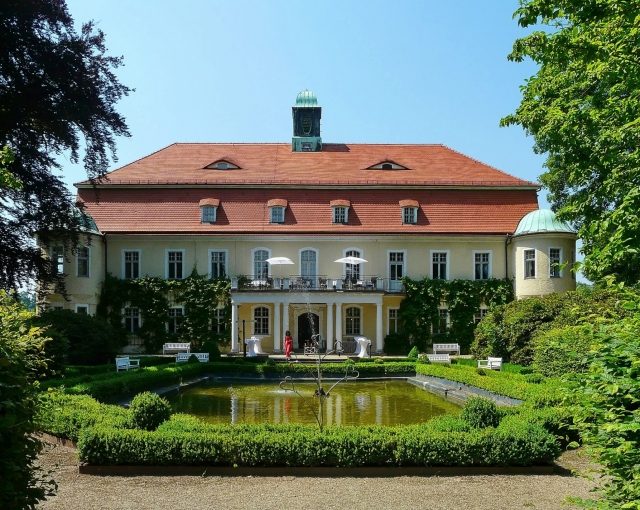
Schweinsburg is a moated castle located at approximately 250 m above sea level in Neukirchen in the district of Zwickau in Saxony. Remains of the medieval castle are clearly visible in the complex, which was converted into a conference center in 1994.
In the course of East German colonization, the town and castle of Crimmitschau were established in the second half of the 12th century. Although there are no documentary records to prove this, neighboring towns (Waldenburg Castle 1165–72, Meerane 1174) are mentioned for the first time during this period. An older Slavic settlement served as the basis for the new settlement. The Lords of Crimmitschau, a noble family of unknown origin, were first mentioned in documents in 1212 as guarantors for Otto IV. From their position, it can be concluded that they held the lordship as an imperial fief. The Lords of Crimmitschau were among the leading families of the Pleißenland and repeatedly served as regional judges of Pleißenland.
In the northwest, simultaneously with the Lordship of Crimmitschau, the Lordship of Starkenberg around Grünberg, Heyersdorf, and Frankenhausen had emerged. The Vögte of Weida also colonized the territory and owned, among other things, estates in Rudelswalde and Lauenhain. To the southeast, the Schönburg possessions extended. The expansion possibilities of the Lordship of Crimmitschau were thus limited. Furthermore, it was located at the intersection of two colonization lines, one leading from Thuringia via the Pleißenland to the Ore Mountains and the other from Weida eastward into the forest area. This significantly hindered the development of the lordship.
The construction of the medieval moated castle, parts of which are preserved, dates back to the 13th century. In 1222, it was referred to as "vest huz cremascowe". The family of the Lords of Crimmitschau died out as early as the 13th century. Günther von Crimmitschau had joined the Teutonic Order in 1270–73. The Schönburgs took over the lordship and founded a collateral line here. In 1322, Friedrich von Schönburg documented at Crimmitschau Castle. When the Crimmitschau line of the Schönburgs also died out at the end of the 14th century, the Lordship of Crimmitschau fell to the Wettins. The Schönburgs had to recognize the feudal sovereignty of the Wettins over the Lordship of Crimmitschau in 1307. The castle served as the administrative center of the manorial estate. In 1486, the name Schweinsburg was used for the castle for the first time.
In 1743, the dilapidated castle was converted into a Baroque palace by the von Berbisdorf family. The owners Christian Friedrich and Friedrich Emil Robert Meinhold were members of the Saxon Landtag in the 19th century. From 1908 to 1911, another renovation took place in the Neo-Baroque style. In 1945, the owners were dispossessed and expelled by the communists. The bell tower (tower of the lower castle) was demolished. Since then, the historically valuable bell from the Harthau chapel (now Lauenhain) has been missing. Between 1946 and 1989, the palace served as a party school for the KPD/SED, and the building fabric was significantly damaged; among other things, the house chapel was converted into a gymnasium with the loss of the historic altar.
In 1998, the palace was renovated and a hotel was established in the lower castle. Guided tours are conducted by telephone appointment.
Take Mobile History with you
You are reading this text for free. Premium adds what matters on the road: descriptions read aloud, sites found through your camera, whole regions taken offline.
- Every description, including the ~17,700 Premium sites
- Audio guide: have descriptions read to you on location
- AR finder: see sites through your camera, with distance and bearing
- Unlimited saved sites
14 days free, then from €2.99 a month. Cancel anytime.
Source: Wikipedia · Licence: CC BY-SA 4.0 · Image: Thomas Eichler
This description draws on the facts documented in the linked Wikipedia article; Wikipedia content is licensed under CC BY-SA 4.0. Wording and editing: Mobile History.
Location: 50.7876, 12.3781