Restaurant
Cultural Events
CastleSchwante
Schwante Castle
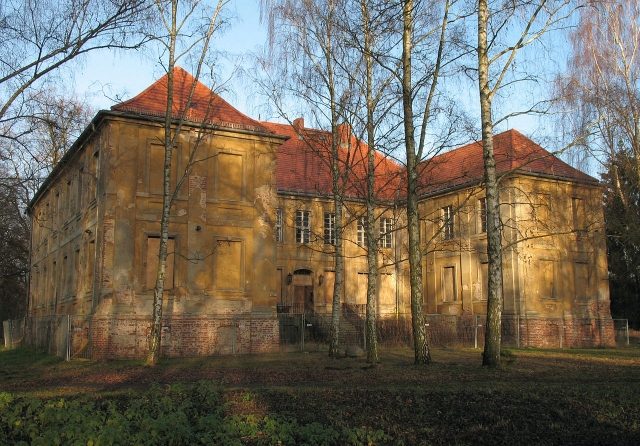
Schloss Schwante is located southwest of the village center of Schwante (municipality of Oberkrämer) in Brandenburg. It is actually a former manor house, which, due to its stately dimensions as a two-story, three-winged complex, is commonly referred to as a castle (Schloss).
The castle was built from 1741 to 1743 under the estate owner Erasmus Wilhelm von Redern from the House of Schwante and his wife Catherina Elisabeth von Bredow from the House of Sontz by an unknown architect, likely with advice from Knobelsdorff. It was erected on the site of a fortified house from 1618, parts of which have been preserved in the cellar vaults of the current castle. The two narrow side wings were probably added only in 1744 – which can be deduced from the construction of the roof truss – and served as utility rooms and for housing staff.
In 1888, Richard Sommer, who was also the builder of Schloss Sommerswalde in the Schwanter Forst, acquired the estate and had new farm buildings constructed from 1903 to 1905. In 1910, the interior of the three-winged complex was also fundamentally altered. The current arrangements of the doors, door frames, and wooden panels largely date from this period. The staircase was also moved from the antechamber to the side, into former living quarters.
After Sommer's death in 1916, the eleven heirs sold the property. The lands were taken over by the agricultural cooperative "Freie Scholle," while the castle went in 1924 to Vicco von Bülow – an engaged member of the Stahlhelm, Bund der Frontsoldaten, and from 1935 Chief of Protocol in the Foreign Office. He then called himself Vicco von Bülow-Schwante. Under him, a balcony extension with a terrace was added to the rear facade in the 1920s, and in the 1930s, a driveway made of Silesian sandstone with a ramp balustrade and portal lions was created on the entrance side.
After the Second World War, the castle temporarily served as a makeshift hospital for typhoid patients and then as an educational institution for the FDJ. In 1962, it came under municipal administration. It stood empty until 2009 and was then sold to Hexenkessel Hoftheater und Strand GmbH, which operates a theater there. In the premiere season, up to 500 spectators per performance could be attracted. The castle is to be gradually renovated. The opening of a restaurant is planned for 2011.
Take Mobile History with you
You are reading this text for free. Premium adds what matters on the road: descriptions read aloud, sites found through your camera, whole regions taken offline.
- Every description, including the ~17,700 Premium sites
- Audio guide: have descriptions read to you on location
- AR finder: see sites through your camera, with distance and bearing
- Unlimited saved sites
14 days free, then from €2.99 a month. Cancel anytime.
Source: Wikipedia · Licence: CC BY-SA 4.0
This description draws on the facts documented in the linked Wikipedia article; Wikipedia content is licensed under CC BY-SA 4.0. Wording and editing: Mobile History.
Location: 52.7312, 13.0836