Museum
Offices
CastleLünen
Schwansbell Castle
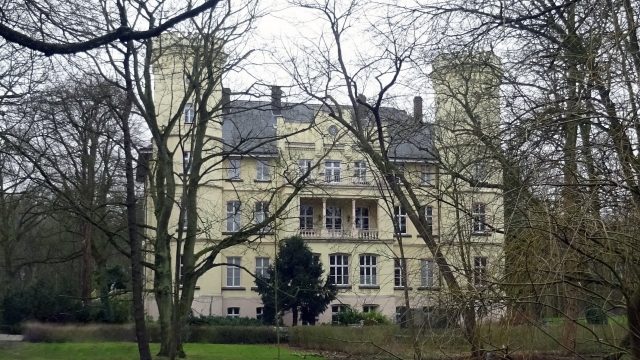
Schwansbell Castle in Lünen (North Rhine-Westphalia) is an old Westphalian moated castle, but its moat does not enclose the castle itself, but a garden island, on which a small castle originally stood.
Located about three kilometers outside the town center, Schwansbell Castle has a varied past. Until 1998, it housed the former building authority of the city of Lünen, after the Second World War it temporarily served as a kind of military hospital, and then also as a youth/orphanage. For decades, the structural stability of the castle was questionable due to mining in the neighboring collieries and the Datteln-Hamm Canal running in its immediate vicinity.
The castle in its present form was built between 1872 and 1875 according to plans by the Dortmund master builder Fritz Weber by Wilhelm von Westerholt with two octagonal towers. Before that, it was demonstrably used as a knight's seat by the Lords of Schwansbell since 1187. In the course of the incorporation of the Horstmar district, the city of Lünen acquired the castle in 1929, which served the Hitler Youth in 1934. Later, the buildings were used as an orphanage.
During the Second World War, the building served as accommodation for the flying crews of the nearby Dortmund air base.
The former building contractor and "castle king" Herbert Hillebrand acquired the castle in 1982 for his daughter Adriana from the city of Lünen and had it restored.
Until November 2004, the adjacent outbuilding was used for gastronomy; it housed a restaurant that was formerly awarded a star in the Guide Michelin. The former restaurant owner and star chef Franz L. Lauter has since worked at Nordkirchen Castle.
After a renovation, Schwansbell Castle is now divided into rental apartments and office spaces.
On November 1, 2008, the property was sold by Hillebrand to Initium Germania I C.V., a company based in Geffen (Netherlands).
The Museum of the City of Lünen is located in the side outbuilding.
The castle park, in contrast to the small garden island, is open to the public and is a popular walking path in Lünen. It also houses unusual tree species from eastern North America and southeastern Europe, such as the trumpet tree, the Christ thorn, black locusts, or the tulip tree.
The castle is a listed building.
Take Mobile History with you
You are reading this text for free. Premium adds what matters on the road: descriptions read aloud, sites found through your camera, whole regions taken offline.
- Every description, including the ~17,700 Premium sites
- Audio guide: have descriptions read to you on location
- AR finder: see sites through your camera, with distance and bearing
- Unlimited saved sites
14 days free, then from €2.99 a month. Cancel anytime.
Location: 51.6034, 7.5372