Restaurant
CastleBockenheim
Schönhof Castle (Bockenheim)
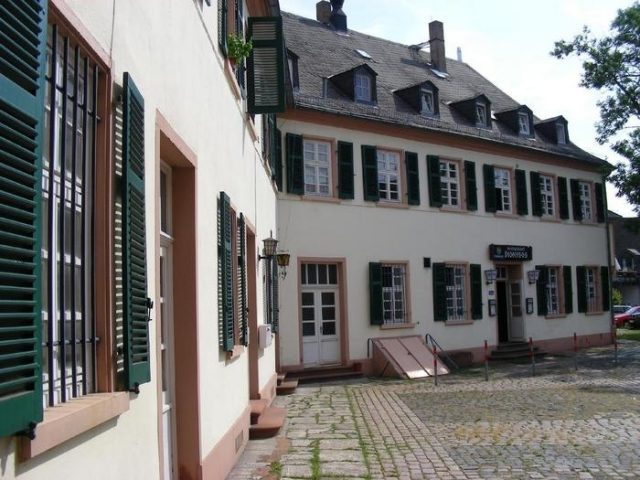
The Schönhof was one of the largest estates in Bockenheim, a small town northwest of Frankfurt am Main that was independent until 1895 and has since become one of its largest districts.
The estate belonged to the Knights of Praunheim until 1590. From 1730 to 1765, it was owned by the family of the banker Isaak d’Orville. In 1743, he was ennobled by the German Emperor Charles VII, who resided in Frankfurt for five years. The family received the name "Edler von Löwenclau und Herr zu Schönhöffen". Since then, the name Schönhof became common for the estate. The estate was sold to the Bruère family and almost completely burned down in 1818.
In 1819, it was acquired by the retired Hessian-Darmstadt minister Carl Ludwig Freiherr von Barckhaus gen. Wiesenhütten. He commissioned the then very successful architect Nicolas Alexandre Salins de Montfort with the renovation. The latter had the manor house, which was built between 1650 and 1700, renewed and part of the older residential and farm buildings demolished and replaced by spacious new buildings. In addition to the farm buildings, a small theater was built (demolished in 1937) and the estate's park was extended. In 1820, the architect Friedrich Rumpf erected a garden temple, which was moved to Grüneburgpark in 1964.
The new owner could not enjoy his property for long, as he died childless in 1823, only four years after the purchase. His heirs sold the Schönhof to the city of Frankfurt in 1898.
In 1872, the Schönhof became the western terminus of the first line of the Frankfurt tramway. The horse-drawn tram line of the Frankfurter Trambahn-Gesellschaft ran from here through the town of Bockenheim and the Frankfurt Westend to Hauptwache. A tram depot was built at the Schönhof for this purpose, which served as accommodation for both the vehicles and the horses.
Later, the tram line was extended to Rödelheim. To alleviate an accident blackspot, the Breitenbach Bridge (named after the Prussian Minister for Public Works, Paul von Breitenbach, 1850–1930) was built over the tracks of the Main-Weser Railway in 1914/16. This construction project led to the destruction of the Schönhof park.
During the Second World War, large parts of the Schönhof were also destroyed. Only the baroque manor house was rebuilt. Today, it houses the Greek restaurant "Dionysos". The large beer garden aims to commemorate the lost park. In 1981, the manor house was renovated again, and next to it, the city of Frankfurt built an award-winning music practice center, the Saalbau Schönhof. Events are sometimes held here as well.
Source: Wikipedia
Take Mobile History with you
You are reading this text for free. Premium adds what matters on the road: descriptions read aloud, sites found through your camera, whole regions taken offline.
- Every description, including the ~17,700 Premium sites
- Audio guide: have descriptions read to you on location
- AR finder: see sites through your camera, with distance and bearing
- Unlimited saved sites
14 days free, then from €2.99 a month. Cancel anytime.
Source: Wikipedia · Licence: CC BY-SA 4.0
This description draws on the facts documented in the linked Wikipedia article; Wikipedia content is licensed under CC BY-SA 4.0. Wording and editing: Mobile History.
Location: 50.1238, 8.6346