The Castle can be visited
CastleSchönfeld
Schönfeld Castle
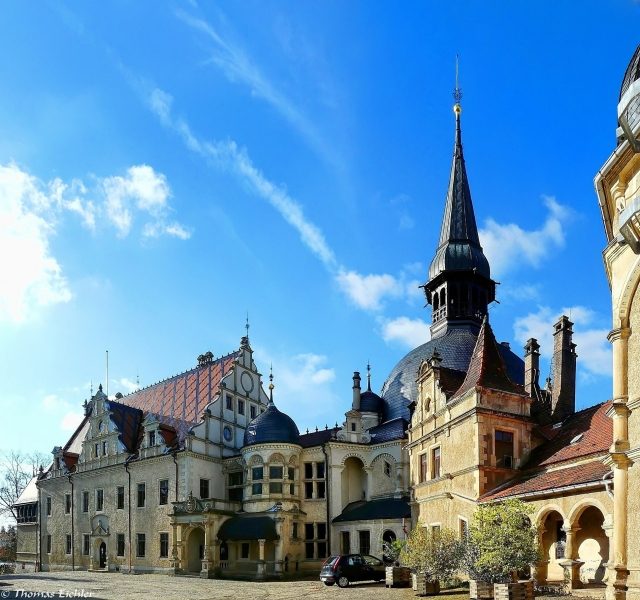
Schönfeld Castle in the Saxon municipality of Schönfeld was first mentioned as a moated castle in the 13th century and was expanded over the centuries. The noble family of Schönfeld resided here until the early 15th century. The buildings date from 1560 to 1580. In 1882, Baron von Burgk acquired Schönfeld Castle and had it rebuilt by 1884. Today, Schönfeld Castle is one of Saxony's most significant Neo-Renaissance castles.
Schönfeld Castle is located three kilometers from the A13 exit (Thiendorf) in the direction of Großenhain in the municipality of Schönfeld on the B 98. The castle can be reached by bus lines 455 and 456 of the Verkehrsgesellschaft Meißen.
A document from January 21, 1216, names Tammo de Sconevelt as a witness to the transfer of the village and church of Zadel by Margrave Dietrich to the Altzella monastery. This represents the first mention of Schönfeld as a feudal lordship. At that time, in the area of the large tower, there was a fortified complex to protect the Hohe Straße, a trade route. In 1309, the noble seat of Sconevelt included 37 Hufen of land. The noble family of Schönfeld owned several manors, some of the lords were the right hand of the margrave. In 1350, the mercenaries of the Upper Lusatian League of Six Towns besieged the place. Due to death and inheritance, half of the Schönfeld lordship passed to the von Köckritz family in 1400. Jan de Schonfeld is mentioned in 1413 as the last owner from the Schönfeld lineage. The rule of the namesake family in Schönfeld finally ended in 1421.
Subsequently, two feudal lords resided in Schönfeld, with the lordships of "Neuen Theils" (New Part) and "Alten Theils" (Old Part) existing. Initially, representatives of the Meissen families Maltitz and Miltitz were enfeoffed. In Schönfeld "Neuen Theils", "Titz von Honsberg" followed in 1448. The lordship "Alten Theils" passed to "Ludold von der Sahla" through marriage. From 1465, the other part of the Schönfeld manor also belonged to the Lords von der Sahla. During their reign, the two castle complexes were built as solid structures in the forms of the Saxon Renaissance from 1560 to 1590. After three centuries, the rule of the von der Sahla family finally passed to the Electoral Saxon Chamberlain Carl Friedrich von Erdmannsdorf, who married Charlotte Sophia von der Sahla in 1765. From this point on, the von Erdmannsdorff family provided the Schönfeld hereditary, feudal, and judicial lords for several generations. In 1768, Carl Friedrich von Erdmannsdorff had the moat around the castle partially filled. In 1830, three towers and the two drawbridges of the castle were demolished. Schönfeld "Alten Theils" and "Neuen Theils" were formally reunited into one manor in 1860.
In 1882, Maximilian Dathe von Burgk, the grandson of Carl Friedrich August Freiherr Dathe von Burgk, received Schönfeld Castle and the manor from his father as a wedding gift. Between 1882 and 1884, he had the building extended and furnished in the Neo-Renaissance style under the direction of architect Gotthilf Ludwig Möckel. In 1883, the outbuildings and the "Inspector's House" on the manor grounds were expanded. Between 1889 and 1893, the "Royal Garden Director" Max Bertram supervised the creation of the 6.4-hectare castle park as an open English landscape garden. From 1900 to 1901, a newly built riding hall was added. In 1945, the Barons von Burgk were dispossessed and expelled by the Communists.
The first safeguarding works for the preservation of the castle were carried out in 1989. Between 1990 and 1994, the exterior of the large tower, including the connecting building and the northeast gable of the main building, was renovated and reconstructed. Until 1997, the facade of the main building and its annexes were renovated. The balustrade of the main building was completed in 1998. In 1999, the exterior of the economic wing was renovated and reconstructed. This also included the installation of the heating system for the entire castle complex. A pilgrim hostel on the Saxon Way of St. James was established in 2003.
Take Mobile History with you
You are reading this text for free. Premium adds what matters on the road: descriptions read aloud, sites found through your camera, whole regions taken offline.
- Every description, including the ~17,700 Premium sites
- Audio guide: have descriptions read to you on location
- AR finder: see sites through your camera, with distance and bearing
- Unlimited saved sites
14 days free, then from €2.99 a month. Cancel anytime.
Source: Wikipedia · Licence: CC BY-SA 4.0 · Image: Thomas Eichler
This description draws on the facts documented in the linked Wikipedia article; Wikipedia content is licensed under CC BY-SA 4.0. Wording and editing: Mobile History.
Location: 51.3039, 13.7093