Uninhabited
CastleSchnaditz
Schnaditz Castle
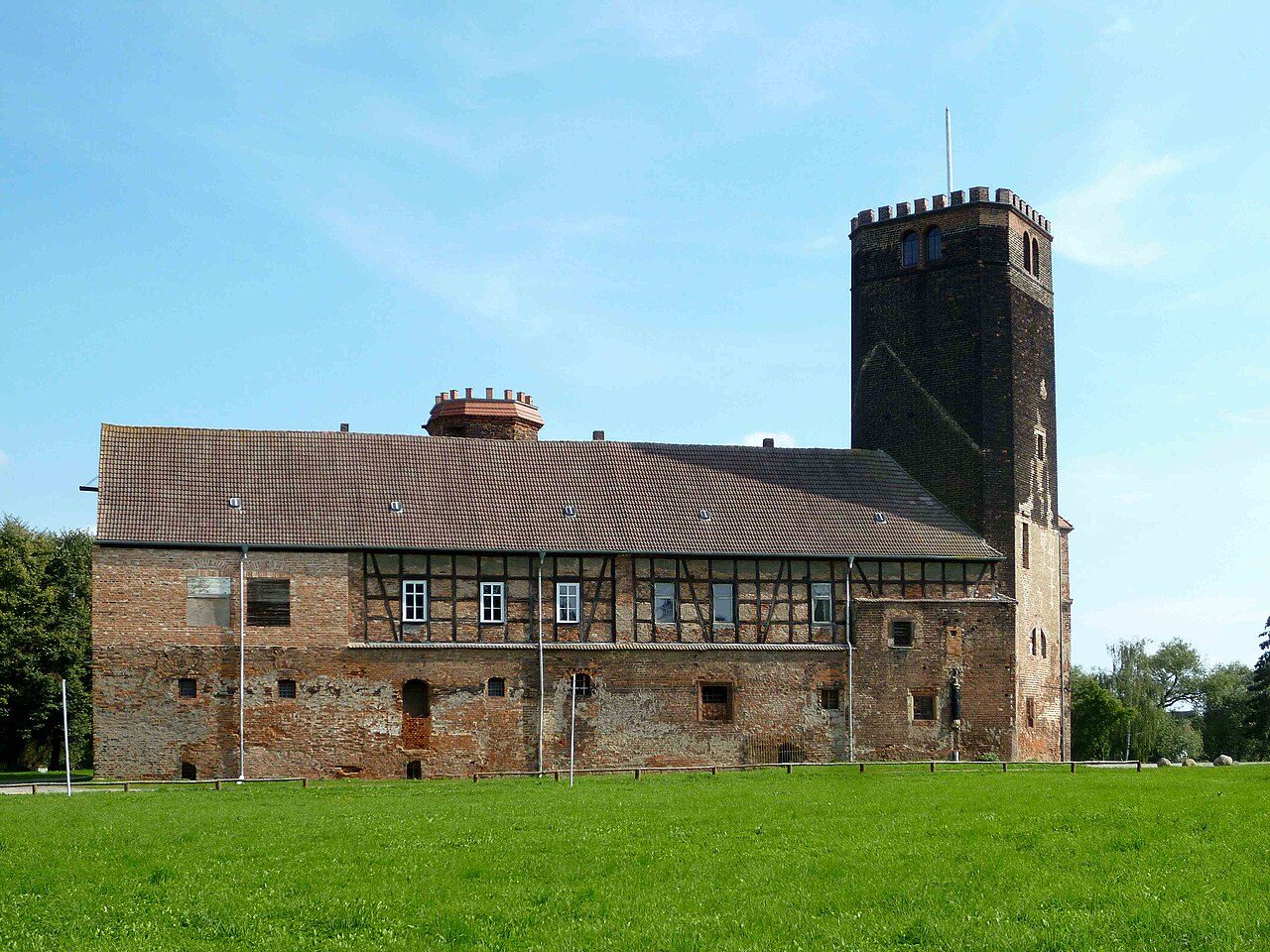
Schnaditz Castle is located in the Schnaditz district of the city of Bad Düben. It is currently empty and belongs to the city. The castle has a 29-meter high defensive tower.
History
The castle was built around the year 1237. Bodo and Otto "Knights of Schneuditz" are listed first among the lords of the manor in Schnaditz. Names such as Albrecht von Oechlitz, Heinrich von Bünau, Nickel von Rabil, and Ludwig von Wuthenau follow. For the longest period (1463–1655), members of the von Zaschnitz family lived there, also related to the Steuben family through marriage. One of these lords of the castle, Gunther von Zaschnitz, entered literary history rather infamously at the time: in 1532, he stole the horses of the merchant Hans Kohlhaase in Wellaune (then an outwork of Schnaditz). The case later became the basis for Heinrich von Kleist's novella "Michael Kohlhaas".
Christoph Otto von Steuben bought Schnaditz Castle in 1678 from the community of heirs of the von Bülow family. He leased the ancestral estates of Gerbstedt and Friedeburg, moved his residence to Schnaditz, and became the new hereditary and judicial lord there. He took over the acquired property, which included a brickworks, a brewery, and a distillery, on July 17, 1678, with a solemn ceremony. In 1686, his son Christoph Liborius von Steuben inherited it; he partially rebuilt and renovated the associated Schnaditz church in 1716. After Christoph Liborius's death in 1738, the castle and the associated knight's estate were sequestered in 1757 at the request of his widow, along with 1300 Morgen of land, and initially placed under the administration of the office in Düben. In 1764, Baroness Dorothea Maria Justina von Görtz bought it at auction; in 1789, the Counts of Einsiedel zu Schönfeld and Baldria took it over. In 1792, it passed into the possession of the Saxon Commissioner Christoph Samuel Martini, who redesigned the 10-hectare park modeled after the famous Wörlitz Castle Park (near Dessau).
Nazi Era
Schnaditz Castle remained in the possession of the Martini family until 1940. The last private owner, Dr. med. Erich Wendenburg, was dispossessed in 1945.
Walter Martini, a son of the penultimate owner, was married to Marie Oster, a sister of Major General Hans Oster. The latter was head of intelligence in the High Command of the Wehrmacht and, as a leading member of the military resistance group, was involved in the assassination attempt against Adolf Hitler. After the attack failed, Hans Oster was arrested in Schnaditz on July 21, 1944, and hanged on April 9, 1945, in Flossenbürg concentration camp (Upper Palatinate).
After 1945
After the end of the war, the castle served as accommodation for Eastern European refugees. During GDR times, the three wings housed, among other things, the municipal administration and a kindergarten, and the structural decay seemed unstoppable. Since the fall of the Berlin Wall, the building has been empty; currently, the listed building is being restored.
Take Mobile History with you
You are reading this text for free. Premium adds what matters on the road: descriptions read aloud, sites found through your camera, whole regions taken offline.
- Every description, including the ~17,700 Premium sites
- Audio guide: have descriptions read to you on location
- AR finder: see sites through your camera, with distance and bearing
- Unlimited saved sites
14 days free, then from €2.99 a month. Cancel anytime.
Source: Wikipedia · Licence: CC BY-SA 4.0 · Image: Radler59 / CC BY-SA 3.0 via Wikimedia Commons
This description draws on the facts documented in the linked Wikipedia article; Wikipedia content is licensed under CC BY-SA 4.0. Wording and editing: Mobile History.
Location: 51.5924, 12.5483