To be privately owned
CastleIchendorf
Schlenderhan Castle (Ichendorf)
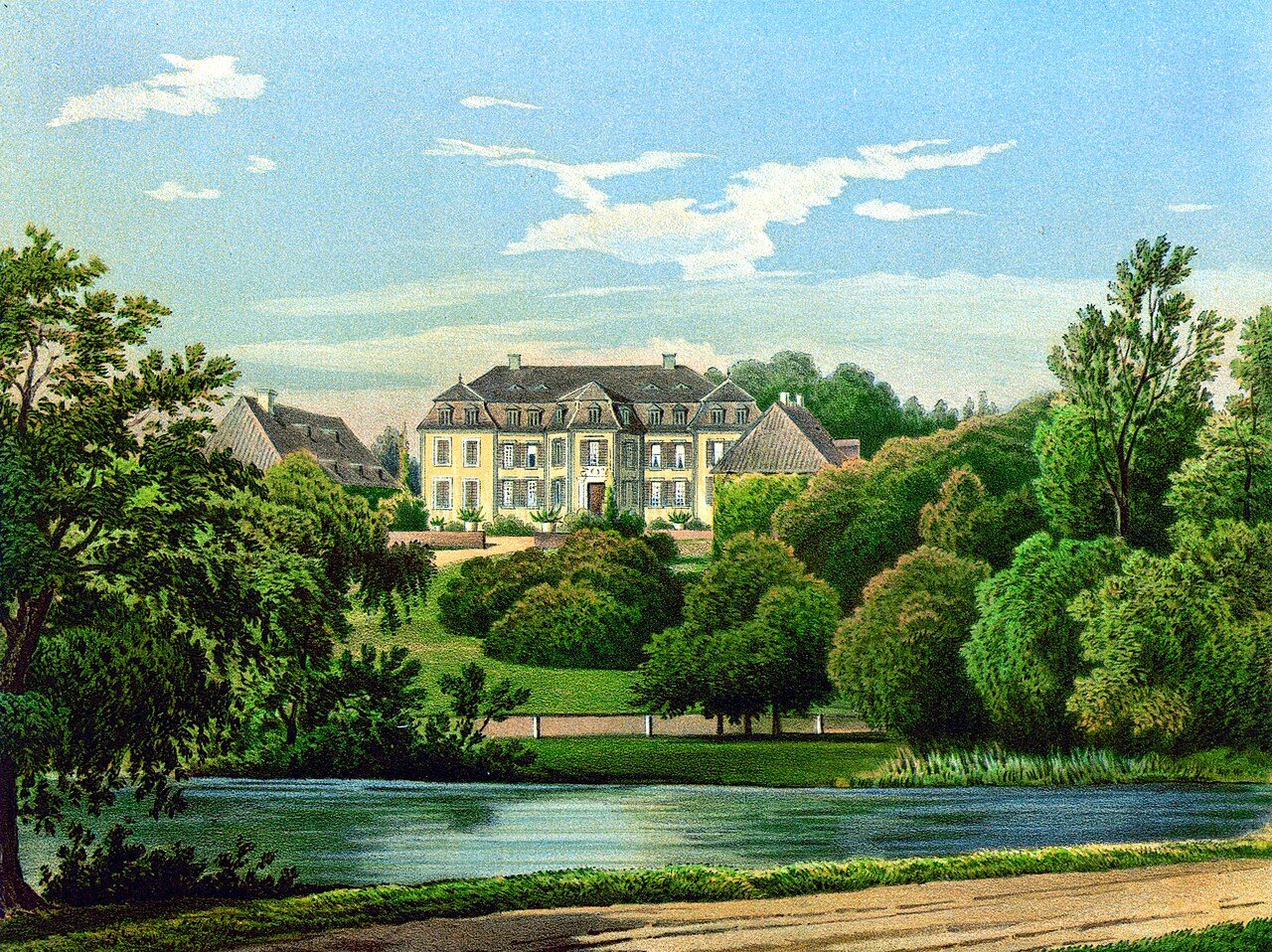
Schloss Schlenderhahn is a country estate and manor farm in Quadrath-Ichendorf, which belongs to the city of Bergheim in the Rhein-Erft-Kreis. The castle is best known for the Schlenderhan stud farm located there.
Slenderhagen was first mentioned in 1028, when Count Palatine Erenfried gifted the estate to the newly founded Brauweiler Abbey. The donation was confirmed in 1051 by Archbishop Pilgrim, mentioning the estate's name. During the division of the Villewald forest in 1258, the estate passed to Kornelimünster Abbey, which granted it as a fief. In 1271, a knightly family named after the estate first appeared in documents. In 1527, the property came into the possession of the Raitz von Frentz family through the marriage of the heiress Maria to Winand (the neighboring Schloss Frens also came into the possession of the Cologne Raitz family around this time). In the 17th century, the later famous cavalry general of the Thirty Years' War, Jan von Werth, whose daughter later married the estate owner, served on the farm. Having become even wealthier, the family was elevated to the status of Imperial Barons in 1650. When the last of this family, Adolf Carl Hubert Freiherr Raitz von Frentz, who was the long-serving district administrator of the Bergheim district, died without descendants in 1867, the wealthy Cologne banker Simon von Oppenheim acquired the estate, also with regard to the lignite deposits there in the Rhenish lignite mining area. In the same year, he was ennobled. His son Eduard then founded the stud farm, today the oldest and most important private German racing stable.
Building+
The older water-surrounded castle complex, located about one kilometer from the current castle, was abandoned in 1780 and largely demolished. The last tower slid into the then immediately adjacent, now refilled, lignite mine in the 1940s. The castle is depicted in miniature on a pilgrim's image from 1767 from the Bethlehem monastery.
The new late Baroque castle is one of the last country estates built by the Rhenish nobility before the French period. It forms a double horseshoe shape and is separated by the castle ponds from the village of Quadrat-Ichendorf with its parish church and small cemetery. The central older building of the two-story Maison de Plaisance with a hipped mansard roof has 11 by four axes and a central risalit projecting towards the park side. Towards the courtyard, two later added wings form a kind of courtyard of honor. The same was designed towards the park with a garden parterre laid out around 1870 and enclosed by the projecting wings, which has been the show side of the castle since the Oppenheims. The resulting forecourt was enclosed in 1873 with a wrought-iron grille and gate. Noteworthy inside the main house are the stair railing created in 1786 and doors with Zopfstil frames from the late 18th century.
A wide landscape park adjoins the garden parterre. Beyond the castle pond, the neoclassical stallion house stands representatively for the stud farm. Paddocks, horse stables, barns, and servants' residences are otherwise scattered over the extensive grounds.
Take Mobile History with you
You are reading this text for free. Premium adds what matters on the road: descriptions read aloud, sites found through your camera, whole regions taken offline.
- Every description, including the ~17,700 Premium sites
- Audio guide: have descriptions read to you on location
- AR finder: see sites through your camera, with distance and bearing
- Unlimited saved sites
14 days free, then from €2.99 a month. Cancel anytime.
Source: Wikipedia · Licence: CC BY-SA 4.0 · Image: Alexander Duncker / Public domain via Wikimedia Commons
This description draws on the facts documented in the linked Wikipedia article; Wikipedia content is licensed under CC BY-SA 4.0. Wording and editing: Mobile History.
Location: 50.9447, 6.6829