To be privately owned
CastleKronstorf-Schieferegg
Schieferegg Castle
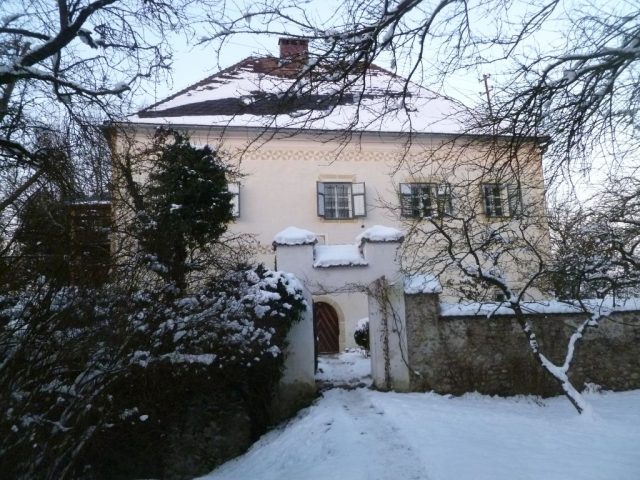
Schloss Schieferegg is located in the district of the same name in the municipality of Kronstorf in the Linz-Land district (Schiffereck 6).
Schiefereck is first mentioned in 1361 as the seat of the Enns citizen Berthold (Perichtolt) Scheffolt (Schefvolt) von Scheffoltsegk, when he sold thirty feudal estates to the daughter of Friedrich von Wallsee. The Scheffolts were also citizens of Enns. For the next 40 years, no documents concerning Schiefereck are available.
The next owners towards the end of the 14th and beginning of the 15th century were the Habichlers. Friedrich Habichler sold the noble seat of Schiffertseck to Wolf Feuchter (Feichter) in 1409; the latter then received it as a fief with all its appurtenances from Georg von Dachsberg in 1424. The Feuchters were a knightly family who owned properties in both Lower Austria and the country above the Enns (Schloss Fridau, Grueb, Schiferegg). With Wolf Feuchter's great-grandson, Wolfgang Feuchter, married to Beatrix V. Knörring, this branch of the family died out in the country above the Enns, while the lines in Friedau and Grueb continued to exist in Lower Austria.
Heinrich von Geumann owned the castle around 1460. In 1466, the seat of Schiferegg was taken by the citizens of Steyr, as the knight Ortolph Geymann († 1483), with whom there had been a legal dispute lasting several years with the people of Steyr, had entrenched himself there. He and his helpers were captured and taken to Steyr. In 1485, the Hungarians, in the war against Emperor Frederick III, captured the castle from the Tettau redoubt located on the western bank of the Enns. The castle was burned down when the Hungarians withdrew, but was rebuilt after 1490 and still corresponds to the illustration in Georg Matthäus Vischer's Topography from 1674. The Feuchters remained in possession of the princely fief until 1520. The Feuchters were followed by Siegmund von Polheim. In 1539 (or 1533), he sold the seat "Schiferegk sambt dem Pawhof" to his brother-in-law Wolfgang von Volkenstorff. In 1625, the seat of Schiefereck was renovated. In 1628, Schiefereck and other properties (including Schloss Tillysburg, Schloss Weißenberg, Schloss Stein) had to be sold by Katharina von Volkersdorf, the last of this Protestant family, to Count Werner t'Serclaes von Tilly. After several generations, Maria Anna Catharina, widowed Countess Montfort and sister of Ferdinand Laurentio Francisco Xaverio Graf Tilly, sold Schiefereck in 1730 to her cousin Johann Joseph Antonius Freiherr von und zu Weichs. He had to declare bankruptcy in 1750, and in 1756 his widow Maria Ludowika received Tillysburg and Stein. Since that time, Schiefereck has no longer been managed as a noble seat. Thereafter, the feudal sovereignty over Schiefereck passed to the lordship of Gleink and from 1764 to St. Florian Abbey.
In 1852, the castle was bought by Anna Maria Hoislbauer, married Lindner. She was succeeded in ownership by Johann Lindner from 1859-1901. From 1901-1902, the property passed to Klara Steindl, in 1902 to Franz and Aloisia (née Steindl) Trunk, and subsequently to Margarete Trunk. Under Franz Trunk, the castle was renovated. The Prtaks are to be mentioned as further owners. As descendants, Peter Prack and his family are now in possession of the small castle.
Description+
The somewhat hidden castle building is two-story and covered with a hip roof. The entrance is a simple round-arched door with a granite ashlar frame. Above it is a half-relief with a Pietà and a plaque commemorating the former owners of Schiefereck and providing information about renovations. The house facade is structured by a sgraffito ornamental band; the windows are also highlighted by sgraffito fascias. The west side of the castle has recently been built with a wooden veranda. A moat still surrounds the castle building today, which has only been filled in the area of the former bridge. The complex includes agriculturally used buildings (press house with the year 1688 and stable buildings). On one of them, an image of the Holy Trinity can be seen. A large garden is enclosed by a wall made of oversized river stones.
The castle is privately owned and cannot be visited.
Take Mobile History with you
You are reading this text for free. Premium adds what matters on the road: descriptions read aloud, sites found through your camera, whole regions taken offline.
- Every description, including the ~17,700 Premium sites
- Audio guide: have descriptions read to you on location
- AR finder: see sites through your camera, with distance and bearing
- Unlimited saved sites
14 days free, then from €2.99 a month. Cancel anytime.
Source: Wikipedia · Licence: CC BY-SA 4.0 · Image: http://commons.wikimedia.org/wiki/File:Schloss_Schiefereck.jpg
This description draws on the facts documented in the linked Wikipedia article; Wikipedia content is licensed under CC BY-SA 4.0. Wording and editing: Mobile History.
Location: 48.1637, 14.4644