Holiday apartments
CastleItzgrund
Schenkenau Castle
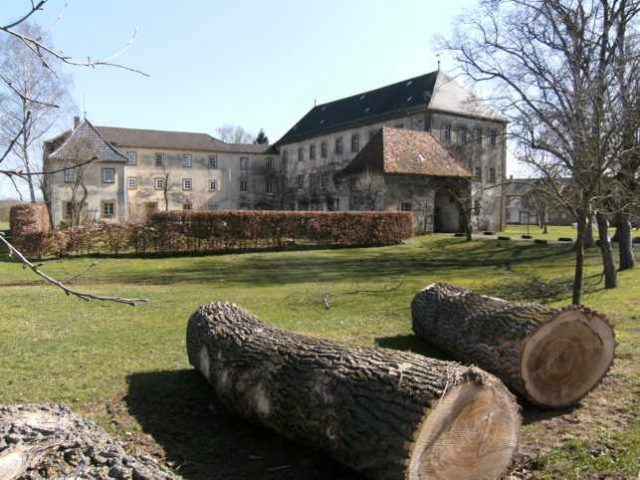
Schenkenau is first mentioned in 1286 as the ancestral seat of the von Rotenhan family. The medieval fortress on the Erfurt-Nuremberg trade route was destroyed down to the ground floor during the Peasants' War in 1525. Rebuilt as a Ganerbenburg (a castle owned by several families), it became a steam-powered cotton manufactory during the Mercantilist era, owned by the Prince-Bishops of Greiffenklau, to whose private estate "Herrschaft Gereuth" Schenkenau belonged.
The old castle is said to have been built by Ludwig I von Rotenhan (Merzbach line), who died in 1258. In 1427, Jobst, Kilian, Johann Georg, and Wolfram von Rotenhan, together with Knight Veit I von Rotenhan in Rentweinsdorf and his brother Anton, Prince-Bishop of Bamberg (Konrad line), and then Gottfried zu Rentweinsdorf (Gottfried line), established a castle peace (Burgfrieden) over the castle and fortress of Schenkenau.
After 1437, Jobst von Rotenhan (Merzbach line) resided in Schenkenau, who later sold the castle to the von Sternberg family. From then on, the castle frequently changed owners and never returned to the possession of the von Rotenhan family. During the Peasants' War in 1525, the castle was destroyed but rebuilt. In 1660, it was owned by Junker Adam Friedrich von Ostheim zu Friesenhausen, in 1675 by the von Modersbach, then in 1693 by the von Wolfstal. In 1711, Friedrich Wilhelm von Wolfsthal sold the Schenkenau manor to Lothar Franz von Schönborn, Elector of Mainz, for 17,000.00 Franconian Gulden plus 50 ducats. On January 1, 1711, Lothar Franz issued a power of attorney in Bamberg to Prince-Bishop of Würzburg Johann Phillipp von Greiffenklau for the legitimation of the purchase of the Schenkenau manor. According to building inscriptions from 1763 and 1764 and the Greiffenklau coat of arms on the southwest side, the main building's ground floor and first floor were converted into a steam-powered cotton spinning mill. In 1814, the banker Hirsch bought the Gereuth manor from the Lords von Greiffenklau zu Vollraths, including the associated other estates and castles. Under Jacob Hirsch, the cotton spinning mill continued to operate.
In 1859, the brothers Oskar and Karl Prieger bought Gereuth. After the reconstruction of Gereuth, in 1778, Schenkenau was converted into an art mill. For this purpose, in 1872, Ferdinand Karl Prieger bought the "Alte Mühle" (Old Mill) with its water power on the Itz from the Gunzenheimer family. The main building and the central section were each raised by one floor; the Baroque roof truss of the main building was reused.
In 1955, the mill was shut down by the last Prieger. Since 1960, Schenkenau has been owned by the Treiber family; the mill was not reactivated, electricity generation started in 1961, and farm holidays have been offered since 1973.
Take Mobile History with you
You are reading this text for free. Premium adds what matters on the road: descriptions read aloud, sites found through your camera, whole regions taken offline.
- Every description, including the ~17,700 Premium sites
- Audio guide: have descriptions read to you on location
- AR finder: see sites through your camera, with distance and bearing
- Unlimited saved sites
14 days free, then from €2.99 a month. Cancel anytime.
Source: Wikipedia · Licence: CC BY-SA 4.0
This description draws on the facts documented in the linked Wikipedia article; Wikipedia content is licensed under CC BY-SA 4.0. Wording and editing: Mobile History.
Location: 50.1310, 10.8713