Local Authorities
CastleScheibbs
Scheibbs Castle
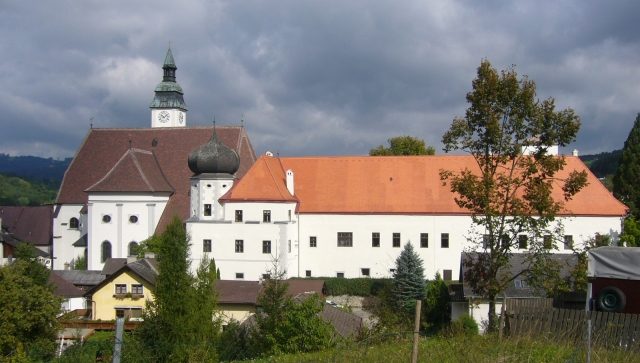
Scheibbs Castle is located on Rathausplatz in the center of Scheibbs (Lower Austria) and forms an ensemble with the parish church, town wall, and rectory. The former secular administrative seat of the Carthusian monastery of Gaming now houses the district administration of the Scheibbs district.
Scheibbs Castle is presumably a castle-church complex from the early Middle Ages, built at a strategically favorable point in the Erlauftal (intersection with the connection Waidhofen/Ybbs - Gresten - Scheibbs - Melktal) by the ancestors of the Counts of Peilstein and later became an essential part of the fortifications of Scheibbs.
In 1338, Duke Albrecht II gifted the market town of Scheibbs to his favorite foundation, the Carthusian monastery of Gaming. Thus, Scheibbs became the secular administrative center of the monastic lordship and the castle its core, on which its centuries-old tradition as an administrative seat is based.
After the dissolution of the Gaming Charterhouse in 1782, the ownership of the castle changed repeatedly. First, it came into the possession of the imperial state property administration, which sold the castle to Ignaz Müller in 1826. In 1829, Wenzel Joseph Ritter von Sallaba acquired the castle, and Johann Heinrich Freiherr von Sallaba sold it to Andreas Töpper in 1867. His widow Amalia Horst sold it to Eduard Musil, the owner of the Neubrucker paper mill. The subsequent owner of the paper mill, Fritz Hamburger, also acquired the castle in 1906, and since 1954, it has been owned by the Province of Lower Austria.
The Exterior+
Approaching the castle, one first notices the entrance area from 1868, built after the purchase in 1867 by Andreas Töpper, as well as the somewhat stately appearance of a typical Mostviertel castle (Vierkanter), comparable to Zeillern Castle or Ernegg Castle near Steinakirchen am Forst.
To the left, the sturdy keep stands out, which probably once had a baroque dome, followed by the archway with the tower of the old town wall. To the right, the choir of the parish church adjoins. At the corner of the square castle building, which borders the town wall and is therefore not visible from Rathausplatz as it is obscured by the church, there is still a small corner tower with a baroque onion dome attached.
Entering the inner courtyard of the castle, one finds a romantic Renaissance arcaded courtyard with wrought-iron window baskets, a fountain, forged ornamental window grilles, and gargoyles.
The Interior+
Those rooms that served the Prior of the Gaming Charterhouse are partly adorned with beautiful stucco ceilings and occasionally with frescoes. For example, the "small meeting room" with the "Ascension of Saint Bruno as the founder of the Carthusian Order" features arguably the most beautiful fresco in the castle.
Take Mobile History with you
You are reading this text for free. Premium adds what matters on the road: descriptions read aloud, sites found through your camera, whole regions taken offline.
- Every description, including the ~17,700 Premium sites
- Audio guide: have descriptions read to you on location
- AR finder: see sites through your camera, with distance and bearing
- Unlimited saved sites
14 days free, then from €2.99 a month. Cancel anytime.
Source: Wikipedia · Licence: CC BY-SA 4.0 · Image: http://commons.wikimedia.org/wiki/File:Scheibbs_schloss.jpg
This description draws on the facts documented in the linked Wikipedia article; Wikipedia content is licensed under CC BY-SA 4.0. Wording and editing: Mobile History.
Location: 48.0048, 15.1686