To be privately owned
CastleDiez-Balduinstein
Schaumburg Castle
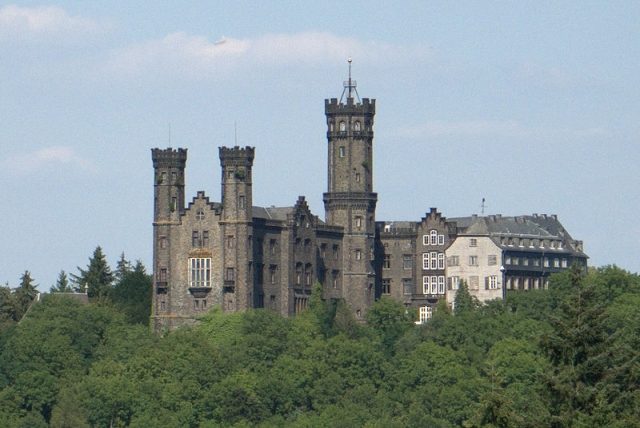
Schaumburg Castle, also simply called the Schaumburg, is a castle south of Balduinstein near Limburg an der Lahn. Originally, the complex was a hilltop castle. Its main tower is the zero point of the Soldner coordinate system for the Duchy of Nassau.
The mountain may have been built with a castle for the first time around 915. Originally it was called "Schauenburg" or "Schowenburg". The Schaumburg was first mentioned in 1197; it was the center of a lordship of the same name. This included, in addition to the castle at that time, the villages of Biebrich, Cramberg, and Steinsberg. In the 12th century, the castle complex was owned by the Counts of Leiningen.
With the extinction of the counts in the male line around 1220, there was a division and multiple changes of ownership of the castle fief. Part of the castle was owned by Elise, the daughter of Count Emicho of Leiningen and wife of Ruprecht the Belligerent of Nassau. With her death, this share passed through her daughter to the County of Virneburg. Another share in the castle fell to the County of Diez and from there to the County of Weilnau. A third part of the Schaumburg fell to the House of Isenburg. In its inheritance division in 1232, the Schaumburg share came into the possession of Gerlach I of Limburg. However, the House of Limburg had to relinquish its part of the castle in 1266 in an arbitration award in favor of Electoral Cologne. The Archbishop of Cologne, Siegfried von Westerburg, transferred the Electoral Cologne share to the House of Westerburg in 1276.
The House of Westerburg expanded the Schaumburg from 1279. To weaken the castle's position, Balduin of Luxembourg built Balduinstein Castle near the Schaumburg. A prolonged dispute ensued, as a result of which the town of Balduinstein was separated from the Lordship of Schaumburg in 1321 and elevated to a city.
By the 15th century, the House of Westerburg had acquired all other shares of the castle. From 1557, the House of Leiningen-Westerburg-Schaumburg, a collateral line of the House of Westerburg, resided at Schaumburg. In 1656, Georg Wilhelm von Leiningen sold the castle and lordship to Agnes von Effern, the widow of Count Peter Melander von Holzappel, who united the Lordship of Schaumburg with the County of Holzappel. Agnes died in the same year; the Schaumburg remained in the possession of her female descendants: House of Nassau-Dillenburg (1656–1707), Anhalt-Bernburg-Schaumburg (1707–1812), Habsburg-Lorraine (1812–1867).
From 1847 to 1867, Archduke Stephen of Austria owned the Schaumburg. In 1848, in the course of the revolution, he had to leave his homeland Hungary and from 1850 to 1855, he elaborately rebuilt the Schaumburg in neo-Gothic style into the present castle, according to plans by the architect Carl Boos, who also supervised the construction. Stephen of Austria established a picture gallery, a library, collected coins, and left behind a considerable mineral collection. He had two larger-than-life heralds made in Berlin, which today adorn the main entrance to the castle, and maintained a small animal park. Only the magnificent hall, which spans the entire width of the building between the two towers and is bounded by the large, west-facing window, was never completed. Neither Archduke Stephen nor later owners developed the planned magnificent hall, and so it remains today unplastered in its shell state, as the builders left it unfinished in 1855. With the construction of the Lahn Valley Railway in 1862, the Schaumburg became easily accessible and a meeting place for nobles from all over Europe.
The childless Archduke Stephen bequeathed the castle to the youngest son of his cousin Peter, his grand-cousin Duke Georg Ludwig of Oldenburg. The House of Oldenburg owned the castle from 1867 to 1888. At the same time, the House of Waldeck-Pyrmont laid claim to the complex. After a court case lasting over twenty years, it was awarded to Georg Viktor zu Waldeck-Pyrmont in 1888.
The castle came to its last noble owner in 1967 with the death of Josias zu Waldeck und Pyrmont. His son and heir Wittekind zu Waldeck und Pyrmont sold it in 1983, along with its inventory and lands, for 15 million DM. The Schaumburg was to be converted into a hotel with an attached golf course. This plan fell through, and the decay of the substance continued.
After another sale in 1990 to a businessman from Southern Germany for six million Deutsche Mark, the castle was again for sale in 2011 for 1.3 million Euros. By this time, a large part of the lands had already been sold to several buyers. At the end of 2012, the Schaumburg was sold to a Turkish investor group, which, according to their own statements, planned to establish an educational institution there. Corresponding construction measures have not yet taken place.
The complete Schaumburg archive, carefully maintained over the centuries, was acquired by the state of Rhineland-Palatinate and has since been located in the State Main Archive Koblenz.
Complex+
The castle is a three-wing complex on a mountain peak. It received its current appearance during the expansion from 1850 to 1855 and is designed according to the ideal of Rhine Romanticism. The castle is dominated by an elongated three-story palas with octagonal corner towers made of basalt. In the southeast corner of the palas is a 42-meter-high tower, which is intended to represent a keep. A gate system was built in the north as access to the castle.
Little remains of the medieval castle complex. There are still remnants of the gate system in the south of the castle, the zwinger, and remnants of the outer bailey with a flanking tower. The east wing is a late medieval building, but it was heavily rebuilt during the construction work under Archduke Stephen of Austria.
Miscellaneous+
Schaumburg Castle served as the backdrop in 1999 for the fictional high school in the horror film Scream – I Know What You Did Last Summer!.
Take Mobile History with you
You are reading this text for free. Premium adds what matters on the road: descriptions read aloud, sites found through your camera, whole regions taken offline.
- Every description, including the ~17,700 Premium sites
- Audio guide: have descriptions read to you on location
- AR finder: see sites through your camera, with distance and bearing
- Unlimited saved sites
14 days free, then from €2.99 a month. Cancel anytime.
Source: Wikipedia · Licence: CC BY-SA 4.0 · Image: http://de.wikipedia.org/wiki/Datei:Schloss-Schaumburg-JR-G6-3708-2009-08-04.jpg
This description draws on the facts documented in the linked Wikipedia article; Wikipedia content is licensed under CC BY-SA 4.0. Wording and editing: Mobile History.
Location: 50.3390, 7.9775