Museum
CastleScharnstein
Scharnstein Castle
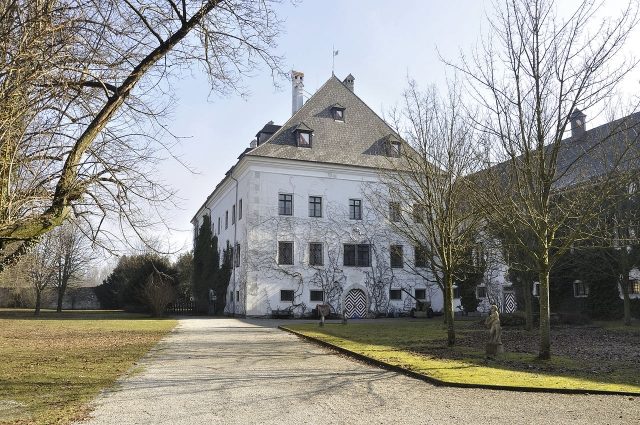
Scharnstein Castle is a castle in the municipality of Scharnstein in Upper Austria.
In 1538, construction began on a new administrative building on a hill above the left bank of the Alm, after a large fire had occurred at Scharnstein Castle. The building and the place were called "Schafferleithen", meaning the slope ("Leiten") where the manorial "Schaffer" (administrator) had his seat.
In 1584, the imperial court chamber president Helmhard von Jörger bought the dominion of Scharnstein. This was his free property, meaning he was no longer a feudal tenant but an owner. He began with the construction of a new castle on the Schafferleiten, which was later called "Neuscharnstein". In addition to the manor house, farmsteads, taverns, and a brewery were built.
Under Helmhard's son Georg Wilhelm, the construction of the richly furnished Renaissance building was completed around 1606. Georg Wilhelm's wife came from the house of the Counts Polheim von Parz, and so the alliance coat of arms of the Jörger and Polheim von Parz was affixed to the painted wooden ceilings.
Georg Wilhelm's heir, his younger brother Karl von Jörger, fought as a Protestant and commander of the Marchland troops against the imperial army. He was defeated and died after his capture in prison in Passau. The emperor sold the requisitioned dominion of Scharnstein to Kremsmünster Abbey in 1625.
After the dissolution of the manorial lordships in 1848, forest offices and staff apartments were installed in the former state rooms. In 1897, Kremsmünster Abbey was forced to deliver, among other things, 34 iron window grilles, three painted wooden ceilings, and numerous oil paintings to Ort Castle. In 1903, the castle chapel was divided into an apartment. Finally, the castle was converted into a rental house with 30 apartments and more than 70 residents. During the Second World War, numerous refugee families were housed in the castle.
In the 19th/20th century, however, the building visibly deteriorated, especially during both World Wars.
When Harald Seyrl, an Austrian historian, finally acquired the castle from Kremsmünster Abbey in 1967, it was in a highly dilapidated state and was even partially in danger of collapsing. In the still intact rooms, partition walls had also been erected after the war and substandard apartments had been built, which had caused considerable further damage to the historic building fabric. Seyrl subsequently had the original state of the rooms restored and, with the help of the Federal Monuments Office and the Province of Upper Austria, managed to renovate the castle through painstaking detailed work. Since the 1980s, it has shone in new splendor, is home to the Austrian Crime and Gendarmerie Museum, and is the family seat of the Seyrls, who, as lords of the castle, also offer guided tours of their private rooms on Sunday mornings.
Take Mobile History with you
You are reading this text for free. Premium adds what matters on the road: descriptions read aloud, sites found through your camera, whole regions taken offline.
- Every description, including the ~17,700 Premium sites
- Audio guide: have descriptions read to you on location
- AR finder: see sites through your camera, with distance and bearing
- Unlimited saved sites
14 days free, then from €2.99 a month. Cancel anytime.
Source: Wikipedia · Licence: CC BY-SA 4.0 · Image: http://commons.wikimedia.org/wiki/File:Scharnstein_Neues_Schlo%C3%9F.JPG
This description draws on the facts documented in the linked Wikipedia article; Wikipedia content is licensed under CC BY-SA 4.0. Wording and editing: Mobile History.
Location: 47.9058, 13.9642