To be privately owned
CastleKlipphausen-Scharfenberg
Scharfenberg Castle
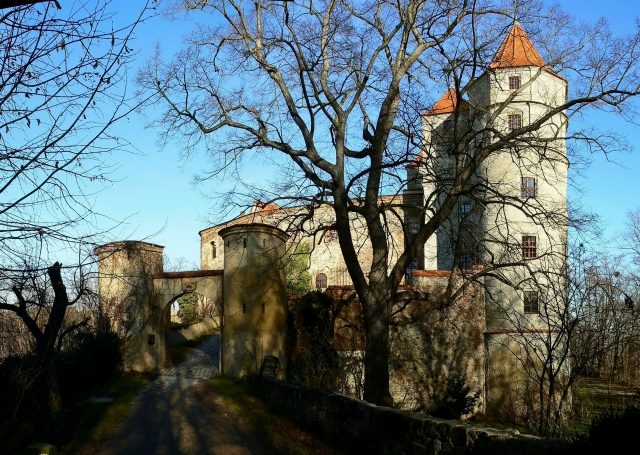
Scharfenberg Castle is one of the typical castle complexes in Saxony built around 1200 during the consolidation of rule. It is situated on a rock spur above the Elbe valley near Meissen in the district of Pegenau, which belongs to the village of Scharfenberg, named after the castle, in the municipality of Klipphausen. From the castle, one has a magnificent view of the Elbe valley near Coswig and the Spaargebirge mountains. The castle can be visited by appointment; guest rooms and other spaces are also available for rent.
Scharfenberg Castle is located in the greater municipality of Klipphausen in the lower part of the district of Scharfenberg and is easily accessible from the B 6 via Schachtberg. The towns of Meissen and Dresden are in the immediate vicinity.
The castle was built during the German eastward expansion around the year 1200, as could be unequivocally determined by extensive archaeological excavations by Dieter Stuchly. The oldest structural elements are remnants of the ring wall in the northwest and southwest (around 1200) as well as the excavated round keep (around 1220). Whether the late Romanesque courtyard portal from around 1200, which has been in secondary use on the inside of the gate passage since the 16th century, originates from Scharfenberg itself (palace portal) or from a nearby sacred building (Kloster Heilig Kreuz downstream from Meissen was suspected), can no longer be determined. The name Scharfenberg is a typical castle name that has nothing to do with the silver mines attested in the 13th century, as was initially assumed in the 19th century due to a lack of onomastic research.
The alleged founding of the castle by King Henry the Fowler in 938 is a scholarly invention of the 19th century. The castle was first mentioned in a document in 1227. Scharfenberg was initially owned by the Bishops of Meissen; in 1390, Bernhard von Maltitz is attested, and in 1403, Dietrich von Miltitz.
From 1403 to 1941, it was owned by the Miltitz family. During the Thirty Years' War, the castle was conquered and partially destroyed by the Swedes. Afterwards, it was rebuilt in the Renaissance style. In 1706, during the Great Northern War, the castle was again unsuccessfully besieged by the Swedes. In 1783, the palace on the Elbe side burned down. The palace on the mountain side also only remains as a ruin.
In the first quarter of the 19th century, Scharfenberg Castle became a center of Romanticism (as the so-called "Scharfenberg Circle") through the art-loving Miltitz family (with Dietrich von Miltitz and Karl Borromäus von Miltitz), including Novalis (Friedrich von Hardenberg) and Theodor Körner. Due to its wild romantic location, Scharfenberg Castle was a beloved motif, especially for painters Ernst Ferdinand Oehme, the Norwegian Thomas Fearnley, Johan Christian Clausen Dahl, and Caspar David Friedrich.
In 1945, the owners were dispossessed and expelled by the communists. After 1945, displaced persons and resettlers lived in the castle. Afterwards, it served as a local history museum. In the 1960s and 1970s, the castle was saved from final decay by the sporadic presence of artists – painters, graphic designers, and related enthusiasts – who used their artistic presence to preserve it. Several of these artists have a reputation beyond regional borders, such as Achim Freyer, Emil Nolde, Achim Heym, Andreas Reinhardt, Karl-Heinz-Schäfer, Otto Walcha, among others. The castle inspired them to countless landscape paintings. Art and culture creators, connoisseurs, and enthusiasts met here for festivals, hikes, and discussions. Scharfenberg remained a Genius loci even during this time.
Until 1990, a wing of the castle served the civil defense of the GDR as a secret depot for medicines, food, and other reserves in case of an ABC attack.
The castle is now in private ownership and is being successively expanded and renovated. Since 2007, a highly acclaimed poetic castle event titled "Do you also have a liking for us, dark night?" has taken place annually in autumn, theatrically and musically approaching the era of Romanticism.
Take Mobile History with you
You are reading this text for free. Premium adds what matters on the road: descriptions read aloud, sites found through your camera, whole regions taken offline.
- Every description, including the ~17,700 Premium sites
- Audio guide: have descriptions read to you on location
- AR finder: see sites through your camera, with distance and bearing
- Unlimited saved sites
14 days free, then from €2.99 a month. Cancel anytime.
Source: Wikipedia · Licence: CC BY-SA 4.0 · Image: Thomas Eichler
This description draws on the facts documented in the linked Wikipedia article; Wikipedia content is licensed under CC BY-SA 4.0. Wording and editing: Mobile History.
Location: 51.1252, 13.5277