To be privately owned
CastleSandersdorf
Sandersdorf Castle
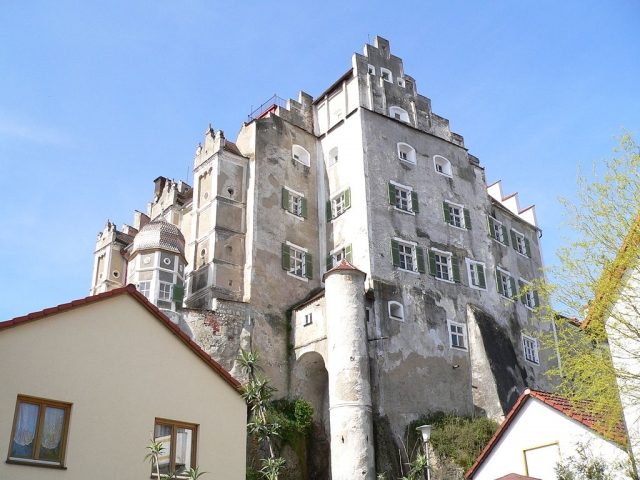
Sandersdorf Castle is a Baroque castle in the eponymous village of Sandersdorf in the municipality of Altmannstein in the Upper Bavarian district of Eichstätt. The castle is located in the upper Schambach Valley, a tributary of the Altmühl, on an eastward-facing, approximately 50-meter-high mountain spur. The village of Sandersdorf spreads out below the castle.
The current castle dates back to a medieval fortress built by the Lords of Sandersdorf as Wittelsbach ministerials. The family is documented since the 12th century. The last of this lineage, Ulrich der Sandersdorfer, was succeeded in 1372 by the Rindsmaul family, and in 1382 by Konrad der Kemnater. In 1420, the Forchheimer family was in possession of the castle.
In 1420, the castle was plundered by Duke Heinrich of Bavaria-Landshut when he was at war with Duke Ludwig the Bearded of Bavaria-Ingolstadt. In 1425, the castle was granted to the Muggenthaler family; the first owner of this family, Erhart von Muggendal, rebuilt the castle. For this, he had also been granted half of the Hofmark Sandersdorf. His plan to unite the two Hofmarks of Sandersdorf and Hinzenhausen was only achieved by his son Hans Heinrich von Muggenthal in 1507 through a grant from Duke Albrecht IV.
Hans Heinrich managed to keep the peasant uprising away from his dominion, as well as the Reformation. In 1536, Palatine Count Ottheinrich also stopped at Sandersdorf Castle during his journey to Krakow. In 1550, the castle brewery was founded. During the Thirty Years' War, the castle was destroyed; by 1646, it had been rebuilt by Albrecht Ulrich von Muggenthal in its current form as a four-winged castle.
In 1646, the era of the Muggenthalers at Sandersdorf Castle came to an end when they sold the castle to Wolfgang Unverzagt Freiherr von Roy (or Retz). He had to part with his new property in 1650, and the Ingolstadt professor Johann Jakob Lossius acquired the castle by satisfying the creditors. In 1652, Lossius was also enfeoffed with half of the ducal fief of Sandersdorf (and Mendorf). Without descendants, he designated Giovanni Dominico Bassus, the son of his sister Lucretia, wife of Tommaso Bassus, as his heir. The inheritance occurred in 1675. "Dominikus" Bassus, as he now called himself, also became a professor of law in Ingolstadt and acquired several additional estates in the vicinity to his inherited property. He had to witness his castle suffer destruction in the War of the Spanish Succession in 1703.
Without descendants, Dominikus Bassus designated Franz Peter von Bassus, the son of his older brother Johann Josef Bassus, as his heir. After the extinction of the Muggenthaler line in Hinzenhausen, Franz Peter von Bassus bought their Hofmark in 1725, which he had to sell again in 1774. With him, the older line died out; the property passed to the great-grandson of Dominikus Bassus and son of his half-brother Giovanni Maria, named Thomas von (de) Bassus.
The composer Johann Simon Mayr, born in Mendorf in 1763, was strongly supported by Thomas de Bassus and consequently resided at Sandersdorf Castle for a time. In May 1787, the castle was searched by Bavarian officials, as it was considered an "Illuminati nest." Thomas de Bassus was a high-ranking member of the Order of the Illuminati, founded in Ingolstadt in 1776 by Adam Weishaupt. Extensive secret documents were confiscated during the search.
Around 1900, the castle was partially renewed and renovated under the direction of the Munich architect Gabriel von Seidl. For example, the coach house in the inner courtyard dates from this period. In 2008, the castle, along with the forest properties, was sold by Margarethe Baroness de Bassus to the Wittelsbach Compensation Fund.
Description+
The richly structured building complex of a four-winged layout was erected on medieval foundations in the 17th century and rebuilt in the 19th century. The high main wing faces east; it has high stepped gables on its narrow sides and three bay windows with gable tops on the broad sides facing the valley, in front of which is a kind of bailey with two octagonal corner turrets. The lower castle wings in the north and south face west. The castle chapel of St. Joseph with an octagonal dome tower is located in the inner courtyard. The chapel has a Romanesque tympanum (around 1200). Inside, the most valuable piece of equipment is a crucifix probably by the Rococo artist Ignaz Günther, who came from nearby Altmannstein; the stucco decoration dates from the 17th century.
Take Mobile History with you
You are reading this text for free. Premium adds what matters on the road: descriptions read aloud, sites found through your camera, whole regions taken offline.
- Every description, including the ~17,700 Premium sites
- Audio guide: have descriptions read to you on location
- AR finder: see sites through your camera, with distance and bearing
- Unlimited saved sites
14 days free, then from €2.99 a month. Cancel anytime.
Source: Wikipedia · Licence: CC BY-SA 4.0
This description draws on the facts documented in the linked Wikipedia article; Wikipedia content is licensed under CC BY-SA 4.0. Wording and editing: Mobile History.
Location: 48.9017, 11.6088