Cultural Events
Restaurant
CastlePotsdam-Sacrow
Sacrow Castle
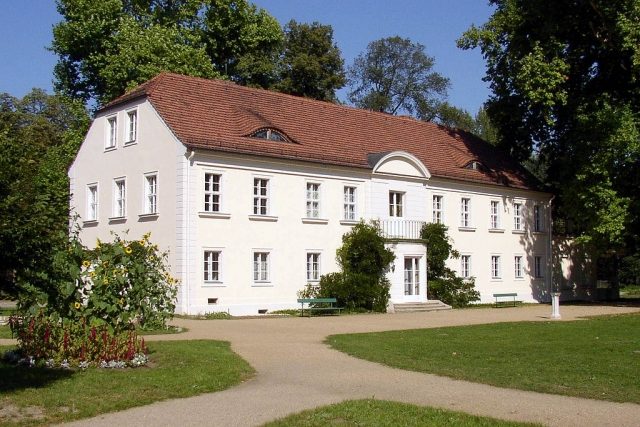
Sacrow Palace is a palace in the Sacrow district of Potsdam. It was built in 1773 by the Swedish Lieutenant General Johann Ludwig von Hordt.
The origins of the Sacrow site date back to a knight's estate, first mentioned in the 14th century in Emperor Charles IV's land book. In 1764, the fortress commander of Spandau Citadel, the Swedish Lieutenant General Count von Hordt, acquired the estate and built a new manor house in 1773 on the site of a previous building. In accordance with Baroque style conventions, it is strictly symmetrical with four rows of windows on either side of the central axis. A special feature even at the time of its construction was a large greenhouse, which was directly attached to the south gable of the building. In the palace park there is also a (today) thousand-year-old oak, which is protected as a natural monument. In 1779, Heinrich Karl de la Motte Fouqué, coming from Brandenburg, acquired the estate and with it the manor house. His son, Friedrich de la Motte Fouqué, the later poet, spent several years of his youth here. He probably received significant inspiration for his "Undine" at Lake Sacrow. The names of the estate owners in Sacrow changed rapidly.
Among others, in 1816, the Berlin banker Magnus acquired the estate. He was a friend of the Moses Mendelssohn family, whom he occasionally hosted here. Felix Mendelssohn Bartholdy probably composed parts of his String Quartet in A minor (Op. 13) here. A decisive date for Sacrow was 1840, when King Friedrich-Wilhelm IV acquired the estate and manor house. At the same time, he gave the order for the construction of the Church of the Redeemer by his architect Ludwig Persius, who was also to expand the manor house. Persius added a two-story extension with a representative Italian-style entrance to the north gable. A large storage building was also built behind the greenhouse. Peter Joseph Lenné, commissioned by the king, laid out the park, which included the church and whose sightlines offered views of the neighboring palaces of Pfaueninsel, Glienicke, Babelsberg, and Cecilienhof. Since this time, the manor house in Sacrow has been referred to as a palace, although the king himself never lived in it. Little is known about Sacrow from the following decades until the end of the German Empire. After the November Revolution in 1918, the Prussian Minister of State and Finance Albert Südekum lived in the palace, initially as a weekend residence, and permanently from 1920. From autumn 1922 to November 1934, Eberhard Cranz, a friend of Gotthard Sachsenberg, and his wife Emma née Neuhaus lived here.
During the Third Reich
In 1938, the palace was converted into the residence and official seat of the General Forestry Master Friedrich Alpers. In the process, it completely lost its Baroque appearance internally. The reception rooms were moved to the ground floor, while the apartment was located on the upper floor.
The roof ridge was extended to incorporate part of the extension built by Persius on the north wing into the building. The remaining extension received a large roof terrace instead of the pointed roof, and a banquet hall with floor-length windows was created underneath. The outbuildings were removed, and the adjutant's house, as well as the chauffeur's and forester's apartments and a small falconry, were built.
In the GDR
In 1945, the palace became "people's property" and subsequently served as a children's home and recreation home for victims of the Nazi regime. With the construction of the Berlin Wall, the National People's Army initially moved in, and from 1973, the GDR customs authorities occupied the palace. The greenhouse was demolished, and training facilities for the customs' sniffer dogs were built in the park.
After Reunification
With the reunification of the two German states in 1990, the "pro Brandenburg" association was initially able to establish economic contacts between the so-called old and new federal states from Sacrow. In 1993, the palace became the property of the "Prussian Palaces and Gardens Foundation Berlin-Brandenburg". Work began to restore the park according to Lenné's original plans and to set up the building as a museum. However, it turned out that Sacrow was not very suitable for a permanent exhibition due to unfavorable infrastructural conditions. After the roof was repaired and heating was installed, work had to be temporarily suspended until a viable usage concept was developed. In 2003, the Ars Sacrow association received support from the SPSG for a temporary interim use of the palace as a "Museum for a Summer".
A café is set up in the courtyard of the outbuildings. The art exhibitions are organized by the Ars Sacrow association, in which committed and interested citizens have come together. They want to further open the church, palace, and palace park to visitors and continue to support the urgently needed restoration work.
From August 2006 to the end of 2008, Sacrow Palace with its outbuildings was the new outdoor filming location for the telenovela "Wege zum Glück" (Paths to Happiness), portraying the manor house of the van Weyden family.
Take Mobile History with you
You are reading this text for free. Premium adds what matters on the road: descriptions read aloud, sites found through your camera, whole regions taken offline.
- Every description, including the ~17,700 Premium sites
- Audio guide: have descriptions read to you on location
- AR finder: see sites through your camera, with distance and bearing
- Unlimited saved sites
14 days free, then from €2.99 a month. Cancel anytime.
Source: Wikipedia · Licence: CC BY-SA 4.0 · Image: http://de.wikipedia.org/wiki/Datei:Potsdam_Sacrow_palace.jpg
This description draws on the facts documented in the linked Wikipedia article; Wikipedia content is licensed under CC BY-SA 4.0. Wording and editing: Mobile History.
Location: 52.4276, 13.0949