Museum
CastleFrankenberg/Sa.-Sachsenburg
Sachsenburg Castle
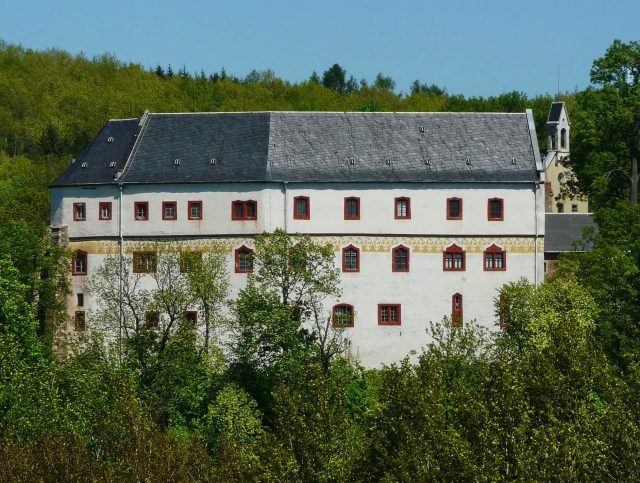
Sachsenburg Castle rises near Frankenberg/Sa. on a rock above the Zschopau river. The castle complex, built at the latest in the early 13th century, was converted into a palace in the 1480s. The complex represents one of the few examples of a fully preserved residential castle in Saxony.
Middle Ages
Lords of Sachsenburg were first mentioned in a document in 1197. Whether a castle already existed at that time is uncertain. However, the existence of the castle can be reliably proven by archaeological finds around 1210/30. The builders were apparently the Lords of Mildenstein. After the destruction of their rule in connection with the Mildenstein Tithe Dispute by Margrave Heinrich the Illustrious in 1232, the lordship passed into the possession of this Wettin ruler.
Around the middle of the 13th century, rich silver-bearing lead and copper ore deposits were found on Sachsenburg territory on the Treppenhauer; the mining town of Bleiberg emerged, which "fell into ruin" after the middle of the 14th century. During the period of "mining prosperity," Sachsenburg served to protect mining. At the end of this first rich mining era in this region (1364), the Wettins sold the castle to two knights from Döbeln.
In 1368, the complex passed into the possession of the Lords of Schönberg. Caspar von Schönberg († 1491) had Sachsenburg in its present form built by the Saxon master builder Hans Reynhart on the remains of the older castle around 1480 (according to dendrochronology). An inscription in the chapel indicates that the building was completed as a Gothic residential castle in 1488. The building complex encloses a triangular courtyard.
Modern Era
From 1610, the castle served as the administrative building of the Electorate of Saxony's Sachsenburg office with Frankenberg. However, the small administrative district comprised only 10 localities. During the Thirty Years' War, the first and second outer baileys were destroyed and the castle was plundered.
19th/20th Century
After its abandonment as an administrative seat (1864), a phase of varied uses began. From 1864, the castle was managed as a detention center for juvenile female prisoners, and in 1867, a penal and correctional institution was established here. The property remained reserved for prisoners until 1926, with prisoners of war (Russians, including academics and students from the Freiberg Mining Academy, English, Serbs) being held there from 1914.
In 1926, the State of Saxony had Sachsenburg converted into a public school home. In 1933, a protective custody camp was briefly located here, which was later moved to a spinning mill on the Zschopau (see: Sachsenburg concentration camp). From the mid-1930s, it served the NSDAP as a Gauleiterin school for the N.S.F. Saxony. Towards the end of the Second World War, the castle was then used as a bacteriological institute (outpost of the Robert Koch Institute). (An exhibition on this epoch was later set up.)
After the end of the war, Sachsenburg served as a residence for resettlers before a youth work camp was established in 1947, which existed until 1967. From 1968, the state-owned housing construction combine Dresden was in charge of the castle, which used it as a children's holiday camp and training center.
Current Use+
In 1990, Sachsenburg was sold to Stuttgarter Hofbräu AG for one Mark. Restitution claims led to the transfer of the castle to the municipality of Sachsenburg (since 1994 a district of Frankenberg) in 1993. After unsuccessful further sales attempts, the complex has been structurally secured and renovated by the city of Frankenberg and the Kuratorium Schloß Sachsenburg e. V. since 2001, with the construction work being accompanied by intensive building investigations under the direction of Wolfgang Schwabenicky. Despite the ongoing construction measures, several exhibitions (castle history, excavations and medieval mining on the Treppenhauer, paintings by the Hainichen artist Leo Lessig) can be seen at the castle.
Take Mobile History with you
You are reading this text for free. Premium adds what matters on the road: descriptions read aloud, sites found through your camera, whole regions taken offline.
- Every description, including the ~17,700 Premium sites
- Audio guide: have descriptions read to you on location
- AR finder: see sites through your camera, with distance and bearing
- Unlimited saved sites
14 days free, then from €2.99 a month. Cancel anytime.
Source: Wikipedia · Licence: CC BY-SA 4.0 · Image: Thomas Eichler
This description draws on the facts documented in the linked Wikipedia article; Wikipedia content is licensed under CC BY-SA 4.0. Wording and editing: Mobile History.
Location: 50.9328, 13.0297