Hotel
Restaurant
CastleHammelburg
Saaleck Castle
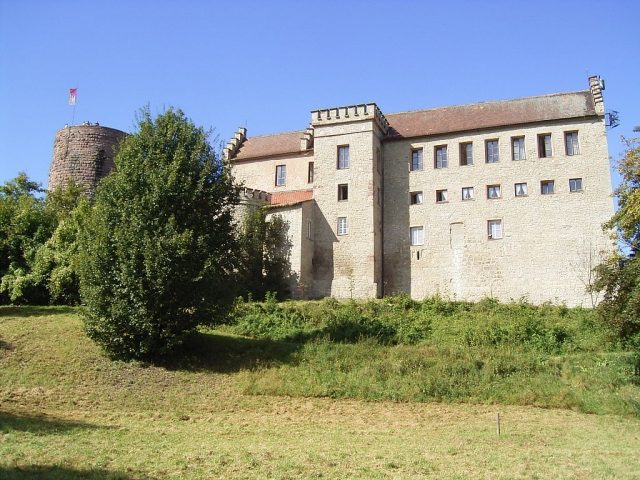
Even in prehistoric times, the mountain spur of Saaleck Castle near Hammelburg was used for defensive purposes. Although nothing remains of the prehistoric fortifications, it is said that a chapel was built on this site around 800 AD. During the Christianization of the Rhön, small chapels or churches were often built within "pagan" cult sites or fortifications. Further examples of this are the Grabfeldonoburg near Münnerstadt or the Gangolfsberg near Oberelsbach.
The only visible relic from the 12th-13th century is the keep, which has been preserved in its original state, but lost about 6m in height due to dilapidation during the Thirty Years' War. The current appearance of the complex is predominantly attributable to the period after the Thirty Years' War, when Salentin von Sintzig expanded the castle as his retirement residence. According to his statements, the castle must have been in a very ruinous state at that time. Even the heaviest stones are said to have been removed by the surrounding population. From 1644 to 1667, he had the entire complex rebuilt with the greatest care. Already before the Peasants' War, the complex had lost its military significance and fell into ruin.
Originally, Fulda's southernmost cornerstone played an important role in this area. The castle was located in a strategically favorable position and was significantly strengthened during the time of Abbot Marquard I.
However, the origins of the castle remain obscure. The castle is first mentioned by a historian from the nearby Homburg around 1030, which was extensively expanded at that time. From him, one can read that after the expansion, the people "stood guard towards Trimburg and Saleck, so that they could no longer raid here!"
Significant extensions were then made in the 13th century. Abbot Heinrich von Erthal (1249-1261) completed the fortification and provided it with moats, walls, and battlements. The neck ditch was also deepened and the shield wall strengthened. Of course, construction on the castle continued constantly in the following centuries. Even Ulrich von Hutten once paid 50 guilders for the renewal of a wooden bridge over the southern neck ditch.
Until the time of the Peasants' War, the castle had not experienced any major damage from wars or fires, which was to change abruptly with the beginning of the same. The castle was occupied and devastated by the rebellious hordes. Approximately 100 meters below the castle is the upper end of the Chapel Way of the Altstadt Monastery.
Hotel+
The Hotel Schloss Saaleck offers not only overnight stays but also the possibility of conferences. Furthermore, one can dine in the castle restaurant.
Schloss Saaleck Winery+
Since October 2011, the traditional winery has belonged to the Lange family. A total of approximately 18 hectares of vineyards are cultivated in the Saalecker Schlossberg and Hammelburger Heroldsberg sites. In addition to Schloss Saaleck, the wines are aged in the cellar building and sold in the vinotheque in the town hall. The former municipal winery was sold after 47 years. It began on April 1, 1964, when the Hammelburg city council decided to take over Schloss Saaleck with its associated winegrowing operation into municipal ownership. The ongoing dispute over the existence of the castle complex was ended. This courageous decision at the time gave new impetus to viticulture in the valley of the Franconian Saale and ensured its preservation for the future.
Until October 2011, the city of Hammelburg, with its own enterprise, the municipal winery, cultivated vineyards in the Saalecker Schlossberg, Hammelburger Heroldsberg, and Hammelburger Trautlesthal sites, with around 25 hectares of vine area. Extraordinary climatic conditions and shell limestone soil give the wines their special character and individuality. In addition, a modernly equipped winery ensures gentle and clean aging of the wines.
Take Mobile History with you
You are reading this text for free. Premium adds what matters on the road: descriptions read aloud, sites found through your camera, whole regions taken offline.
- Every description, including the ~17,700 Premium sites
- Audio guide: have descriptions read to you on location
- AR finder: see sites through your camera, with distance and bearing
- Unlimited saved sites
14 days free, then from €2.99 a month. Cancel anytime.
Source: Wikipedia · Licence: CC BY-SA 4.0
This description draws on the facts documented in the linked Wikipedia article; Wikipedia content is licensed under CC BY-SA 4.0. Wording and editing: Mobile History.
Location: 50.1107, 9.8721