To be privately owned
CastleHückelhoven-Rurich
Rurich Castle
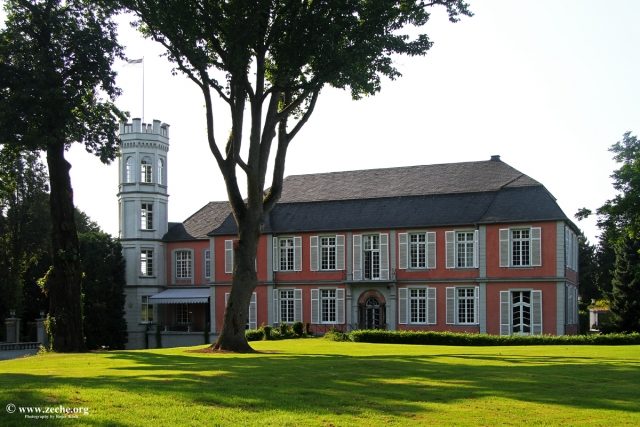
Rurich Castle is a moated castle in Rurich, a district of the city of Hückelhoven in the North Rhine-Westphalian district of Heinsberg. The complex is surrounded by an approximately 20-hectare English-style landscape park, in which part of the old moats still exist.
"Rurich lies, surrounded by a beautiful park adorned with magnificent trees, 1½ miles from Jülich, in the midst of the meadow-rich Roer Valley, in a lovely, exceedingly fertile area. The estate covers an area of over 1000 acres, making it the most significant in the richly blessed Jülich region."
– Alexander Duncker: The Rural Residences, Castles and Palaces of the Knightly Landowners in the Prussian Monarchy, together with the Royal Family, House, Fideicommissum and Privy Purse Estates in True-to-Life, Artistically Executed, Colored Representations with Accompanying Text
The castle still holds water rights to the Malefinkbach, where a grain mill belonging to the castle was formerly operated. However, it was destroyed by fire in 1986.
Description+
The castle complex consists of a manor house with a chapel, the New Palace, a coach house building, and an adjoining economic building. The Neoclassical palace was built on the old, square castle island according to design proposals from the early 19th century and was intended to counteract the further decay of the castle vault.
The garden side of the simple two-story manor house has a central and two narrow corner projections. The facade is divided by windows into seven axes. Above the courtyard-side entrance, there is a coat of arms stone with the marital coat of arms of the families von Hompesch and Ketzgen von Geretzhoven with the year 1659. The castle chapel, which adjoins the manor house to the west, is a single-nave, Neo-Gothic brick hall with a polygonal choir.
Opposite the manor house from 1788 is a three-winged coach house, whose two stories are topped by mansard roofs. The simplicity of the white plastered facade is only relieved by the corner quoins of the building. A projection protrudes from the wall line of the south facade of the main wing, above whose basket-arch gate the alliance coat of arms Reuschenberg-Gymnich is found.
To the north of the coach house is an economic courtyard, which was structurally renewed in the 19th and 20th centuries due to a fire in 1975.
The extensive English landscape park with valuable old trees and a large obelisk dates in its current form from the mid-19th century.
Owners and Proprietors
The castle was the ancestral seat of the family of the same name, from which Engebrand and Wilhelm von Rurich are first mentioned in documents in 1248. In the middle of the 15th century, the then castle came through marriage to the von Zweibrüggen family, whose members, like all subsequent families, called themselves "von Rurich". Again through marriage, this time of Sophia von Rurich with Heinrich von Reuschenberg (later Lord of Eicks), the property came to his family in 1517.
Since Reinhard Dietrich von Reuschenberg (Heinrich's great-grandson) died unmarried and without descendants in 1612, the complex passed through his aunt Anna to her husband, Baron Hermann Philipp von Hompesch-Bollheim. This family was elevated to the status of Imperial Counts in 1706. In 1909, after the death of the last male descendant of this family branch, Count Alfred Polycarp von Hompesch, Rurich Castle came to the house of the knightly estate owners Hubertus and Theodor Schlick zu Rurich and finally by inheritance to the current owner Imperial Count Eckbrecht von Dürckheim-Montmartin.
Building History
Of the old castle, whose construction, as evidenced by a coat of arms stone preserved in the coach house building, was probably completed in 1585, only the former cellar vaults remain today. It was a square brick building with small round towers with Welsche Hauben (Rhenish helmets) at its corners and flat gables above the windows. In the course of the Jülich-Cleves War of Succession, imperial troops of Rudolf II conquered Rurich, which was also plundered in the following year.
The manor house dates from the end of the 18th century and was built in the Rococo style. Gustav Vincent von Hompesch had the old castle demolished in 1787 and this new building erected very close by until 1790. In the years from 1860 to 1870, it was significantly altered. A tower, destroyed in the Second World War, was added to its southeast side - towards the park. On the west side towards the courtyard, Count Alfred Polycarp von Hompesch added a chapel in 1862, which was consecrated in 1865.
Located in the heavily contested Rur front area, the building complex was completely destroyed by shell hits on Christmas 1944. The valuable library with a collection of over 18,000 volumes was plundered. Subsequently, a systematic reconstruction began, which was completed in 1965.
Take Mobile History with you
You are reading this text for free. Premium adds what matters on the road: descriptions read aloud, sites found through your camera, whole regions taken offline.
- Every description, including the ~17,700 Premium sites
- Audio guide: have descriptions read to you on location
- AR finder: see sites through your camera, with distance and bearing
- Unlimited saved sites
14 days free, then from €2.99 a month. Cancel anytime.
Source: Wikipedia · Licence: CC BY-SA 4.0 · Image: http://www.zeche.org/
This description draws on the facts documented in the linked Wikipedia article; Wikipedia content is licensed under CC BY-SA 4.0. Wording and editing: Mobile History.
Location: 51.0126, 6.2725