To be privately owned
CastleSchlossrued
Rued Castle
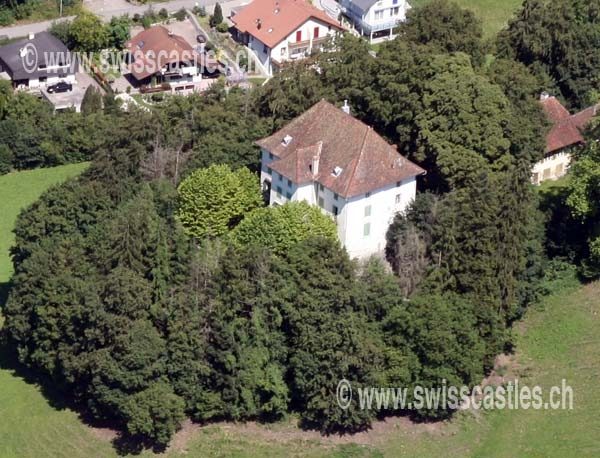
Rued Castle is a small castle in the municipality of Schlossrued in the Swiss canton of Aargau. It is located on a 50-meter-high rock outcrop north of the village and was built on the foundations of a medieval castle.
In 1155, the Lords of Ruoda were mentioned for the first time. They were ministeriales of the Kyburgs, and from 1264, of the Habsburgs. Their ancestral seat, Alt-Rued Castle, once lay on the southern side of the valley at a distance of about four hundred meters, but was abandoned in the 11th or 12th century and destroyed by the Confederates in 1386 during the Sempach War.
The noble family of Ruoda died out in 1369. The Lordship of Rued, which included the Ruedertal valley as well as the villages of Kirchleerau and Moosleerau, passed by inheritance to the Lords of Büttikon, and in 1429 to the Lords of Rüssegg. From approximately 1450, the Lordship of Rued belonged to the Scharnachthal family, and from 1491 to the bourgeois Herport family from Willisau. In 1520, Glado May acquired the castle and the lordship. The Mays originally came from Lombardy and had achieved an influential position in the patriciate of the city of Bern.
In 1775, the medieval castle was completely destroyed in a major fire. Between 1792 and 1796, master builder Carl Ahasver von Sinner erected a new castle on the same site on behalf of the lord of the manor, Carl Friedrich Rudolf May. With the exception of the southeast side, Sinner had the main walls of the castle demolished, and the rubble was used to fill the former moat. After 1803, the district archive of Kulm was housed here for several years, as suitable premises were lacking in the district capital of Unterkulm. The May family inhabited Rued Castle until 1861 and then sold it. To this day, the castle remains in private ownership.
Building+
The castle stands northeast of the village center on a hilltop projecting into the Ruedertal valley and presents itself as a four-story, cubic building in early Classicist style. With its high hip roof and the tower-like central risalit on the valley side, the castle resembles a Bernese country house, but deviates from this type due to its massiveness. From the forecourt on the rear side, a grand staircase leads to the main entrance. A lower terrace concentrically surrounds the castle and the elevated upper terrace. Both terraces have been adopted from the previous building.
Take Mobile History with you
You are reading this text for free. Premium adds what matters on the road: descriptions read aloud, sites found through your camera, whole regions taken offline.
- Every description, including the ~17,700 Premium sites
- Audio guide: have descriptions read to you on location
- AR finder: see sites through your camera, with distance and bearing
- Unlimited saved sites
14 days free, then from €2.99 a month. Cancel anytime.
Source: Wikipedia · Licence: CC BY-SA 4.0 · Image: http://www.swisscastles.ch/Aargau/rued.html
This description draws on the facts documented in the linked Wikipedia article; Wikipedia content is licensed under CC BY-SA 4.0. Wording and editing: Mobile History.
Location: 47.2928, 8.0891