Youth hostel
CastleRauenberg - Rotenberg
Rotenberg Castle
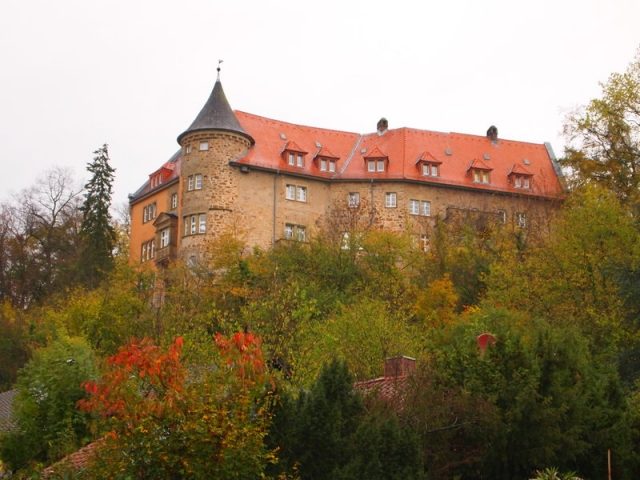
Rotenberg Castle is a former castle and palace complex above Rotenberg, a district of Rauenberg in the Rhein-Neckar-Kreis. Its current appearance is essentially due to a new construction from 1921/22.
13th to 16th Century
In 1255, the knights Streipe von Rodenburg called themselves by that name. By this time at the latest, a castle of this name existed. Bishop Heinrich of Speyer spoke in his will of 1272 of a fortification called Rothenburch. From 1394, an agreement between Bishop Nikolaus of Speyer and Henselin Mu(r)er of Mingolsheim is documented, concerning the construction of a tower.
By this time, the castle had already endured a storm when Bishop Berthold of Speyer, after his election as Bishop of Strasbourg, refused to hand it over to his Speyer successor. Bishop Walram of Veldenz forcibly took Rotenberg Castle in 1329. In 1376, Bishop Adolf of Nassau found himself compelled to pledge the castle and town with people, goods, and revenues to his uncle Crafto von Hohenlohe. In 1384, he sold to the squire Triegel von Gemmingen, bailiff of Kisslau, for 1500 guilders an annuity of 150 fl. annually, for which the castle and town of Rotenberg with the associated villages were liable. The aforementioned Bishop Nikolaus was able to redeem the pledge in 1391. Bishop Reinhard von Helmstatt redeemed the castle, which had been pledged again in the interim, from Knight Eberhard von Nieppingen in 1439. In 1456 and 1459 respectively, Bishops Siegfried III von Venningen and his successor Johannes, Baron von Hoheneck zu Entzenberg, each stayed in Rotenberg for homage. In the conflicts between Elector Friedrich I of the Palatinate, allied with the Count of Württemberg, and Margrave Karl of Baden, allied with the Duke of Zweibrücken, Bishop of Metz, and Bishop of Speyer, the Battle of Seckenheim took place in 1462, which was a success for the Elector, whereupon he besieged Rotenberg. After five days, they surrendered, and in the Peace of Heidelberg, the castle, town, and associated villages fell to the Electoral Palatinate. Only Bishop Philipp, Baron von Rosenberg, managed the re-redemption of Rotenberg Castle and town in 1505.
1525 was the year of the Palatine Peasants' War. At Easter, the first rebels gathered in Malsch, and very soon Rotenberg, Kisslau, and Bruchsal fell into their hands. It required the support of Bishop Georg of Speyer by his brother, Elector Ludwig of the Palatinate, to regain control of Rotenberg (as well as his entire territory). Bishop Georg's successor, Philipp II, Baron von Flersheim, found Rotenberg Castle in a desolate state. From 1540–1542, he had it expanded into a palace, of which the Renaissance portal with its coat of arms still bears witness today.
17th to 19th Century
During the Thirty Years' War, alternating battles took place in the Rotenberg area in 1621/1622 between the Protestants under Count Ernst von Mansfeld and the Catholics under Lieutenant General Tilly. In 1633, Rotenberg Castle was burned down by the Swedes but was repaired after the war. The French temporarily occupied Rotenberg Castle in 1675 during the so-called Dutch War. After the cellar was moved to Rauenberg in 1720 and the administration in 1739, the castle gradually fell into disrepair. Under Baden rule, it was sold to private individuals for demolition in 1809. However, it passed through several hands without the existing structural parts being demolished.
20th Century
In the years 1905/1906, Eugenie Mayfarth, to whom the property had passed after the death of her father Gustav Weissheimer, a brother of the composer Wendelin Weissheimer from Osthofen near Worms, carried out a partial reconstruction.
In 1919, Privy Councillor Franz von Reichenau and his wife became owners of the castle. They generously completed the reconstruction in 1921/1922, built a new access road (today's Schlossstrasse), and showed great generosity towards the citizens of Rotenberg. Therefore, the street between the Hofäckern and Schlossstrasse, which seemingly leads directly to the castle, is also called Von-Reichenau-Strasse.
In 1936, the castle passed to the Reich Youth Leadership and, after the war, to the state of Baden-Württemberg. It served as emergency accommodation for refugees and finally became a youth castle for the Baden District Youth Council.
Complex+
The new building from 1921/22 adopted hardly anything from the older castle, which by then was completely dilapidated, except for the Renaissance portal. Only the outer walls still partially use older foundations. The 20th-century castle is a two-winged building with a round corner tower and a Neo-Renaissance bay window facing the valley.
Take Mobile History with you
You are reading this text for free. Premium adds what matters on the road: descriptions read aloud, sites found through your camera, whole regions taken offline.
- Every description, including the ~17,700 Premium sites
- Audio guide: have descriptions read to you on location
- AR finder: see sites through your camera, with distance and bearing
- Unlimited saved sites
14 days free, then from €2.99 a month. Cancel anytime.
Source: Wikipedia · Licence: CC BY-SA 4.0 · Image: http://www.wehrbauten.de/thread.php?threadid=981
This description draws on the facts documented in the linked Wikipedia article; Wikipedia content is licensed under CC BY-SA 4.0. Wording and editing: Mobile History.
Location: 49.2590, 8.7190