To be privately owned
CastleRoßrieth
Roßrieth Castle
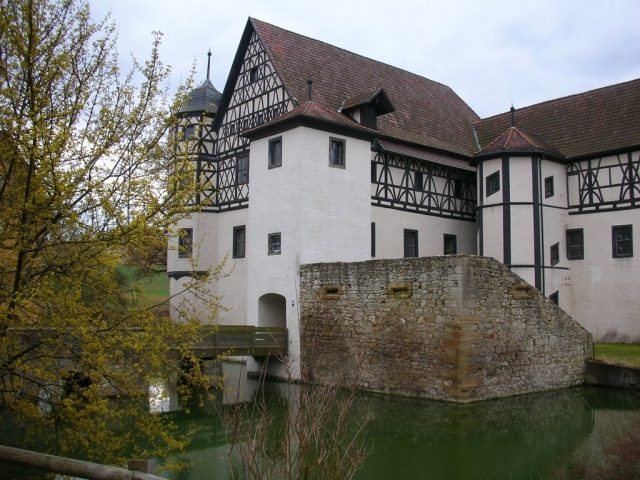
Around 1140, the place Rossrieth is mentioned for the first time in a deed of cession, and only in 1345 is there another mention, referring to a "Conrad von Rosserieth". In this respect, the former castle must have existed as a seat of power since the first mention of the place.
According to Schultes' historical-statistical description, in 1361 the Schenken von Stretelingen owned the castle, which they partially ceded to Fulda, but then had themselves enfeoffed with it again.
The captains of the Landfrieden demonstrably destroyed the castle in 1401, as it presumably degenerated into a robber baron's nest, and in 1548 it was granted by the Counts of Mansfeld to the Barons von Thüngen. This proves that the castle as such continued to exist. After the death of Kunz von Thüngen, in 1589 the Lords von Bibra were enfeoffed with the castle as a Saxon fief.
It is assumed that the Lords von Bibra built the castle or palace in its present form. This can be deduced from the coat of arms above the stair tower. The coat of arms is a so-called alliance coat of arms of the "Bibra and Gebsattel".
Finally, in 1681, Hilmar von Grappendorf acquired the castle, selling it in 1768 to the Barons von Stein, who owned it until the last century.
Most recently, it was called "K. Baier Patrimonialgericht der Freiherrn von Stein" and was voluntarily transferred to the Bavarian state in 1835. After World War II, in the course of the Bavarian land reform, the agricultural engineer Paul Frantz became the owner of the estate and the castle. The latter was obviously sacrificed to the economic boom for economic reasons. It served not only as a granary but also partly as an oversized chicken coop.
From 1980 to 1985, extensive exterior renovations took place, to which the castle owes its current appearance. However, this should not obscure the fact that it is merely the facade. Inside, the castle is still in a ruinous state.
The two-winged, almost square complex is surrounded by a moat about 20 m wide and about 2 m deep. The basement, rising out of the water, clearly bears medieval features. These are certainly the origins of the castle complex. The towering half-timbered buildings result from the reconstruction in the 16th century. Evidently, significant parts of the castle's buildings were incorporated into the construction of the palace. This can be seen especially in the loopholes in the basement or in the former keep. Due to its wall thickness and structural conditions, it seems that it retained its original form up to the half-timbered superstructure. Likewise, the gate system shows features that certainly suggest construction before the 16th century.
A visit to the vaulted cellar is definitely worthwhile, and it can be entered without difficulty. The entrance is to the left of the stair tower on the south-west wing. The half-timbered superstructures are very richly designed and contribute significantly to the charming character of the castle. They extend as a single story over both wings.
The stair tower is an artistic gem. It contains a stone spiral staircase, whose spindle is formed by three columns and has a richly decorated finial. Some stucco is still preserved in the rooms. The heavy oak beams on the upper floor of the main wing are very impressive.
Also interesting is the largely preserved layout of the manor house, which in its entirety conveys a very good impression of a castle complex.
Take Mobile History with you
You are reading this text for free. Premium adds what matters on the road: descriptions read aloud, sites found through your camera, whole regions taken offline.
- Every description, including the ~17,700 Premium sites
- Audio guide: have descriptions read to you on location
- AR finder: see sites through your camera, with distance and bearing
- Unlimited saved sites
14 days free, then from €2.99 a month. Cancel anytime.
Source: Wikipedia · Licence: CC BY-SA 4.0
This description draws on the facts documented in the linked Wikipedia article; Wikipedia content is licensed under CC BY-SA 4.0. Wording and editing: Mobile History.
Location: 50.4306, 10.3629