To be privately owned
CastleRosegg
Rosegg Castle
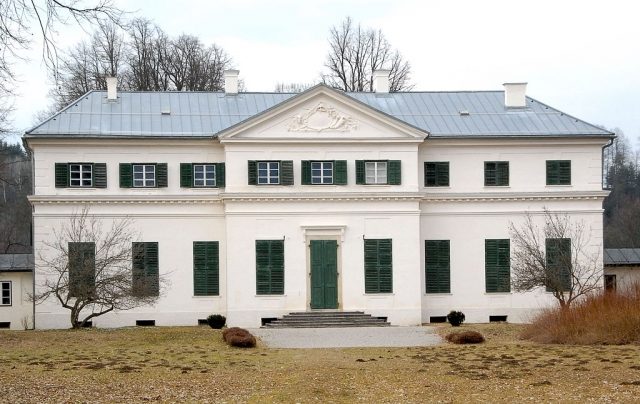
Rosegg Castle, also known as Lukrezia Castle or Liechtenstein Castle, is a castle built from 1772 onwards in the valley floor north of the castle hill of Rosegg in Carinthia, halfway between St. Michael and Duel.
The lordship, with its seat at Rosegg Castle, had been owned by the Orsini-Rosenberg family since 1686. In September 1772, Count Franz Xaver Wolfgang von Orsini-Rosenberg, Lord Chamberlain and Conference Minister, and a close confidant of Maria Theresia and her son Joseph II, began the construction of a "residential and castle building" not far from the old castle, which was intended to replace the medieval castle as the seat of the lordship. The two-story building with two lower service wings was completed before 1780. Similar buildings in Tuscany, where the builder had close contacts, or in the Terraferma near Venice, where his second wife Justinia Wynne had written a richly illustrated book about a villa, could have served as models for the castle.
After its construction, the castle replaced Rosegg Castle as the seat of the Rosegg lordship. In 1829, the Orsini-Rosenberg family transferred their Rosegg possessions to Peter Ritter von Bohr, who, from 1830 onwards, had a wildlife park laid out around the castle – which had been severely damaged during the Napoleonic Wars at the beginning of the 19th century. Already in 1833, Rosegg changed owners again and passed to the House of Liechtenstein, in whose possession it still is today.
The building itself has hardly changed externally since its construction, the interiors probably only in the second half of the 19th century. In 1996/97, the interiors were renovated, revealing late Baroque and Neoclassical room designs with stucco ceilings and wall paintings (floral wallpaper patterns).
Building Description+
The Rosegg Castle complex consists of the two-story main building, designed in the Neoclassical style, and the two late Gothic former farm buildings, which adjoin the main wing laterally and were probably built at the end of the 15th or beginning of the 16th century. In a property listing from 1774, they are listed as granaries.
The main building has a shallow central risalit and corner risalits. It is decorated with a cornice. In the garden wall of the castle are two Roman-era tomb inscriptions. A maze has been laid out between the castle and the former castle hill.
Take Mobile History with you
You are reading this text for free. Premium adds what matters on the road: descriptions read aloud, sites found through your camera, whole regions taken offline.
- Every description, including the ~17,700 Premium sites
- Audio guide: have descriptions read to you on location
- AR finder: see sites through your camera, with distance and bearing
- Unlimited saved sites
14 days free, then from €2.99 a month. Cancel anytime.
Source: Wikipedia · Licence: CC BY-SA 4.0 · Image: http://commons.wikimedia.org/wiki/File:Rosegg_Schloss_Suedansicht_25022007_01.jpg
This description draws on the facts documented in the linked Wikipedia article; Wikipedia content is licensed under CC BY-SA 4.0. Wording and editing: Mobile History.
Location: 46.5915, 14.0243