The Castle can be visited
CastleBallenstedt
Roseburg Castle
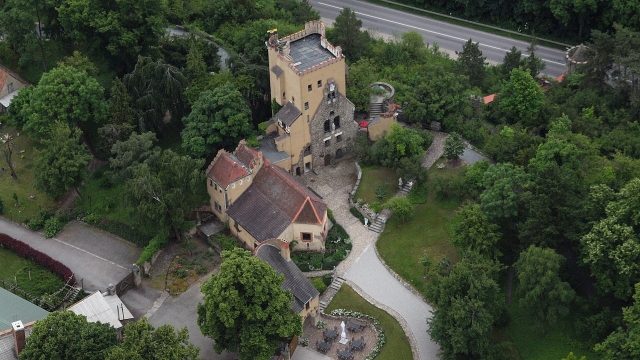
The Roseburg is a castle built in 1908 by Bernhard Sehring on Landesstraße 242 between Ballenstedt and Rieder in the Eastern Harz, Harz district, Saxony-Anhalt.
The castle, located on a Muschelkalk ridge along the old road to Goslar, was first mentioned in a document in 963 as Rudeloffsburg/Rolevesborch. It was a donation from Margrave Gero to the Gernrode convent. Bernhard Sehring excavated the foundations of the fort in 1929.
Heinrich III gifted it to the Ballenstedt monastery ('Rothallasburg') in 1056. In the 13th century, it was again in the possession of the Gernrode monastery, which was confirmed by Pope Innocent III in 1207 and Pope Gregory IX in 1227. It soon fell to the Ascania principality of Anhalt, which enfeoffed Albrecht II of Regenstein with it, along with the village, two forests, a farm, a mill, and 23 hides. In 1477, another Ascania (Woldemar zu Anhalt) again enfeoffed a count (Ulrich von Regenstein) with the castle 'and appurtenances'.
From 1563, the village, like the castle before it, was no longer mentioned. In 1579, a lawsuit referred to "By de Roseburg, where a piece of wall is still visible and where foxes are hunted." In 1801, it was recommended to 'strike out' the Rudolfsburg from maps as no longer existing. The Counts of Regenstein had, as documented in 1835, pledged the castle to citizens of Quedlinburg.
In 1905, Sehring, who had already planned the construction of a private castle complex near Stettin in 1893, acquired the site on the recommendation of Prince Friedrich of Anhalt-Dessau.
Reconstruction+
In 1907, Sehring had a palas, the gatehouse, and a watchtower with an ascending battlement built. Above a staggered outer bailey, a keep with battlements, numerous annexes, a residential tower in the style of a Norman donjon, and several castle courtyards were created, modeled after (other) old castle complexes.
After 1945+
The builder died in 1941, his wife in 1950. Sehring's collections, as far as they still existed, were taken over by various museums. During the war, the Roseburg served as the business headquarters of Junkers General Director Leo Rothe until the end of June 1945. In 1945, the owners were dispossessed and expelled by the communists. In 1955, the complex was taken over by the LPG '7. Oktober' Rieder, which used the large orchard for chicken breeding and egg production. The buildings served as a training center for poultry breeders. Between 1967 and 1984, the Kulturbund der DDR (Society for Monument Preservation) managed and restored the castle and park.
With the end of the GDR, the Steyler Missionaries managed the castle on behalf of the Sehring heirs. The property also had land register entries secured by investments from the predecessors of the agricultural cooperatives Rieder, Ballenstedt, Badeborn, and Ditfurt. In 2005, it was sold to a Berlin entrepreneur and is accessible (as a non-profit GmbH) in summer. Since July 2006, the water axis has been functioning again on weekends.
Architecture+
The castle complex has no precedent in the Harz landscape. It is a reminiscence of the 11th to 13th centuries and at the same time Sehring's private synthesis of stylistic pluralism with typical elements of Romanesque architecture (hall of the palas) and medieval (battlement) as well as late medieval building elements (Georgsturm, castle chapel).
The castle park is an English garden of the early 19th century combined with an early Baroque Italian complex. A 100-meter long, terraced water cascade as the main axis is crossed by a linden avenue.
Many structure-forming elements of the park are originals from Italy, such as a Gothic fountain column (11th century) from the 'Palazzo Malatesta' in Rimini, two marble columns from the 'Palazzo Malaspina' in Bologna, and marble busts from Senigallia. At the apex of the water cascade, an observation tower was erected, which contains a grotto as a mausoleum in its lower part, intended as a final resting place.
Take Mobile History with you
You are reading this text for free. Premium adds what matters on the road: descriptions read aloud, sites found through your camera, whole regions taken offline.
- Every description, including the ~17,700 Premium sites
- Audio guide: have descriptions read to you on location
- AR finder: see sites through your camera, with distance and bearing
- Unlimited saved sites
14 days free, then from €2.99 a month. Cancel anytime.
Source: Wikipedia · Licence: CC BY-SA 4.0 · Image: https://commons.wikimedia.org/wiki/File:Ballenstedt_Roseburg.jpg
This description draws on the facts documented in the linked Wikipedia article; Wikipedia content is licensed under CC BY-SA 4.0. Wording and editing: Mobile History.
Location: 51.7273, 11.1951