The Castle can be visited
CastleRochlitz
Rochlitz Castle
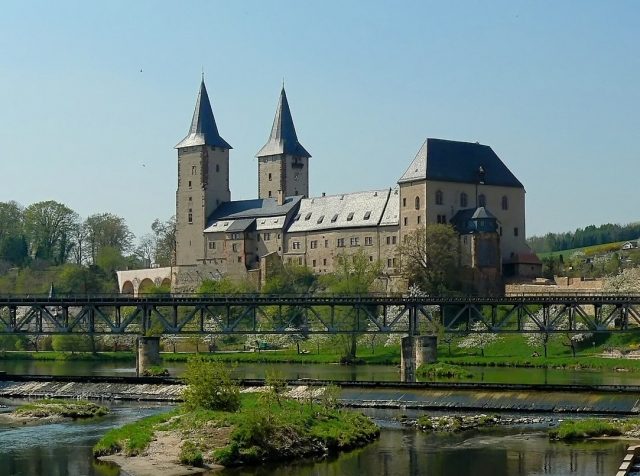
Rochlitz Castle is located in the west of the town of Rochlitz in the district of Mittelsachsen in the Free State of Saxony. An extensive castle complex stands on the site of an imperial castle built in the second half of the 10th century, which passed into the possession of the Wettin margraves in 1143. Its appearance is largely determined by a conversion into a margravial castle in the last quarter of the 14th century, in addition to several Romanesque building parts. Further alterations and new constructions took place at the end of the 15th and in the 16th century, when the castle was used as a secondary residence, widow's seat, and hunting lodge by the Wettins. In total, the castle served as a residence for members of the Saxon princely house eight times. From the 18th century, the castle served as an administrative seat (justice office, district court), and from 1852 also as a prison, which again necessitated major alterations. The museum, founded in 1892, was gradually expanded and will in the future occupy almost the entire castle.
The castle is located southwest of the historic town center of Rochlitz on a spur of the Rochlitz mountain, which gradually slopes down to the east-northeast and is flanked by the Zwickauer Mulde in the southeast and the Hellerbach in the northwest. The spur divides into the Nosswitzer Schlossberg in the west, which is considerably higher at about 200 m above sea level and covers an area of about 300 m in length and about 60 m in width, and – separated by a late medieval neck ditch – the Rochlitzer Schlossberg with the castle complex (about 90 x 30-40 m), the so-called Unterschloss (lower castle) separated by ditches, and the eastern outer bailey with St. Peter's Church and a total extension of about 220 x 40 m.
Rochlitz Castle in the Middle Ages
In the Middle and Late Slavic periods, the castle formed the center of the Slavic small gau of Rochlitz. Archaeological finds suggest that a fortified rampart from the 9th and 10th centuries existed on the Nosswitzer Schlossberg, which adjoins the present castle to the west, as a predecessor to the German castle, and was later re-purposed as a western outer bailey (Suburbium). The area on the Mulde probably came under German rule under King Henry I. In the second half of the 10th century, a Burgward was established, with Rochlitz Castle as its center. St. Peter's Church was founded in the eastern outer bailey (Suburbium) by the Diocese of Merseburg before 981 as a mission and parish church for the entire Burgward. In 995, the Rochlitz area is first mentioned in writing in a document by Emperor Otto III, when, after the dissolution of the Diocese of Merseburg, the Zwickauer Mulde was designated as the border of the Dioceses of Naumburg and Meissen.
The Rochlitz castle complex – originally certainly imperial property – and the surrounding area came into the allodial possession of Margrave Ekkehard of Meissen around 1000. In the dispute between his two sons, Count Hermann (1009 to around 1031/32) and Ekkehard II, and their uncle Margrave Gunzelin over the inheritance, Gunzelin set fire to the castle in 1009. The entry in the chronicle of Bishop Thietmar of Merseburg, which reports on the feud, is also the first direct mention of the castle. In May 1018, Thietmar himself went to the southeastern part of his diocese and took the possessions of the Merseburg church in the Rochlitz area back into his care. He also most likely performed confirmations in St. Peter's Church.
In 1046, the Ekkehardinian possessions reverted to the Empire and were consolidated by King Henry III with the remaining imperial property on the Mulde, which included, in addition to Rochlitz, the Burgwards of Colditz, Leisnig, Polkenberg, and Döben (Grobi). In the same year, Henry gifted to his wife Agnes possessions inherited from Margrave Ekkehard, including those in burchwardo Rochidez. Rochlitz developed into an important Salian imperial castle in the second half of the 11th century, for which at least two royal and imperial stays are documented. In addition to Henry III, his son King Henry IV also issued a document on October 28, 1068, actum Rochlezi. A deed of gift from Emperor Henry IV from 1074, with which he is said to have transferred, among other things, the castellum Rochedez cum adiacente pago similiter nominato to the Diocese of Naumburg, is disputed, as the diploma was probably redrawn and falsified in the second half of the 12th century.
In 1143, Margrave Conrad I of Meissen received the castle and the land of Rochlitz (provincia Rochelez) as a gift from King Conrad III. Thus, the castle came into the possession of the House of Wettin, where it remained until 1918. After Conrad's abdication in 1156 and his retreat to the Augustinian Canons Regular monastery on Petersberg near Halle, the property was divided among his five sons. The County of Rochlitz, along with the County of Groitzsch, which had only been partially won for the Wettins in 1135, went to Dedo V the Fat. Although he called himself Count of Groitzsch (comes de Groiz), he probably resided not in the castle now known as Wiprechtsburg, but in Rochlitz. Under his rule, the development of the Rochlitz region took place, and shortly after 1160, the Zschillen Monastery was founded in proprio suo videlicet pago Rochelez in ripa Milde fluminis. Below Rochlitz Castle, the legal town of Rochlitz with the town church of St. Kunigunde was founded by Dedo or one of his sons, Dietrich and Konrad. The castle itself served as the residence of an apparently not insignificant court, under which, in 1208, even a Henricus burggravius de Rochlitz and several castrenses de Rochlitz appear. Extensive Romanesque building parts from this period still exist, such as two residential towers and the palas in the south wing.
After the extinction of the Rochlitz line in the male line, the county reverted to the main line of the Wettins in 1210 and was reincorporated into the Margraviate of Meissen by Margrave Dietrich of Meissen. Rochlitz remained an important fortified point within the overall Wettin rule and administrative seat of the Rochlitz district, but its overall significance probably declined. In 1223, the castle was conquered by the Thuringian Landgrave Ludwig IV, during which a siege castle had been built and a trebuchet used. Between 1286 and 1291, the Palatine Count Friedrich of Saxony-Lauchstädt resided here; in 1288, he held his father Landgrave Albrecht II the Degenerate captive in Rochlitz. Between 1296 and 1298, the castle briefly belonged to the Empire again. In 1298, the Palatine and Margrave Friedrich returned from his exile in Tyrol. Meissen troops conquered the castle and captured the royal governor for the Margraviate of Meissen, Henry of Hesse, a cousin of the king. In 1325 and 1329, Friedrich the Serious held court in Rochlitz.
Rochlitz experienced another flourishing period under the jointly ruling brothers Friedrich, Balthasar, and Wilhelm. Margrave Wilhelm I the One-Eyed had an elaborate Gothic castle complex built here in the last quarter of the 14th century. This included the construction of the Fürstenhaus (Prince's House) from 1375 to 1380 and the two towers called "Jupen" around 1390, as well as the conversion of the transept with the chapel and the south wing. These new constructions and alterations to the margravial "sloß" (first mentioned as such around 1370) still largely define its appearance today. At this time, the complex served as a main payment office of the Margraviate, as a financial archive for the Freiberg mining scribes, and from 1384 as a court for a Landfrieden (public peace).
In 1430, the castle and town had to be defended during a Hussite invasion, but while the town fell, the castle was held. After having stayed here for a longer period in 1436, Duke Sigismund, who had been deposed as Bishop of Würzburg, lived here in appropriate exile. Furthermore, the castle temporarily served as a princely school for Ernst and Albrecht in 1457, and for Friedrich (later the Wise) and Johann (the Steadfast) in 1477. In the second half of the 15th century (from 1477 to 1480), a further conversion to a fortified castle took place, where from 1481 to 1501 Duchess Amalia of Saxony, the widow of Duke Ludwig the Rich of Bavaria-Landshut and sister of Ernst and Albrecht of Saxony, resided. This period also saw the renovation of the castle chapel (around 1480) and the new construction of St. Peter's Church (1470/99). From 1507 to 1510, the castle served as the residence for the Grand Master of the Teutonic Order, Friedrich of Saxony. In 1511, Margrave Albrecht of Brandenburg-Ansbach from the Franconian line of the Hohenzollerns was admitted to the Teutonic Order in Zschillen and, the next day, was elevated to successor as Grand Master at Rochlitz Castle.
Rochlitz Castle in Modern Times
The castle and town experienced a cultural highlight when, from 1537 to 1547, the Dowager Duchess Elisabeth of Hesse, a key promoter of the Reformation in Saxony, took up residence here. She was followed from 1586 to 1591 by Elector Christian I and from 1591 to 1611 by Electress Dowager Sophie. This period saw the conversion of the complex into a hunting lodge with alterations to the Fürstenhaus (Prince's House) in 1537/47 and from 1586, as well as the construction of the "Kleines Haus" (Small House) in 1588. A Renaissance pleasure garden with a summer house and vineyards was laid out on the forecourt of the castle hill before 1548.
During the Thirty Years' War, the castle was besieged and captured several times by Swedish troops, of which cannonball impacts on the "Finsteren Juppe" still bear witness today. The Unterschloss (lower castle), which had also been built upon until then, was destroyed by fire in 1645. In 1693, Emperor Leopold I, at the request of Elector Johann Georg IV, elevated his mistress Magdalena Sibylla von Neitschütz to Imperial Countess of Rochlitz. During the Great Northern War in 1706/07, the Swedish King Charles XII chose Rochlitz twice as his residence and Swedish garrison headquarters. Three years later, Queen Christiane Eberhardine of Poland, the wife of Augustus the Strong, took up her travel quarters here. Apart from the construction of the castle bridges in 1718, the 18th century marked a strong decline with the final demolition of the Unterschloss in 1717 and, in 1784, even further parts of the castle itself, such as the upper floor of the palas, the well house, the granary, and other building components.
In 1848, a guard detachment of 22 riflemen and later infantry was stationed in the largely unused castle. From 1850, it also served as the seat of a district court, where numerous prisoners from the 1848 revolution ("May prisoners") were held. In 1852, alterations were made to the Fürstenhaus and transept for the judiciary, and the cell block of the remand prison, used until 1961, was erected. In 1893, Dr. W. C. Pfau (1862–1946), a secondary school teacher from Rochlitz, established a museum in the castle chapel, the fourth oldest castle museum in Saxony.
From 1934 to 1936, during the Nazi era ("Third Reich"), extensive renovation measures were carried out as part of the "Rheinhard Program" (= Reich Labor Service), culminating in the opening of the Lichten Jupe as an observation tower. In 1944/45, Rochlitz Castle served as an evacuation site for art and cultural assets from the Dresden State Archives, the Leipzig University Library, and the Museum of Fine Arts Leipzig (numerous losses after 1949).
After the capitulation, from April to June 1945, a reception camp for prisoners of war and NSDAP functionaries of the United States Army was located here, which was converted into an NKVD headquarters and camp from July 1945 to May 1947 after the area was taken over by Soviet troops. After its closure, the museum was able to reopen in May 1948, but extensive losses due to looting and improper handling were recorded. During the GDR era, the castle passed from the Ministry of Justice of the GDR to the city administration in 1960 and experienced various uses as a residential building, office, city archive, museum, and from 1963/64 additionally as a school after-school care center. In 1960, building research and the expansion of the museum began by the museum director and volunteer helpers.
A significant change for the castle was the departure of the district court in 1990 (as part of reunification) and the subsequent demolition of the cell block with the reconstruction of the northern battlement. With the takeover by the State of Saxony in 1994, extensive securing, renovation, and restoration began. This is associated with extensive archaeological investigations and building research, which are expected to yield numerous further insights into the history and building history of Rochlitz Castle and Palace in the coming years (when?).
Take Mobile History with you
You are reading this text for free. Premium adds what matters on the road: descriptions read aloud, sites found through your camera, whole regions taken offline.
- Every description, including the ~17,700 Premium sites
- Audio guide: have descriptions read to you on location
- AR finder: see sites through your camera, with distance and bearing
- Unlimited saved sites
14 days free, then from €2.99 a month. Cancel anytime.
Source: Wikipedia · Licence: CC BY-SA 4.0 · Image: Thomas Eichler
This description draws on the facts documented in the linked Wikipedia article; Wikipedia content is licensed under CC BY-SA 4.0. Wording and editing: Mobile History.
Location: 51.0450, 12.7914