Restaurant
Register office
CastleHamminkeln-Ringenberg
Ringenberg Castle
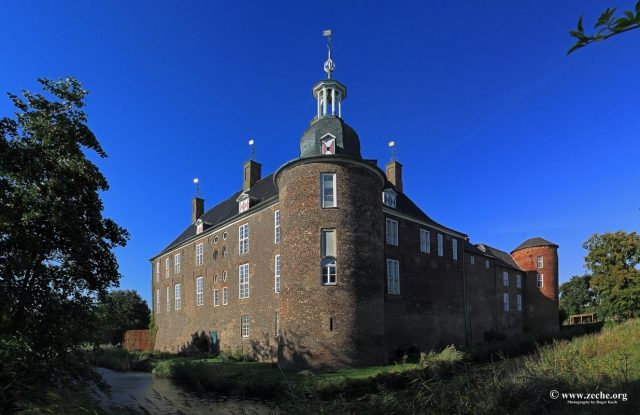
Ringenberg Castle is a moated castle in the city of Hamminkeln in North Rhine-Westphalia. It is located in the southeast of the Ringenberg district, to which it gave its name.
The castle dates back to a 13th-century castle foundation in the strategically important border region of the territories of the County of Cleves, the Electorate of Cologne, and the Prince-Bishopric of Münster. Destroyed by Dutch troops, the complex came into the possession of Baron Alexander von Spaen in the 17th century, who rebuilt it.
After the castle was listed as a historical monument in 1984, the site was registered as an archaeological monument three years later. Today, the building is owned by the city of Hamminkeln, which operates its registry office there. The building also houses an artist studio center of the Derik-Baegert-Gesellschaft and a restaurant.
Description+
Architecture
The castle, in the style of Dutch classical Baroque, is a three-winged brick complex surrounded by moats. Its south and east corners are formed by mighty, round corner towers. The southern one has a curved, lantern-crowned dome. The two floors of the castle are topped by a hip roof that bears several iron weather vanes with the year 1661. Classical triangular gables are found above the projecting, risalit-like entrances of the two side wings. A ten-step outdoor staircase still leads to the former main portal in the central wing, although its execution is much simpler than the original state.
The building is the former main castle. The former outer bailey located to the west of it is no longer preserved.
Interior
On the ground floor of the southwestern side wing, the building has a painted wooden beam ceiling from the end of the 17th century. Because it was hidden under a suspended ceiling for a long time, it is largely preserved in its original state and is therefore almost unique in the Rhineland. In addition to its floral paintings in the High Baroque style, it shows the coats of arms of Alexander von Spaen and his first wife Henriette von Arnheim.
The Beginnings
A document from 1229 first mentions the name Ringenberg. At that time, it was owned by the knight and free count Sueder III von Dingden, who had it built as a fortified castle in the swampy area of the Isselbruch. When the noble family then permanently moved their ancestral seat there, they called themselves "von Ringenberg" from 1242 onwards.
It is said that Sueder III wanted to evade his feudal obligations to the Prince-Bishop of Münster and therefore had the castle built for a possible defense. Only a little later, in 1247, he already pledged allegiance to Münster's most powerful adversary, Archbishop Konrad von Hochstaden of Cologne. In the following years, the lord of the castle skillfully maneuvered between the powerful figures of the country, pledging his castle sometimes to the Bishop of Münster, sometimes to the Elector of Cologne. In the same year that Sueder III received 270 marks from Münster for his property, he betrothed his daughter Beatrix to Dietrich Luf I, the brother of Count Dietrich VII of Cleves, and promised to transfer half of his property and half of Ringenberg Castle to the couple after the marriage. After Sueder III's death in 1265, the property passed to the Counts of Cleves through his daughter, who appointed a bailiff there from 1359. Count Dietrich IX of Cleves had Ringenberg expanded into a residence in 1329. Four Dutch families came as specialists to drain and cultivate the swamp landscape around Ringenberg. The two three-story round towers at the south and east corners of the complex also date from the 14th century.
Alterations and Destruction
Several alterations followed in the 15th century. Among other things, the increased use of firearms was taken into account by installing keyhole embrasures suitable for arquebuses in the basement of the east tower. At times, the castle was occupied by a large number of castlemen during this period. An official letter from October 14, 1437, for example, mentions, in addition to the responsible bailiff, ten other people, including a porter, a gatekeeper, and two tower guards. In the course of the Soest Feud from 1444 to 1449, Ringenberg also threatened to become a theater of war, and so Duke Adolf of Cleves had his official castle further fortified by surrounding it with a defensive wall and widening the Zwinger moat. In the second half of the 15th century, the Dukes of Cleves were forced to lease Ringenberg frequently due to acute indebtedness.
During the Dutch-Spanish War, the fortified castle was severely damaged by Spanish soldiers. Although there were plans to convert the complex into a pure fortress, these were never realized. Captured by Dutch troops in 1629 during the Thirty Years' War and finally destroyed in 1635, a contemporary report from 1648 describes the castle as "completely ruined and demolished, and utterly fallen into a heap of stones."
Reconstruction under Alexander von Spaen
In the same year, the Dutch colonel and Landdrost Jakob von Spaen, together with his brother, the Brandenburg Field Marshal Alexander von Spaen, received the uninhabited ruin as a male fief from Elector Frederick William for his services. The von Spaens had actively supported him in the fight against the States General. From 1648, the brothers built the present castle on the ruins of the medieval castle. Remaining parts of the defensive structure were incorporated into the new buildings, such as the two-meter-thick outer walls of the complex on the moat side. The weather vane on the castle roof indicates the year 1661 as the completion date of the construction work. Alexander von Spaen commissioned the same master builder for this work whom he also engaged for the renovation of the Dutch Biljoen Castle near Velp, a district of Rheden, near Arnhem, and who is probably to be sought in the circle of the Dutch architect Pieter Post. His name remains unknown to this day. After the presumably childless death of Jakob von Spaen, his brother Alexander became the sole feudal lord. Upon the death of the Field Marshal, one of his twelve children inherited the castle complex: his son Alexander Bernhard, who sold it to his older brother Friedrich Wilhelm in 1696.
The last direct descendant of Alexander von Spaen was Alexander Sueder von Spaen (1703–1768). Due to massive financial difficulties, he had to sell the castle to his nephew Alexander Dietrich from the Dutch branch of the family in 1737. However, he continued to live at Ringenberg until his death in 1768. His widow Agnes Jacoba von Nassau-Lalecq was also able to use the castle free of charge for the rest of her life. At the end of the 18th century, Ringenberg Castle was mostly deserted and under the administration of a rent master. Under his aegis, the demolition of the two square corner towers in the east and north of the area, as well as the former gatehouse, which were demolished between 1733 and 1823, can probably be dated. Visitors once had to pass the latter to reach the castle, which was surrounded by moats on all four sides, via a drawbridge. During the Seven Years' War, the castle served as quarters for officers and for housing the wounded. During the French Revolution, nobles who had emigrated from France found refuge there.
The 20th Century
After 1848, there were several changes of ownership. Owners included members of the families von Salm-Hochstraten and Salm-Horstmar. Since it was not inhabited by them in the second half of the 19th century, but rented out and only very poorly maintained, it gradually fell into disrepair until Count Clemens von Plettenberg acquired the dilapidated castle complex in 1924. Immediately after the purchase, he began restoring the severely neglected building. However, his efforts were abruptly thwarted by the Second World War. The northeastern wing of the building was severely damaged by artillery and aerial bombs in 1945. The village of Ringenberg was 40 percent destroyed. After the war, a makeshift restoration followed, and the castle was subsequently used as a church and school.
Clemens von Plettenberg's son had extensive gardens laid out around the castle and rented part of the building to the art publisher Der Kreis, whose owner Bodo Bratke, who later founded the Derik-Baegert-Gesellschaft, opened a gallery with changing art exhibitions there. Despite the rental income, the von Plettenberg family was ultimately no longer able to adequately maintain the remaining building stock; the west wing of the castle gradually fell into disrepair.
After the death of Maximilian von Plettenberg, the then municipality of Hamminkeln acquired the complex in 1989 and had it extensively renovated and restored from 1990 onwards in accordance with monument protection regulations. The aim was to restore the 17th-century complex to its original state. In this context, archaeological excavations were also carried out in the basement from December 1990 to August 1991. Interesting finds and the results of these excavations can be viewed in the castle's basement. During the reconstruction work in the southwest wing, a painted beam ceiling was also uncovered, which is very valuable in terms of art history due to its exceptionally good state of preservation.
Current Use
While the mayor's office was housed in the castle buildings between 1909 and 1911, Ringenberg has partly served municipal purposes again since 1994. Since that year, the ground floor rooms of the central wing have housed the registry office of the city of Hamminkeln.
A restaurant has been located in the castle's Baroque cellar vault since 1998. In addition, some cellar rooms are used as an archaeological magazine.
The rooms of the north wing and some of the central wing are meanwhile used by the Derik-Baegert-Gesellschaft. It maintains an artist studio center for young artists there. For this reason, interior visits are only possible by prior arrangement or as part of public exhibitions and concerts.
Take Mobile History with you
You are reading this text for free. Premium adds what matters on the road: descriptions read aloud, sites found through your camera, whole regions taken offline.
- Every description, including the ~17,700 Premium sites
- Audio guide: have descriptions read to you on location
- AR finder: see sites through your camera, with distance and bearing
- Unlimited saved sites
14 days free, then from €2.99 a month. Cancel anytime.
Source: Wikipedia · Licence: CC BY-SA 4.0 · Image: http://www.zeche.org/
This description draws on the facts documented in the linked Wikipedia article; Wikipedia content is licensed under CC BY-SA 4.0. Wording and editing: Mobile History.
Location: 51.7419, 6.6150