Cultural Events
CastleSalzgitter - Ringelheim
Ringelheim Castle
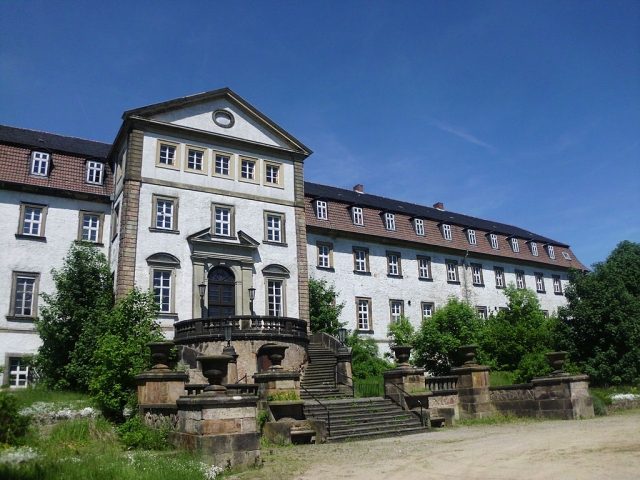
Ringelheim Castle and its park are located on the Innerste river in Salzgitter-Ringelheim in Lower Saxony.
Ringelheim Castle is a former monastery from the 10th century, secularized in 1803. The baroque monastery church of St. Abdon and Sennen is known for its valuable organ and the crucifix from the workshop of Bishop Bernward of Hildesheim.
Probably during the reign of the East Frankish King Henry I and Matilda of Ringelheim (919–936), a royal convent for virgins was established on the Innerste, possibly not until 940 under Otto I by Count Immat from the Immedinger family.
In 1152, the abbey was converted into a Benedictine monastery for men and placed under the Diocese of Hildesheim. From 1523–1641, it was part of Brunswick and thus Protestant. In 1803, the monastery was secularized and became the property of the Prussian Field Marshal von der Schulenburg-Kehnert.
In 1817, Friedrich von der Decken bought the Ringelheim estate and converted it into a manor house. The former convent building, whose new construction dates back to the early 18th century, became the current castle and received a classical facade. The library wing to the east was demolished, as was the cloister between the convent building and the church.
In 1942, Ringelheim Castle and its park were leased to the Landesversicherungsanstalt Braunschweig and used by them as a sanatorium for tuberculosis patients. Later, the castle housed a specialized department of the Lower Saxony State Hospital Königslutter. At the end of the 1990s, the castle residents moved into the village. Since then, several investors have shown interest in the castle, including the BIC Group company, a music academy, and an investor who wanted to create a luxurious residence for wealthy seniors. As of today (2013), the future of the castle has not yet been decided.
In 1848, Adolf von der Decken had the current castle park laid out as an English landscape garden on the site of the monks' old fishponds. Approximately 21.7 hectares in size (110 hectares with surrounding green areas), it is traversed by a branched lake system, which is crossed by several bridges, e.g., the romantic sandstone bridge with a view of the castle (photo). The park is entered through a vase-crowned gate at the west entrance. Not far from the castle is an artificial ruin. Furthermore, von der Decken had an obelisk erected on an island. Away from the paths, along the lake, the park transitions into a small forest to the east. Between the park and the forest and the Innerste, the sports facilities of the Ringelheim clubs connect to the green areas.
The organ dates back to Andreas Schweimb (1696) and was completed after his death by Johann Jacob John (around 1700). Around 1750, the pedal towers were added by an organ builder. The instrument currently has 32 stops on two manuals and pedal, a large part of which is still preserved. Gebrüder Hillebrand Orgelbau carried out a restoration in several sections between 1974 and 1992.
Take Mobile History with you
You are reading this text for free. Premium adds what matters on the road: descriptions read aloud, sites found through your camera, whole regions taken offline.
- Every description, including the ~17,700 Premium sites
- Audio guide: have descriptions read to you on location
- AR finder: see sites through your camera, with distance and bearing
- Unlimited saved sites
14 days free, then from €2.99 a month. Cancel anytime.
Source: Wikipedia · Licence: CC BY-SA 4.0 · Image: https://de.wikipedia.org/wiki/Datei:Schloss_Ringelheim_2013.jpg
This description draws on the facts documented in the linked Wikipedia article; Wikipedia content is licensed under CC BY-SA 4.0. Wording and editing: Mobile History.
Location: 52.0346, 10.3110