To be privately owned
CastlePratval
Rietberg Castle (Pratval)
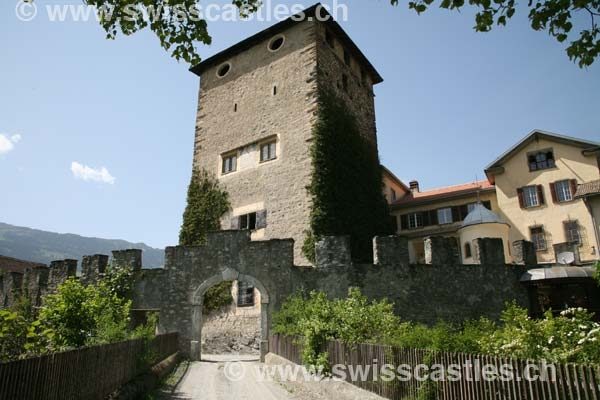
The Rietberg Fortress is one of those that survived the Middle Ages and were converted into modern country estates. It has been inhabited to this day. Extensive renovations have stripped Rietberg Castle of most of its medieval substance. It stands on a rocky spur above a deep moat. The castle was encircled on the mountain side by a moat, which must have covered the northeast sector of the castle's footprint. Recent earthworks and leveling operations have made every trace of this moat disappear.
The massive keep in the center of the castle has retained most of its medieval elements, although its interior, as well as the keep itself, has been renovated over time. The lower floors of the keep were renewed in the 17th century. And with them, it seems, the entire medieval castle was transformed into a patrician residence, similar to those at the beginning of modern times. The interior decoration of the residential building with vaults, coats of arms, and a stucco chimney dates from the 17th century. The knight's hall with its baroque style was built around 1700. The richly sculpted wooden paneling that adorns the western part of the residence dates from the same era.
With its decorated loopholes, which have no defensive qualities whatsoever, the current enclosing wall encircles the castle courtyard. It dates back to the 17th century. The original extent of the former ring wall remains hidden to this day.
The beginnings of Rietberg Castle remain obscure. The tower, the oldest construction of the current castle, was probably built around the year 1200. The origins of the family, which according to documents from the 13th and 14th centuries bore the name of Rietberg, also remain open. The Barons of Rietberg were dependent on the ministerial lords of Sax-Misox and the Bishops of Chur. In addition to the small lordship of Rietberg, they owned lands and rights in Schams, Chur, and Oberhalbstein. Finally, they exercised episcopal rights in Oberhalbstein and Oberengadin.
When the male line of the family threatened to die out around 1340, Jean de Rietberg, the last male descendant, tried through a contract to transfer not only his legacy but also the question of maintenance to his wife and their illegitimate son. Shortly before his death, he bequeathed his horse and weapons to the Chapter of Chur to ensure the annual mass celebration.
He died in 1349. Despite all the precautions he had taken, his legacy caused a conflict that probably lasted more than ten years. The bishop succeeded in thwarting the testamentary transfer of Rietberg Castle to Jean's uncles, the Landenbergers, by making them sign a declaration of renunciation in 1353. Other heirs long maintained their claims; finally, they were compensated by the bishop.
As soon as Rietberg Castle came into the possession of the bishop, it was included in the complex of episcopal estates of Domleschg. A bailiff resided there temporarily. But the long series of pledges, which began even before 1400, cost the bishop the lordship.
Certainly, the bishops initially tried to retain their rights to the castle by forcing the pledge holders to ensure the good maintenance of the castle, which had to remain accessible to them at all times. But, as the pledge sum increased more and more, the pledge gradually transformed into ownership.
After various changes of ownership that took place at the end of the Middle Ages, Rietberg became the property of Antoine von Travers in 1530. In 1554, his children sold the castle and the lordship to Herkules von Salis, a Grisons captain in Valteline. The property was divided in 1617 between the Salis and Pompée von Planta, the brother-in-law of Herkules von Salis's son. Four years later, during the unrest in Grisons, Pompée von Planta was killed by Jurg Jenatsch and his accomplices.
The ownership rights of Rietberg were transferred between the two patrician families Buol and von Planta until 1758, a date on which the Buol acquired the Planta part and thus restored the original unity of their estates. Today, Rietberg Castle still belongs to private individuals.
Take Mobile History with you
You are reading this text for free. Premium adds what matters on the road: descriptions read aloud, sites found through your camera, whole regions taken offline.
- Every description, including the ~17,700 Premium sites
- Audio guide: have descriptions read to you on location
- AR finder: see sites through your camera, with distance and bearing
- Unlimited saved sites
14 days free, then from €2.99 a month. Cancel anytime.
Source: Wikipedia · Licence: CC BY-SA 4.0
This description draws on the facts documented in the linked Wikipedia article; Wikipedia content is licensed under CC BY-SA 4.0. Wording and editing: Mobile History.
Location: 46.7358, 9.4483