To be privately owned
CastleMehrnbach-Riegerting
Riegerting Castle
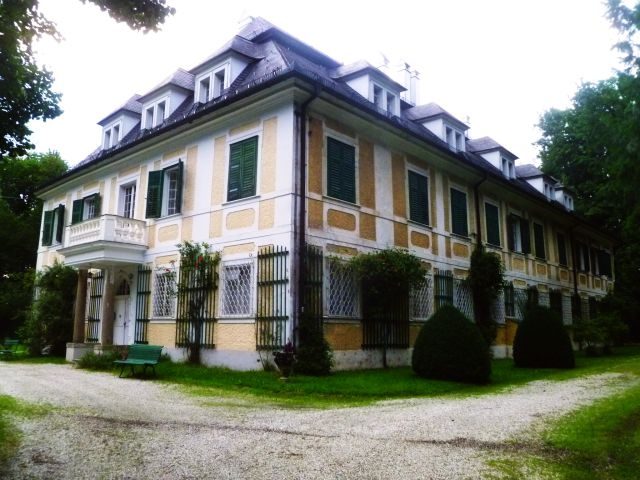
Riegerting Castle is located in the eponymous district of the municipality of Mehrnbach in the Ried im Innkreis district in Upper Austria. As a Hofmark castle, it was the manorial seat of the Hofmark Riegerting. Since the Riegerting district is not signposted, the castle is somewhat difficult to find. Remarkably, the name is pronounced by locals as rikertinɡ, which is closer to the earlier designation (Rueckering) than to the current name.
Riegerting is first mentioned in 1363 in the Friedburg Urbar as Rueckering. The first owner mentioned in 1363 is Hanns Zärtl zue Rueckering. The Zärtls resided here until the extinction of their lineage. Further known from 1479 are the knights Wilhelm (1489–1491) and Christoph († 1543) von Zärtl; the latter was married to Elisabeth Taimer († 1537) and was the last bearer of the Zärtl name; his epitaph is preserved in the church of Mehrnbach.
Successors were Wolf Scharffseder, who was married to a sister of the childless Christoph Zärtel. Hans Jakob had the castle extended in 1545. Other Scharffseders were Wolf (1551) and Wolf Siegmund (1554); the latter handed over Riegerting to his sons Stephan and Hans. A Hans Georg died in 1594, his son Johann Jakob (1587–1657) is buried in Mehrnbach. The Scharffseders received the building rights to the lordship from Elector Maximilian Emanuel of Bavaria. Gravestones of the Scharffseders can be found in Unterdietfurt.
In 1652, Riegerting came as a dowry of Christine Cordula von Scharffseder to Baron Otto von Seiboltsdorff, administrator in Braunau (1669–1672) and in Ried im Innkreis (1672–1690 and 1704). They had the new castle building and the castle chapel erected in 1697. The old water-surrounded seat of Ruekering was located southwest of the current castle chapel; only outbuildings of the old complex are still preserved from this building, but the complex (with the surrounding pond) is clearly visible in Wening's engraving (1721). His son Franz Gottfried von Freyenseiboldstorff was also administrator in Ried until his death († 1703). One of his sons, Otto Philipp Graf von Freyenseiboldstorff auf Riegerting († 1720), was also administrator in Ried (1715–1720); his brother Herrmann Ludwig became a canon in Regensburg in 1726 († 1741).
Maria Barbara von Seiboltsdorff was married to Count Lerchenfeld-Brennberg. She inherited the lordship of Riegerting in 1741 from her brother, the Regensburg canon. Through marriage, Riegerting passed to the Counts of Wartenburg in 1763 and again to the Count of Lerchenfeld in 1769, who was followed by his widow in 1779. Thereafter, Riegerting came to Count von Haslang († 1803), whose son Max Emanuel died as a 19-year-old student in Munich.
In 1829, Baron Philipp von Venningen acquired the property with Mairing Castle and half of Aspach. Since then, the estate has been owned by the von Venningen family.
Castle Chapel of Saint Isidor+
The castle chapel dates from 1685 and is dedicated to Saint Isidor. The consecration was performed by Auxiliary Bishop Johann Max Steiner von Plainfelden. The bells date from 1742 and 1797. The lord of the castle founded a chaplaincy in 1685, which was occupied until 1866. The chapel has a wooden barrel vault (added in 1782 after a fire), an apse vault with wooden ribs, a keystone, and a coat of arms. The altar is made in the style of Thomas Schwanthaler. A Way of the Cross dates from the end of the 18th century, and statues of Barbara and Catherine from the second quarter of the 18th century. Until 1821, the chapel served only the castle lords and their employees as a place of worship. In 1829, the chapel was made accessible to the population of the surrounding communities. The chapel became largely unusable in 1932 due to a ground collapse. A new church building committee enabled its reconstruction. On May 28, 1933, the newly built chapel was consecrated by Canon Karl Schöfecker from Linz.
Riegerting Castle today+
The current castle dates from the 17th century but was largely altered by renovations and additions in 1908. The layout of the interior rooms was retained. Short side wings were added to the two-story building, constructed on a rectangular footprint, and integrated into the existing structure by the roof construction. The castle is covered with a once-broken, hipped mansard roof. The new construction can be recognized by the different chimneys. On the first floor of the left extension, a loggia standing on two columns with a stone balustrade on ornamental columns was added. The entrance gate remained unchanged, supplemented by a porch supporting a semicircular estrade. The exterior sides of the castle are clad with trellises.
Within the castle grounds is an economic wing with an entrance portal featuring granite columns. The castle is surrounded by a well-maintained park; the age of this park is unknown, but Wening's engraving already shows extensive garden areas.
The Riegertinger Schlossbrauerei (Riegerting Castle Brewery), formerly belonging to the castle, was founded in 1689. It was acquired by Schnaitl Brewery in 1981 and then closed.
Take Mobile History with you
You are reading this text for free. Premium adds what matters on the road: descriptions read aloud, sites found through your camera, whole regions taken offline.
- Every description, including the ~17,700 Premium sites
- Audio guide: have descriptions read to you on location
- AR finder: see sites through your camera, with distance and bearing
- Unlimited saved sites
14 days free, then from €2.99 a month. Cancel anytime.
Source: Wikipedia · Licence: CC BY-SA 4.0 · Image: http://commons.wikimedia.org/wiki/File:Schloss_Riegerting_heute.jpg
This description draws on the facts documented in the linked Wikipedia article; Wikipedia content is licensed under CC BY-SA 4.0. Wording and editing: Mobile History.
Location: 48.1807, 13.4004