To be privately owned
CastleGrafenstein-Lind
Riedenegg Castle
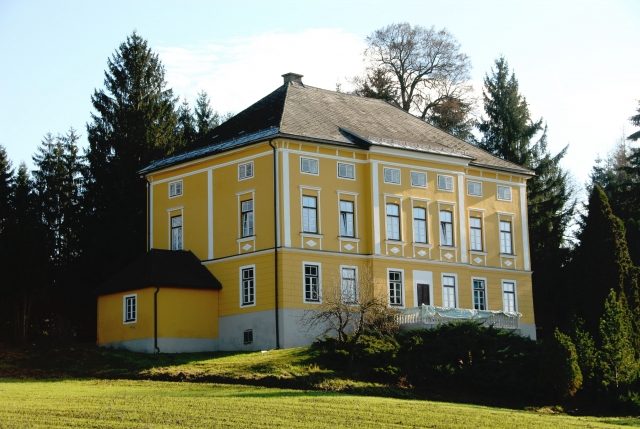
The history of Lind dates back to the 12th century, although at that time there was no mention of a fortified structure. The Abbey of St. Paul in Lavanttal owned two estates here. In 1256, a document from the Diocese of Salzburg first mentions a "castrum," referring to a fortified complex. In 1399, the Lords of Metnitz were enfeoffed with the estate. It was probably already a princely fiefdom at that time. Duke Frederick the Elder enfeoffed Oswald Mordax with Lind in 1433. In 1627, Christof Perger, Baron of Hollenburg, is mentioned as the feoffee. He is likely the builder of the current castle. However, it was altered several times in the following centuries. The owners during this period are unknown. In 1842, Ignaz von Schludermann came into possession of Lind. Under his family, the facades were renewed in the 19th century. In 1942, the castle was handed over to the German Resettlement Trust Company, but it sold it in the same year to Max Flora. The building remains in private ownership to this day and is inhabited. It is the center of an agricultural enterprise.
Lind Castle, also known as Riedenegg, is located on the left bank of the Drau, not far from the local railway bridge. It is a well-maintained three-story building under a high hip roof, now covered with Eternit shingles. The castle has no inner courtyard. The seven-axis main facade features a three-axis central risalit that projects only slightly from the front. A three-axis, pillar-supported portal porch is placed in front of it, serving as a carriage entrance on the lower level and a balcony on the first floor. The entrance in the center of the front is simple and striking, as is another entrance at the rear, which leads to a large terrace in front of the central risalit there. The facades are painted yellow. They are structured by white pilasters on the upper floors. The ground floor is rusticated. The large windows of the first floor, also framed in white, are provided with straight cornices. As the small transversely rectangular and oval windows of the attic floor show, this was probably originally used for storage purposes. The side fronts have only two window axes. In front of the castle are several agriculturally used buildings.
Take Mobile History with you
You are reading this text for free. Premium adds what matters on the road: descriptions read aloud, sites found through your camera, whole regions taken offline.
- Every description, including the ~17,700 Premium sites
- Audio guide: have descriptions read to you on location
- AR finder: see sites through your camera, with distance and bearing
- Unlimited saved sites
14 days free, then from €2.99 a month. Cancel anytime.
Source: Wikipedia · Licence: CC BY-SA 4.0 · Image: http://commons.wikimedia.org/wiki/File:Grafenstein_Lind_Schloss_Riedenegg_17112006_03.jpg
This description draws on the facts documented in the linked Wikipedia article; Wikipedia content is licensed under CC BY-SA 4.0. Wording and editing: Mobile History.
Location: 46.6149, 14.5180