Nursing home
CastleRhoden
Rhoden Castle
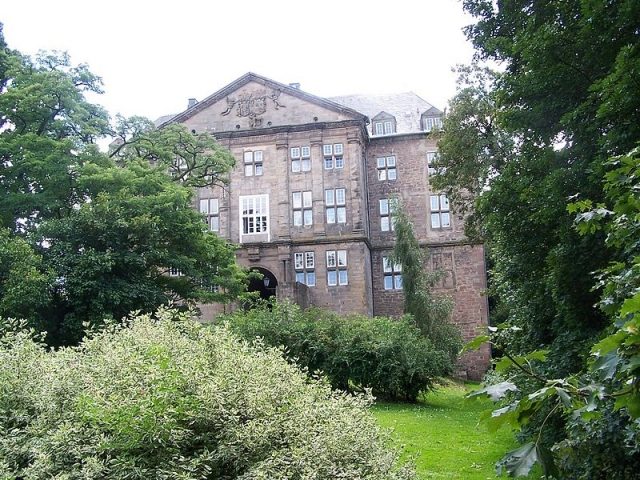
Rhoden Castle is an early Baroque castle with a former pleasure garden in the Rhoden district of Diemelstadt in the northern Hessian district of Waldeck-Frankenberg. Until 2011, the castle housed a nursing home.
Castle
At the beginning of the 13th century, the Counts of Schwalenberg were able to extend their influence to the Diemel. Rhoden presumably came into their possession as a Paderborn fief. To protect the town, a castle was built on the Hagenberg from 1228 to 1230. It was first mentioned in a document in 1237 by Count Adolf I of Waldeck and Schwalenberg as Rothem in Castro. Rhoden became the center of the northern territory of the County of Waldeck. Count Otto I of Waldeck had Rhoden further fortified. Whether he also built a new castle or fortified the existing one is not known. The castle was occupied by burgmannen, including a family from Rhoden. In 1294, the bishoprics of Cologne and Paderborn unsuccessfully protested against the fortification. In 1377, Count Heinrich IV of Waldeck pledged the town and castle of Rhoden to the knight Johann Raven. Subsequently, Rhoden remained pledged. Other documented owners were Kurt Spiegel zum Desenberg (1390), Landgrave Hermann II of Hesse (1398), and the Archbishopric of Mainz (1426), which appointed its own bailiffs. It was not until 1452 that Count Wolrad I of Waldeck succeeded in bringing Rhoden and the castle back into the possession of the County of Waldeck. In 1495, after the death of Count Otto IV of Waldeck zu Landau, inheritance disputes arose, leading to the division of the county in 1508: the Rhoden office, town, and castle each went half to the Eisenberg and Wildungen lines of the Waldeck counts.
Palace
Shortly before the end of the Thirty Years' War in 1645, Count and later Prince Georg Friedrich decided to renovate and expand the castle. The Dutch master builder Peter Jeanson was commissioned to erect the present palace on the foundations of the former castle, according to the plans of the French architect Belle-Roche. The work lasted from 1647 to 1654. Even during the construction period, a menagerie, an avenue towards "Stucks Forst", a water feature, and a hunting lodge were built in 1650. In 1651, a castle well 160 cubits (approx. 98 meters) deep and about three meters in diameter was dug. In 1655, a prison was built in the vault under the castle. Count Georg Friedrich used the castle as his residence after its completion. In 1664, after the death of his nephew Heinrich Wolrad, he moved it to Arolsen.
In 1786, Karl August Friedrich zu Waldeck-Pyrmont ceded the castle to his brother Georg I zu Waldeck-Pyrmont and his family. From 1787 to 1795, major renovations were again carried out for Prince Georg according to plans by C. Escher and under the direction of construction manager and building director Major Johann Matthias Kitz. The family lived in Rhoden Castle until their relocation to Pyrmont in 1806. After that, the castle was only occasionally used for residential purposes by the princely families.
Around 1800, the interior of the castle was again renovated under the direction of building director Johann Matthias Kitz. From 1817 to 1818, the castle's rooms were converted into official residences. The attic was used as a grain chamber for tax payments. In 1900, the building was converted by the Hannover-Linden Sick Fund into a recreation home for female teachers with 30 guest rooms.
From 1933 to 1936, it was used as the seat of the Reich Labor Service and as a Reich Labor Camp. Towards the end of the Second World War, some craft businesses and refugee apartments were located in the castle.
The structural interior design can be described as rather meager due to the many changes in use. Remains of the medieval building fabric are still clearly visible.
Hereditary Burial Site
In 1794, Hereditary Prince Georg zu Waldeck had the "Princely Hereditary Burial Site" with a mausoleum for the Princes of Waldeck built in the classical style on the western slope of the castle hill, in the castle park, for his children who died young. It still serves as a burial site for the descendants of the former princely house today. (Before 1794, the Waldeck counts and princes were buried in the St. Nicholas burial chapel in Waldeck-Netze).
Use as a Retirement Home+
On August 26, 1920, ownership transferred to the Free State of Waldeck-Pyrmont. After the Second World War, from 1948, parts of the castle were first used as a district retirement home. From 1978 to 1985, a complete renovation was carried out to enable continued use as a retirement and nursing home. On October 1, 2008, the Waldeckische Diakonissenhaus Sophienheim Bad Arolsen took over the district-owned retirement and nursing homes in Flechtdorf (see: Landeshospital and the retirement home) and Rhoden. Today, the Waldeckische Domanialverwaltung is the owner of the building.
In 2010, a fundamental and comprehensive modernization of the castle was discussed in order to operate the existing retirement home profitably. The costs for this were estimated at approximately 8.1 million euros. The district council of the district of Waldeck-Frankenberg, which is the trustee of the Waldeck domain assets, was to decide in December 2010 whether the renovation would be carried out. As possible alternatives, vacancy or the sale of the castle were also considered.
Due to persistent deficits and a likely further deteriorating economic situation, a closure as of July 31, 2011, was surprisingly announced. At that time, this had not yet been definitively communicated by the operator, and a renewed operation after a renovation by the Waldeckische Domanialverwaltung was considered possible. On November 30, 2011, the operator announced that the retirement home would not reopen and would be returned to the Domanialverwaltung as owner at the end of the year.
Take Mobile History with you
You are reading this text for free. Premium adds what matters on the road: descriptions read aloud, sites found through your camera, whole regions taken offline.
- Every description, including the ~17,700 Premium sites
- Audio guide: have descriptions read to you on location
- AR finder: see sites through your camera, with distance and bearing
- Unlimited saved sites
14 days free, then from €2.99 a month. Cancel anytime.
Source: Wikipedia · Licence: CC BY-SA 4.0
This description draws on the facts documented in the linked Wikipedia article; Wikipedia content is licensed under CC BY-SA 4.0. Wording and editing: Mobile History.
Location: 51.4748, 9.0076