Nursing home
CastleBad Bellingen - Rheinweiler
Rheinweiler Castle
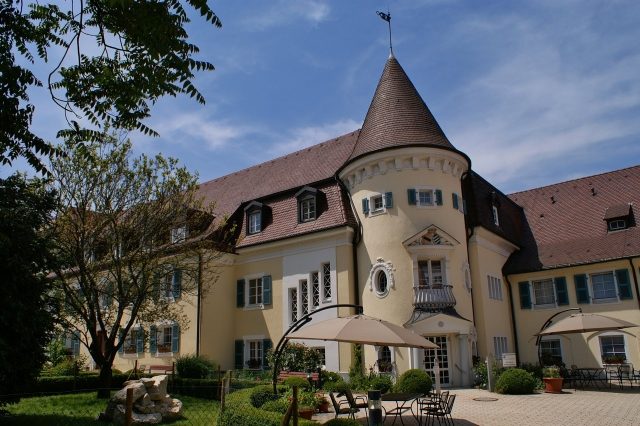
On April 24, 1417, the knight Hans Ludemann von Rotberg, with feudal approval from the Emperor, purchased, among other things, the castle (Schloss) and castle site at Rheinweiler, including fields, meadows, vineyards, and other associated rights and fiefs, from the Provost of St. Alban's Monastery in Basel. At that time, it consisted of a residential building, chapel, farm buildings, herb and fruit garden, and was surrounded by a wall and moat. The remains of the wall, still visible today behind the "Sternen" inn, likely belonged to the foundations of this castle (Schloss).
The castle is said to have had 365 windows. It was burned down and destroyed by the French in 1676. The burned-down castle was divided in 1685 between Bernhard von Rotberg on one side, and Georg (Johann) Jakob Christoph von Rotberg and his brothers Ernst Friedrich and Franz Daniel von Rotberg on the other.
In 1715, two simple buildings were erected side-by-side on the site of the old castle. Due to devastation and quartering in connection with Napoleon I's campaigns, the Rheinweiler castle estate was extraordinarily indebted at the beginning of the 19th century. The hardship became an almost unbearable burden when, in 1813, the lord of the castle and estate, Baron Friedrich August von Rotberg, died, and his wife, Baroness Pauline Waldner von Freundstein, had to fight alone with nine children to preserve the family property. Salvation came through the marriage of General Count Johann von Rapp on January 12, 1816, to the daughter of the castle lord who died in 1813, Baroness Albertine Charlotte von Rotberg. General Count Johann von Rapp took over the castle estate on August 9, 1817, for 121,165 francs, saving it for the family property. In 1908, the two separate buildings were connected by a "round" connecting structure.
The district of Lörrach acquired the castle on April 24, 1928, and converted it into a retirement home. In 1939, the responsibility for the home transferred to the district of Müllheim. In 1940, the district retirement home acquired an agricultural operation. Due to hostilities, the home had to be evacuated. The castle suffered severe damage from artillery shelling. At the beginning of 1944, the residents returned and had to be evacuated again in November 1944. In 1945, the residents returned again.
In 1951, the roof and exterior facade were renewed, and the destroyed outbuilding was rebuilt. In 1955, the agricultural operation had to be sold again, as the costs of management were disproportionate to the yield. From 1965 onwards, the interiors were systematically renovated. In the course of the district reform in January 1973, the home reverted to the district of Lörrach.
From 1974-78, the castle underwent fundamental renovation. As of January 1, 1998, the nursing homes of the district of Lörrach in Weil am Rhein, Wiechs, and Rheinweiler were organized as an independent enterprise, "Pflegeheime des Landkreises Lörrach". From October 1998 to December 1999, a further renovation of the nursing home took place, and it resumed normal operations on February 5, 2000.
Today, the Schloss Rheinweiler nursing home has 45 single rooms and 6 double rooms, with an expansion to 68 care places planned. Additional services offered include day care, outpatient services, and meals on wheels.
Take Mobile History with you
You are reading this text for free. Premium adds what matters on the road: descriptions read aloud, sites found through your camera, whole regions taken offline.
- Every description, including the ~17,700 Premium sites
- Audio guide: have descriptions read to you on location
- AR finder: see sites through your camera, with distance and bearing
- Unlimited saved sites
14 days free, then from €2.99 a month. Cancel anytime.
Source: Wikipedia · Licence: CC BY-SA 4.0 · Image: http://de.wikipedia.org/wiki/Datei:Schloss_Rheinweiler_1.JPG
This description draws on the facts documented in the linked Wikipedia article; Wikipedia content is licensed under CC BY-SA 4.0. Wording and editing: Mobile History.
Location: 47.7107, 7.5324