To be privately owned
CastleRhäzüns
Rhäzüns Castle
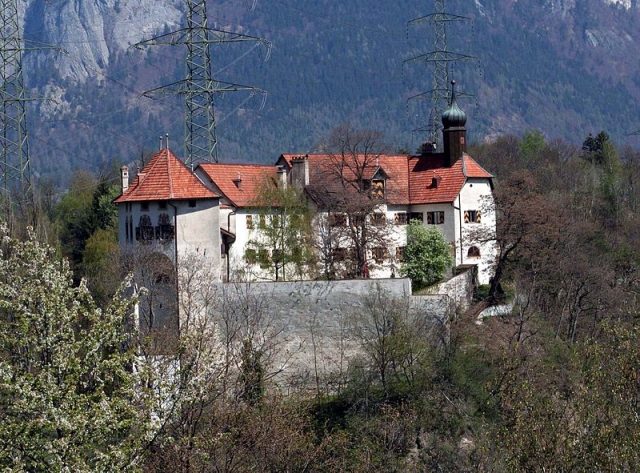
Rhäzüns Castle is located in the east of the municipality of Rhäzüns in the canton of Graubünden. The castle is situated on the lower course of the Hinterrhein, before its confluence with the Vorderrhein, on a prominent plateau of moraine debris, 65 m long and 25 m wide. To the east, the terrain slopes steeply towards the Rhine. Access via the artificially widened moat is gained from the southwest over a dam built around 1700. The original access was either via a bridge or a steep ramp.
The main buildings lean against the inside of a curtain wall running from north to south. The wall extends into open space at its ends and once enclosed a larger complex. The east side is bounded by a weaker wall with loopholes for firearms from the 16th century.
The actual building complex consists of two rectangular residential wings and the chapel wing at the northwest corner. The northern wing, with murals depicting motifs from the Tristan saga, dates from the second half of the 14th century. Doors, windows, and the roof are from the 16th century or later. The elongated intermediate wing was built in the late 16th century under Johannes Planta von Wildenberg. An inscription above the door of the central wing and his coat of arms with initials and the year 1592 on the outer wall facing the courtyard commemorate Planta's building activity. Johannes Planta was beheaded in 1572 during a popular court.
A final major expansion phase dates from around 1700, when the outer gatehouse and the chapel wing were built. However, a chapel seems to have existed before, as a castle chaplain is mentioned in 1396. The tiled roof is modern. Major renovations took place in 1927/28.
From the topography of the hill, it can be concluded that large parts of the original complex must have collapsed. Documents from the 16th century confirm the demolition of a precarious round tower at the outermost edge of the terrain towards the Rhine.
Significant alterations were made in the second half of the 16th century. In 1553, the northern main tower was demolished, and perhaps at the same time, the eastern part was abandoned and the current eastern wall was erected. The interior of the castle is largely post-medieval.
When the complex, or its predecessor buildings, were erected is unknown. Presumably, a castle already existed on the site of the present castle in the 10th century; in documents of Emperors Otto I and Otto II, a castellum Beneduces et Rezunnes is mentioned in the years 960 and 976.
The first verifiable representative of the Barons of Rhäzüns was Arnoldus de Ruzunne, who is mentioned in the Gamertingen documents in 1137/39. The first documentary mention of Rhäzüns Castle itself appears in a sales document of Disentis Monastery from 1282. After the death of the last Rhäzünser, Georg, in 1459, a long succession dispute arose between the Counts Hohenzollern-Hechingen von Zollern and the Werdenbergers. In 1461, the castle fell to the Zollern by arbitration, who pledged it to Conradin von Marmels in 1437. Through an exchange for the lordship of Haigerloch, it came into the possession of Maximilian I in 1497, as he was interested in a strategically important location. However, the Marmels remained the pledge holders and carried out various extensions to the castle; for example, prisons and bathhouses were installed. During the Swabian War, Rhäzüns was occupied by the Graubünden in May 1499, but returned to the Marmels after the peace treaty.
After the death of Hans von Marmels in 1553, Rhäzüns changed hands several times until 1695. Bartholomäus von Stampa followed as pledge holder, and in 1558 Johannes von Planta, later through marriage his daughter Anna to her husband Rudolf von Schauenstein, then to her brother Johann von Planta. In 1674, it was in the pledge possession of Johann Travers von Ortenstein.
In 1695, Austria took possession of the lordship and had it administered by officials. This prevented the integration of the lordship of Rhäzüns into the politics of the Three Leagues. On December 29, 1810, the lordship passed from Austria to France. After the collapse of the Napoleonic Empire, Rhäzüns returned to Austria in 1814 and was assigned to the canton of Graubünden at the Congress of Vienna in 1815. The ceremonial handover to the canton took place on January 19, 1819, in the Landrichter's Hall at Rhäzüns Castle. The sovereign rights of the municipalities passed to the canton, and the castle became private property.
It was acquired by the last Habsburg administrator, the doctor and Landrichter Georg Anton Vieli. It remained in his family's possession until 1927. In the early 1850s, Father Theodosius Florentini established a girls' school there, which was moved to Rorschach in 1854. After the tenant of the estates had lived there, the castle stood empty and began to decay.
On December 11, 1926, it was bought by the "Gemeinnützige Genossenschaft für Auslandschweizer Ferienheim Rhäzüns" (Non-profit Cooperative for Swiss Abroad Holiday Home Rhäzüns) and extensively renovated. In 1929, with the participation of "Pro Campagna," a Swiss organization for the preservation of rural building and living culture, a holiday camp for Swiss abroad was held. Due to the outbreak of the war, these camps became impossible, and the castle returned to the possession of the Vieli family in 1942. Today, the castle is owned by Ems-Chemie AG and leased for life by Swiss politician Christoph Blocher.
Take Mobile History with you
You are reading this text for free. Premium adds what matters on the road: descriptions read aloud, sites found through your camera, whole regions taken offline.
- Every description, including the ~17,700 Premium sites
- Audio guide: have descriptions read to you on location
- AR finder: see sites through your camera, with distance and bearing
- Unlimited saved sites
14 days free, then from €2.99 a month. Cancel anytime.
Source: Wikipedia · Licence: CC BY-SA 4.0
This description draws on the facts documented in the linked Wikipedia article; Wikipedia content is licensed under CC BY-SA 4.0. Wording and editing: Mobile History.
Location: 46.7984, 9.4032