To be privately owned
CastleDippoldiswalde - Reichstädt
Reichstädt Castle
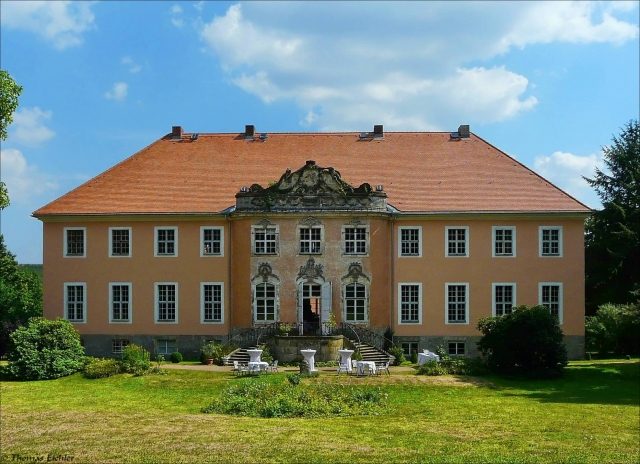
Reichstädt Castle is located in the center of Reichstädt, a district of Dippoldiswalde, about 20 km south of Dresden.
The origins of the castle go back to a knight's estate, which probably existed in Reichstädt since the 13th century. A manor house of the Lords of Reichenstadt was already mentioned in 1336. In 1503, it was acquired by the mining lord Sigismund von Maltitz, who gained wealth in 1507 through the invention of the wet stamp mill. Under his descendant Heinrich von Maltitz, the knight's estate was converted into a moated castle in 1535. The East Wing, built in the Renaissance style with its round tower, bears witness to this conversion. However, little information is available from this phase of the castle's history. A survey map from 1570 merely shows that the complex consisted of a collection of two-story buildings surrounded by a moat.
In 1569, the estate came into the possession of the Saxon Elector August I, who used it as a hunting lodge. During the Thirty Years' War, the castle and estate were partially destroyed in 1632 by troops of Heinrich von Holk. From 1639, reconstruction took place under the court marshal and district governor Heinrich von Taube, who received the complex as a gift from Elector Johann Georg I. In 1682, the castle passed into the possession of the Nostitz family through sale. In 1717, Gottlob von Nostitz sold Reichstädt Castle to his sister Charlotte Christiane von Nostitz, the wife of Caspar Abraham von Schönberg (1680–1763) of Maxen and Wittgensdorf. Thus, Reichstädt came into the hands of the well-known Saxon noble family von Schönberg, who owned the castle until their expropriation and expulsion by the communists in 1945 and have owned it again since 1998.
During the Seven Years' War, the castle suffered significant damage again. In the year the war ended, Reichstädt came into the possession of the Postmaster General Adam Rudolph von Schönberg, who had it expanded into a Baroque complex with a park between 1765 and 1776. The individual building parts were combined to form a four-wing complex. The western part of the moat was filled in to create a flowing transition to the park area. Inside, Reichstädt received elaborate Rococo furnishings. A bronze bust erected in the castle courtyard commemorates Adam Rudolph von Schönberg. Reichstädt Castle was inherited further within the line of Adam Rudolph von Schönberg. Since he received Purschenstein Castle as an inheritance in 1772, he and his descendants only lived in Reichstädt temporarily. Under Caspar Hugo von Schönberg (1833-1890), the Baroque castle park was partially transformed into a rural landscape park. In 1858, he also had the memorial stone to Adam Rudolph von Schönberg erected.
During the Second World War, Reichstädt Castle also served as an evacuation site for art treasures and housed, among other things, parts of Heinrich von Brühl's Swan Service. In May 1945, Soviet soldiers devastated the valuable interior furnishings of the castle. The last owners, Hans and Margarete von Schönberg, were expropriated by the Soviet occupation forces as part of the land reform, so they left for the western occupation zones in October 1945, leaving behind all their possessions. The monument to Adam Rudolph von Schönberg was also removed.
In the following decades, the castle was used for cultural purposes, including as a kindergarten, school, pioneer and cultural center, and as a residential building. For the new uses, significant internal alterations were made, but externally the castle remained preserved in its basic substance. After the fall of the Berlin Wall, the complex stood empty for a time before it was acquired in 1998 for a purchase price of 30,000 DM by Dr. Ilse von Schönberg, thus returning to the possession of the von Schönbergs.
With the reacquisition, the gradual renovation of the structurally valuable complex began, which is currently not yet completed but is already well advanced. Meanwhile, about 60% of the castle has been renovated with an investment of approximately 2 million € (as of spring 2015). In the course of the renovation, valuable Baroque secco paintings and painted wooden beam ceilings from the Renaissance were uncovered, among other things. Parts of the castle premises are available to the public for events and overnight stays.
Famous people at Reichstädt Castle+
- Prince Henry of Prussia (1726–1802), used the castle as quarters in 1748
- Prince Charles of Saxony (1733–1796), lived in Reichstädt for a time after his forced abdication as Duke of Courland and Semigallia in 1763; the castle's interior was elaborately furnished for him from 1765 onwards
- Tsar Alexander I (1777–1825), took up quarters in the castle in August 1813 during a campaign in the course of the Wars of Liberation, together with his adjutant general Jean-Victor Moreau
Take Mobile History with you
You are reading this text for free. Premium adds what matters on the road: descriptions read aloud, sites found through your camera, whole regions taken offline.
- Every description, including the ~17,700 Premium sites
- Audio guide: have descriptions read to you on location
- AR finder: see sites through your camera, with distance and bearing
- Unlimited saved sites
14 days free, then from €2.99 a month. Cancel anytime.
Source: Wikipedia · Licence: CC BY-SA 4.0 · Image: Thomas Eichler
This description draws on the facts documented in the linked Wikipedia article; Wikipedia content is licensed under CC BY-SA 4.0. Wording and editing: Mobile History.
Location: 50.8827, 13.6363