EBS Business School at EBS University of Economics and Law
CastleOestrich-Winkel
Reichardshausen Castle
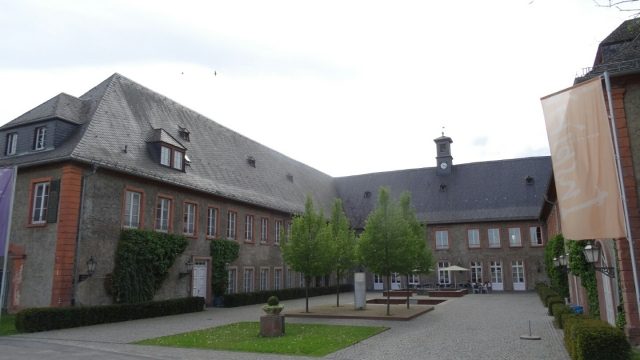
Schloss Reichartshausen is located in Oestrich-Winkel in the Rheingau (Hesse) and has housed the EBS Business School of EBS University of Business and Law since 1980.
Schloss Reichartshausen is surrounded by vineyards between Oestrich and Hattenheim on the old east-west road through the Rheingau ("Rheingaustraße", L 3320) near the Rhine bank, separated from it only by the federal highway 42, which has been expanded into a bypass road.
Reichartshausen, with its associated vineyard Pfaffenberg, was for centuries, since 1152, a wine estate and the largest transshipment and storage point for the wine of the nearby Eberbach Monastery. The estate had a harbor from which the annual journey to the monastery's Cologne city estate took place. The journey to Cologne was the central event in the monastery's economic year. After the devastations of the Thirty Years' War, Abbot Hermann Hungrighausen had the U-shaped complex built in its present form between 1737 and 1740, replacing the old estate, to serve as a second residence.
After the monastery's dissolution in 1803 as a result of the Reichsdeputationshauptschluss, the estate initially became the property of the House of Nassau-Usingen. In 1804, Friederike von Anhalt-Köthen, daughter of the Duke of Nassau, had the estate redesigned in the Neoclassical style by the Wiesbaden city planner Carl Florian Goetz. Friederike's mother, Duchess Louise von Waldeck, received Reichartshausen as a gift from her husband in 1807. After her death, Erwein Graf von Schönborn acquired the property, now referred to as a castle, along with the vineyard in 1817. He had the buildings extended and a landscape park laid out extending to the Rhine. In 1873, the buildings were sold to Countess Louise von Benckendorff, née Croÿ, lady-in-waiting to Marianne of Prussia, while the Pfaffenberg remains in the possession of the Schloss Schönborn winery to this day. From 1889, procurator August Wilhelmj converted the estate into a winery using the latest technical knowledge and made it the center of his world-famous wine trade. He had the inner courtyard covered as a cellar with a terrace and grand staircase, redesigned the park, and had the artificial ruin, which concealed a water tower inside, its own power plant, and the farm buildings constructed.
After further changes of ownership, the company Fritz Werner Werkzeugmaschinen, which was the largest employer in the Rheingau with its machine factory in nearby Geisenheim, was the owner from 1970 to 1980 and restored the property for representative purposes. Essentially, the forms from 1740 were restored. During this period, in 1971, the building known as the Burmese Teahouse was erected. It was a gift from the Burmese government to the company. It represents a copy of the entrance hall of the royal palace of Mandalay, which had been made for the 1967 World Exhibition in Montreal, and at that time became the property of MAN Ferrostaal Industrieanlagen GmbH.
With the exception of the teahouse, for which a separate plot of land had been created, EBS took over the property and expanded the building ensemble in 2000 with the Walter-Leisler-Kiep Center.
Take Mobile History with you
You are reading this text for free. Premium adds what matters on the road: descriptions read aloud, sites found through your camera, whole regions taken offline.
- Every description, including the ~17,700 Premium sites
- Audio guide: have descriptions read to you on location
- AR finder: see sites through your camera, with distance and bearing
- Unlimited saved sites
14 days free, then from €2.99 a month. Cancel anytime.
Location: 50.0119, 8.0503