Conference center
Educational Institution
CastleKloster Lehnin - Reckahn
Reckahn Castle
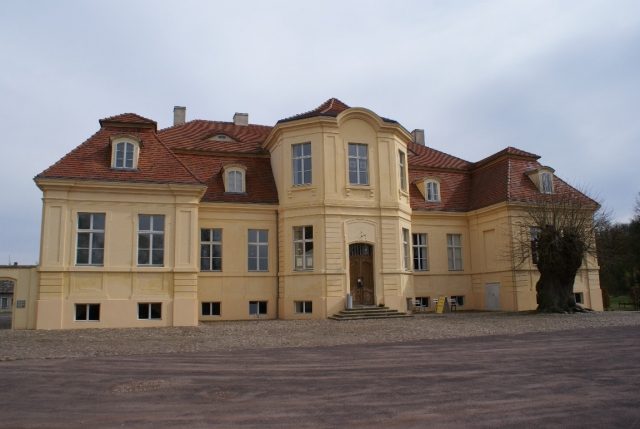
Reckahn Castle, also known as Reckahn Manor, is located in the village of Reckahn, a district of the municipality of Kloster Lehnin in the Potsdam-Mittelmark district in Brandenburg. It lies about ten kilometers south of the city of Brandenburg on the banks of the Plane river.
A section of the castle houses the Rochow-Museum Reckahn, opened in 2001, with a permanent exhibition on the work of the von Rochow family and particularly the school reformer and most famous lord of Reckahn Castle, Friedrich Eberhard von Rochow. Furthermore, the castle is now used as a meeting, conference, and training center by the University of Potsdam.
Part of the Rochow-Museum is the former Reckahn school, which today houses the Reckahn School Museum. It also showcases the work of Friedrich Eberhard von Rochow and honors the first Reckahn teacher Heinrich Julius Bruns with a permanent memorial exhibition.
The Castle+
Development up to the 17th Century
The Reckahn estate belonged to the extensive possessions of the widely branched von Rochow family, one of the oldest noble families in the Margraviate of Brandenburg. In 1351, Reckahn was named as a possession of the von Rochow family under the designation Rickan in a feudal letter from Golzow. At that time, there was a fortified site called Dusterreckahn, about one kilometer from the present castle, which was probably the family seat. This complex was destroyed by 1420 at the latest.
A late medieval predecessor building of the current castle structures is presumed at the site of the present castle. It was not until 1605 that the so-called "old manor house" with a Renaissance gable was built. It was erected for Tobias von Rochow by an unnamed architect from Wittenberg. This building is now located north of the later Baroque building. After the construction of the new manor house, it continued to be used by the family and was referred to as the estate house.
Heyday in the 18th Century
In 1713, Friedrich Wilhelm von Rochow, later the Prussian Minister of War, took over the estates of Reckahn, Meßdunk, Goltin, Rotscherlinde, and Krahne. Between 1726 and 1730, Friedrich Wilhelm had the present castle, largely unchanged externally, built by an unknown architect in the Schlüter Baroque style. At the same time, a Baroque ornamental garden was probably created on the east side of the house.
The unusual plastered building is an approximately 30-meter-long, single-story three-wing complex with stub wings projecting from the facade on both sides, under a mansard roof.
Its architectural peculiarity is a two-story central section, highlighted like a Corps de Logis, which houses the entrance portal and staircase on the courtyard side, and the two halls on the garden side.
The facade, extending over 11 window axes, is subtly structured by rustication, plastered pilasters, string courses, plinth cornices with consoles, etc.
Far greater fame than Friedrich Wilhelm was achieved by his son Friedrich Eberhard von Rochow, who took over the estate in 1760. He gained renown through his agrarian and, above all, pedagogical reforms, as well as his literary and enlightenment activities. As a canon of Halberstadt, he had contact with the intellectual circle around Johann Wilhelm Ludwig Gleim and associated with personalities such as Christian Fürchtegott Gellert, Friedrich Nicolai, Johann Bernhard Basedow, and the Prussian Minister of Interior von Zedlitz.
Friedrich Eberhard von Rochow earned particular merit with the reform of his rural schools. Among his numerous writings, his "Kinderfreund, Ein Lehrbuch zum Gebrauch in Landschulen" (Children's Friend, A Textbook for Use in Rural Schools) achieved European renown. He had a monument erected in the castle park for his Reckahn teacher Heinrich Julius Bruns. The Rochow-Museum Reckahn in the castle and the restored schoolhouse is dedicated to the work of this man. Friedrich Eberhard von Rochow also began converting the pleasure garden into a "Thiergarten" (animal park), used as a game enclosure, and an orchard. In the 19th century, it was transformed into the "English" landscape park, which was restored after the fall of the Berlin Wall.
Further Development
Since Friedrich Eberhard died childless, the estate fell to a community of heirs from family members in 1805. However, members of the family continued to inhabit and manage the Reckahn estate until 1945. The last lord of the manor was Friedrich Leopold Harry von Rochow, who died in 1945. The last resident from the family was Felicitas von Rochow.
In 1945, the castle was used as accommodation by the Red Army, and under military administration, the von Rochow family's property was expropriated in 1946. The soldiers withdrew in 1946. The castle inventory, apart from a few remnants, is no longer present. The estate's archive was largely preserved and is now located in the Brandenburgisches Landeshauptarchiv in Potsdam.
After the soldiers' withdrawal, the manor house, initially structurally unchanged, was immediately used as a school. The old estate house and a former stable were converted into residential buildings, and the remaining farm buildings were demolished, so that the original character of a country estate is no longer recognizable today. Inside the manor house, typical GDR "functional modernizations" were later carried out. In particular, specialized classrooms for the school were created, and central heating was installed.
After the school closed in 1996 and the after-school care center in 1998, the house was restored. Some rooms, especially the staircase, were recreated to resemble their original state, and the exhibition rooms were redesigned in a museum-like fashion. Since August 4, 2001, the permanent exhibition "Vernunft fürs Volk – Friedrich Eberhard von Rochow" (Reason for the People – Friedrich Eberhard von Rochow) has been the core of the Reckahn Castle Museum. It honors the life's work of the reformer in many fields, not only in the school system of the Kingdom of Prussia.
Current Use of the Castle+
In mid-1999, the current usage concept for the castle was developed: the castle, church, and schoolhouse form an ensemble of school and educational history in Brandenburg and Prussia. The following collaborate on this: the State of Brandenburg, the Potsdam-Mittelmark district, the Förderverein Historisches Reckahn (Historical Reckahn Support Association), and the University of Potsdam.
Rochow-Museum Reckahn
A section of the castle was prepared as a museum and opened in 2001 under the name Rochow-Museum Reckahn. The museum features a permanent exhibition titled "Vernunft fürs Volk" (Reason for the People), which is dedicated to the von Rochow family and especially to the work of the agricultural and educational reformer Friedrich Eberhard von Rochow.
The tour begins in the garden hall. Here, four busts illustrate who was instrumental in these reforms:
A recreated conversation between these four individuals introduces the visitor to the topic. The work of the agricultural reformer is presented in two rooms, and four rooms are dedicated to the pedagogical work.
Meeting, Conference, and Training Center
Several rooms in the castle are now available as a meeting, conference, and training center for the University of Potsdam. These include: a conference and concert hall for approx. 60 people, a foyer for break discussions etc., four group rooms for 15–25 people each, and a café. If required, these rooms can also be extended to include some of the collection rooms.
The University of Potsdam uses the Reckahn meeting center for scientific conferences, retreats, doctoral colloquia, seminars, and university further education, as well as for selected academic festivities.
The Castle's Surroundings+
The castle is located on the northern edge of the village of Reckahn. In the square in front of the castle stands a war memorial commemorating the fallen of both World Wars.
A war memorial of a special kind is the Reckahn Pyramid. It was probably erected under Friedrich Eberhard von Rochow. A commemorative plaque from 1760 states: "In memory of the great military camp under Frederick the Great to the irreplaceable damage of the surrounding estates of 29,247 thalers."
The monument and the plaque inscription refer to the large military camp that Prussian troops had set up between Reckahn and Göttin in 1741. The camp, which at its peak is said to have numbered over 40,000 men, led to great destruction in Reckahn and the surrounding area. However, the king never compensated for the damages. The commemorative plaque, which had been missing since the end of World War II, was renewed and reattached to the pyramid in 1992.
Another commemorative plaque on the pyramid, since 1907, commemorates the formation of Hussar Regiment No. 5 – The Black Hussars. This unit under Major von Mackrodt was formed in September 1741 in the large military camp.
South and east of the castle lies the castle park, considered one of the oldest landscape parks in Brandenburg. At the southern end of the park, in a visual axis to the castle, stands the castle and village church. Behind the church is the historic schoolhouse, today the Reckahn School Museum.
The Castle Park
With the new castle construction around 1730, the three-hectare park was also created as a Baroque garden. Further design took place around 1800 under Friedrich Eberhard von Rochow. At this time, the park was also referred to as a "Thiergarten" (animal park), and an orchard was laid out. A landscape garden in the English style was created. This state was restored after 1990.
To the west and south, the park is bordered by the Plane river. A bridge at the southern end leads to the village and castle church. In the west of the park, a ditch connected two carp ponds with the Plane. This ditch was crossed by a curved wooden bridge. The ditch and ponds were filled in 1963 during the regulation of the Plane and for the benefit of a new fish farm near Reckahn.
In the south of the park is the monument to Heinrich Julius Bruns. With the words "He was a teacher," it commemorates the practitioner of school reform.
Between 1898 and 1910, a family burial site for the von Rochow family was erected in the park. 14 family members were buried here until 1945. The building is in need of renovation.
The Village and Castle Church
The village and castle church, quite large for the village of Reckahn, was built between 1739 and 1741. Its external appearance and especially its interior furnishings largely correspond to their state at the time of construction.
School and School Museum
Next to the church is the schoolhouse from 1743. It is now a school museum and a memorial to the school reformer Friedrich Eberhard von Rochow, which also very vividly documents school equipment and daily school life up to the recent past. The school museum also dedicates itself to the work of the first Reckahn teacher Heinrich Julius Bruns and honors him with a permanent exhibition.
Take Mobile History with you
You are reading this text for free. Premium adds what matters on the road: descriptions read aloud, sites found through your camera, whole regions taken offline.
- Every description, including the ~17,700 Premium sites
- Audio guide: have descriptions read to you on location
- AR finder: see sites through your camera, with distance and bearing
- Unlimited saved sites
14 days free, then from €2.99 a month. Cancel anytime.
Source: Wikipedia · Licence: CC BY-SA 4.0 · Image: Roland Neubert, Halle (Saale)
This description draws on the facts documented in the linked Wikipedia article; Wikipedia content is licensed under CC BY-SA 4.0. Wording and editing: Mobile History.
Location: 52.3370, 12.5399