To be privately owned
CastleSigmaringendorf
Ratzenhofen Castle
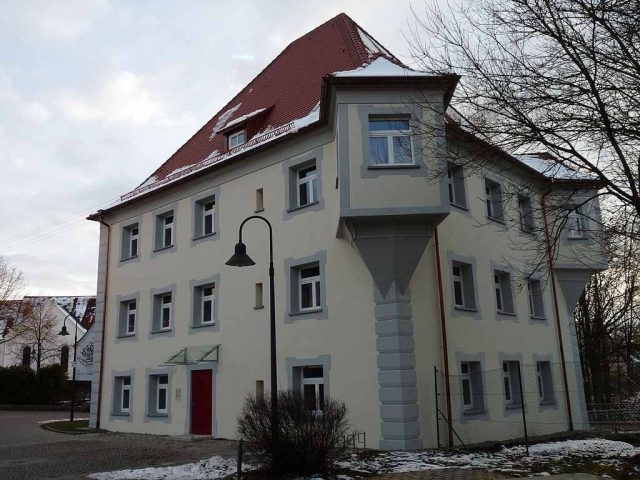
The Schlössle Ratzenhofen, also known as Schlösschen Ratzenhofen or simply the Schlössle, is a Hohenzollern castle in Sigmaringendorf in the district of Sigmaringen, Baden-Württemberg (Germany).
The Schlösschen Ratzenhofen is located in the town center, near the school and church at the Lauchert bridge in Sigmaringendorf. The Schlössle is likely the remains of a settlement to the left of the Lauchert near its confluence with the Danube.
In the chronicle of Sigmaringendorf, the building is first mentioned in 1542, but is likely significantly older. As early as 1171, a Konrad de Ratzenhofen is mentioned, but his connection to the building is unclear.
In 1542, Felix von Honburg zu Langenstein sold it to the chief bailiff of Jungnau, Wolfgang Honburger. Since he required the consent of his wife Agatha, born von Friedingen, for this transaction, the Schlössle was probably a dowry and thus originally in the possession of the Lords of Friedingen, who also owned Hohenfriedingen Castle. In 1577, Leonhard Ratzenhofen bought the building, and since then it has retained this nickname.
On April 22, 1589, the Schlössle first came into the possession of the Princely House of Hohenzollern-Sigmaringen, when it was purchased by Count Karl II of Hohenzollern-Sigmaringen. His successor, Count Johann, established a mint in the building and had, among other things, three-kreuzer coins produced there.
In 1633, the Schlössle Ratzenhofen was partially destroyed by Swedish troops in the Thirty Years' War, but was quickly rebuilt and already inhabited again before 1660, as baptisms were already being held there in that year. The Schlösschen was acquired by purchase in 1727 by rent master Baptist Schmid and in 1760 by Hereditary Prince Karl Friedrich von Hohenzollern-Sigmaringen (1724–1785), the later Prince of Hohenzollern-Sigmaringen.
In 1903, the municipality of Sigmaringendorf finally acquired the Schlössle and converted it for school purposes over the next four years. Initially, the building housed teacher's apartments and in 1907 temporarily a guesthouse after the Hirsch burned down. Eventually, classrooms were set up in it, and until 2008, students of the primary and secondary school of Sigmaringendorf received instruction here. It alternately housed different groups, especially during the Second World War. After the war, residents displaced from their homes lived in it, and even years later, the building was used for residential purposes. After the closure of the secondary school in Sigmaringendorf, the rooms in the Schlössle were made available for use by local associations.
After the list of defects on the Schlössle building had grown longer and longer and the plaster was crumbling everywhere, the municipal council decided in 2008 to subject the Schlössle to a thorough exterior renovation. The work was carried out in agreement with the State Office for Monument Preservation. The total costs amounted to 218,000 Euros. Funds from the state renovation program were also available for its financing. The building received a new roof skin and new roofing, and sheet metal work was also due. Several thermal insulation measures were necessary, such as the ceiling above the second floor insulated with modern technology. The entire house is now encased and plastered with thick full thermal insulation, and the more than 50 windows have been replaced with insulating glass windows. In keeping with the building type, the facade was painted in a reconstructed Renaissance style in consultation with the State Office for Monument Preservation. The outdoor facilities have also been renewed.
Layout+
Ratzenhofen is a three-story complex with an almost square floor plan, a steep hip roof, and two corner oriel windows. The Schlössle is surrounded on three sides by the school grounds of the Sigmaringendorf Donau-Lauchert School, to whose school buildings it belonged until 2008. To the west, the Lauchert flows directly past the building.
Inside, there are mainly rooms that were used by the school as classrooms. In the attic, there is also a costume storage for the Waldbühne Sigmaringendorf.
At the height of the Schlössle, an old mill canal branches off from the course of the Lauchert, where a pan forge belonging to the Schlössle was operated from 1662 onwards.
Take Mobile History with you
You are reading this text for free. Premium adds what matters on the road: descriptions read aloud, sites found through your camera, whole regions taken offline.
- Every description, including the ~17,700 Premium sites
- Audio guide: have descriptions read to you on location
- AR finder: see sites through your camera, with distance and bearing
- Unlimited saved sites
14 days free, then from €2.99 a month. Cancel anytime.
Source: Wikipedia · Licence: CC BY-SA 4.0
This description draws on the facts documented in the linked Wikipedia article; Wikipedia content is licensed under CC BY-SA 4.0. Wording and editing: Mobile History.
Location: 48.0671, 9.2635