Uninhabited
CastleRathsmannsdorf
Rathsmannsdorf Castle
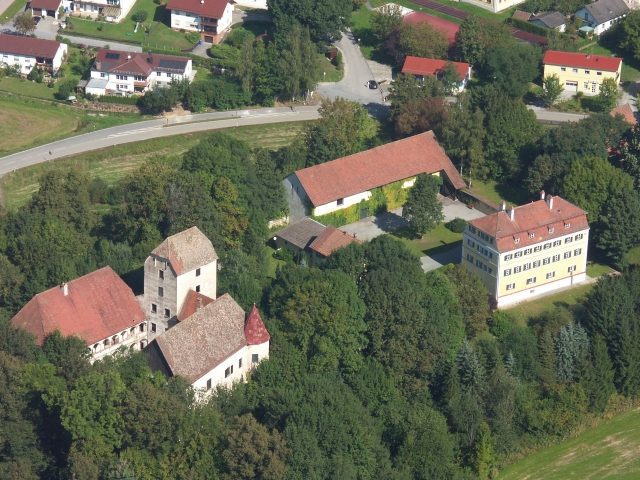
Rathsmannsdorf Castle (also: Rathsmannsdorf Palace) is a 14th-century or earlier castle complex, abandoned to decay, located at the southern entrance to Rathsmannsdorf in the market town of Windorf.
Beginnings of the Castle
The history of Rathsmannsdorf Castle's origins is unknown: A first confirmed mention of the originally three-winged complex with a castle core, tower, and castle wall can be traced back to around the year 1400. At that time, an extensive expansion also took place with various outer and moat systems, a Zwinger, round towers, and a weir, to increase the castle's defensibility in turbulent times. From 1449, the complex came into the possession of the Bishops of Passau. The years 1578/79 were decisive for the castle's still prevailing appearance, when Prince-Bishop Urban von Trennbach had the complex converted into a four-winged Renaissance palace. The south wing, the arcades, and the entrance portal were built during this construction period.
Gradual Decline
In 1763, under Prince-Bishop Leopold Ernst Graf von Firmian, a final comprehensive renovation of parts of the castle complex took place. After secularization, the palace came into the possession of the Bavarian state in 1803 and initially remained uninhabited for a longer period. From then on, the unstoppable decline, which continues to this day, began due to misuse and neglect.
In the 19th century, the complex changed owners several times before it was sold to the local innkeeper Seidl. His son-in-law Wilhelm von Ruffin established a brewery in the castle in 1850. During the renovation work, the south wing was destroyed, the arcades were partially demolished, and the chapel, decorated with art-historically valuable Renaissance paintings, was disfigured by a reinforced concrete ceiling. From 1911 to 1989, the Counts of Preysing were the lords of Rathsmannsdorf Castle. During this period, some buildings were still partially inhabited and were therefore maintained provisionally.
Division of the Property
After the death of Countess von Preysing, who inhabited the manor house of the outer bailey until 1989, the property was divided: The well-preserved manor house with stable building and park, last renovated in 1990 – also known as Ruffin-Schlösschen – remained in the possession of the noble family until 2012. The core castle, threatened by decay, has changed owners several times in recent years.
The current owner is the former Munich businessman Werner von Kahlden-Gmell. He plans to sell the castle complex, even willing to accept significant price reductions. Originally, the castle was to be converted into a facility for the elderly in consultation with the Passau district and the market town of Windorf. However, the project fell through as the district did not pursue these plans further. Werner von Kahlden-Gmell then tried in vain to establish a nursing home on his own. The current owner believes Rathsmannsdorf Castle only has a chance if it is used economically in the long term.
Condition in 2008
In 2008, the structural condition of Rathsmannsdorf Castle was so poor that in a few years only a ruin would remain. The decay of the core castle is already far advanced – in contrast to the relatively well-preserved manor house built in 1859 in front of the castle. The complex is completely overgrown and wild: deciduous trees and bushes reach up to the outer walls, roots burst masonry and plaster, branches destroy roof edges, gutters, and windows in wind and weather. Most panes are shattered or completely missing, allowing moisture and dampness to penetrate the interior of the three-story buildings, as well as through the gaps in the steep gabled roof. Due to the destructive weather influences, parts of the load-bearing timber are damp and rotten and therefore no longer provide the necessary stability for the roof construction. Algae, mold, and animal infestation further accelerate the unstoppable decline of this once proud castle complex. And every new rain, snow, or storm contributes to the further decay of the castle, which is hardly noticed by the public anymore. Urgent preservation and securing work would be immediately necessary to prevent only a sad pile of rubble from remaining in a few years.
This was also the conclusion of a panel of experts from the University of Bamberg and Coburg University of Applied Sciences, who prepared a detailed construction and condition analysis of the castle in 2004. Impressive castle details such as defensive walls, the gate tower keep, or the arcaded courtyard could still be saved. The collapsed round towers in the southwest of the building complex, however, are only fragmentarily visible.
Take Mobile History with you
You are reading this text for free. Premium adds what matters on the road: descriptions read aloud, sites found through your camera, whole regions taken offline.
- Every description, including the ~17,700 Premium sites
- Audio guide: have descriptions read to you on location
- AR finder: see sites through your camera, with distance and bearing
- Unlimited saved sites
14 days free, then from €2.99 a month. Cancel anytime.
Source: Wikipedia · Licence: CC BY-SA 4.0
This description draws on the facts documented in the linked Wikipedia article; Wikipedia content is licensed under CC BY-SA 4.0. Wording and editing: Mobile History.
Location: 48.6565, 13.2475