The Castle can be visited
Cultural center
CastleBad Rappenau
Rappenau Castle
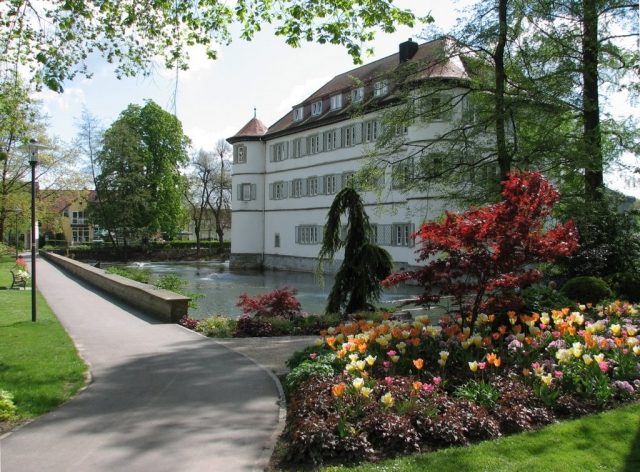
The moated castle of Bad Rappenau is a moated castle from the early 17th century in Bad Rappenau. The castle was built around 1600 by the Lords of Gemmingen on the site of an older manor, came into the possession of the municipality in 1956, and served as the seat of the city administration from 1980 to 2001. Today it serves cultural purposes.
In Bad Rappenau, there were originally two castle complexes, around which the upper village developed around the present-day Protestant city church of Bad Rappenau, and 400 meters to the west, the lower village developed around the present-day moated castle. The complex in the valley floor, in the lower village, is probably the older of the two. In a property description from 1578, the nobleman's residence of Daniel von Helmstatt is still mentioned in the upper village, but this manor was destroyed during the Thirty Years' War, so that since then the moated castle has been the only castle building in the town.
In 1578, a castle with a moat is mentioned in the lower village. The castle at the confluence of the Mühlbach, Straßbach, and Raubach once stood in the middle of an extensive swamp area. The building ground is stabilized with tree trunks driven into the ground, and the Mühlbach was dammed for the moat. In 1592, four-fifths of Rappenau came from Johann Philipp von Helmstatt to Reinhard von Gemmingen through purchase. His son Eberhard von Gemmingen (1567–1611) completed the present moated castle on the grounds of the predecessor building from 1601. Jakob Müller and Adam Wagner from Heilbronn are presumed to be the master builders.
The lower village and with it the newly built forecourt of the castle with a wine press, cattle and bakehouse, and barns were completely burned down in 1622 after the Battle of Wimpfen. Only the castle was saved from destruction because Field Marshal Tilly had assigned a guard for it. In 1630, the Rappenau fief of the Lords of Gemmingen was confiscated by imperial order because the young lord of the castle Philipp von Gemmingen (1601–1638) and his brothers were on the Protestant side at the beginning of the war. In 1645, in the further course of the Thirty Years' War, the second manor in the upper village was destroyed; the moated castle was to be the only manor in the future. After the Peace of Westphalia in 1648, the Rappenau fief returned to Eberhard von Gemmingen (1628–1675). In 1682, the substructure of the castle gave way, and major repairs became necessary.
The castle shares the ownership history of the town of Rappenau; especially in the 18th century, the lord of the castle changed frequently within the widely branched Gemmingen family. In the 18th century, it was often diplomats or military personnel who served elsewhere and neglected their property in Rappenau. Only Sigmund von Gemmingen (1777–1843) took a more intensive interest in it again. Through his son Gustav von Gemmingen (1813–1894), the castle came to the Bürg branch of the family. Gustav's grandson Franz Maria Hans Weiprecht von Gemmingen (1905–1945) was the last lord of the castle. In 1936, his son Eberhard von Gemmingen was born.
The Gemmingen family left the castle during the turmoil of World War II. After the war, it was used for various purposes for several years. Especially on the north and east sides of the complex were outbuildings. North of the moated castle was the sheep house, also known as the Gypsy Quarter, a U-shaped farmyard with partly cellared half-timbered buildings. East of the castle were the servants' quarters and barns.
In 1956, the municipality acquired the castle with the associated area of 156 acres and renovated and expanded it for spa operations until 1965. Until 1977, it housed the Schloss Sanatorium, and from 1980 to 2001, it was the seat of the city administration. Since the completion of a new town hall on the market square, the castle is predominantly used for cultural purposes. Today, the castle houses, among other things, the Kunstverein Wasserschloss Bad Rappenau e.V. (Art Association Moated Castle Bad Rappenau) as well as a gallery and is used for art exhibitions, concerts, and lectures.
Description+
The rectangular building has a corner tower in the northwest and northeast corners, and a stair tower on the south facade, which contains a technically sophisticated spiral staircase with an open newel inside and through which the individual floors are accessible. The portal on the stair tower is very ornate, showing a bust of the builder above the Gemmingen-Rodenstein alliance coat of arms, as Eberhard von Gemmingen was married to Anna Katharina von Rodenstein († 1611), with whom he had eight children. Below the coat of arms is an inscription block dating the construction and naming the married couple, and the door is surrounded by further figural decorations. Stone bands and windows structure the facade of the building, which is otherwise quite unadorned; only in the upper part of the northeast tower are there some decorative elements in the Renaissance style. Above a gate in the building, an old motif stone with a hand can be seen.
A total of eight different stonemason's marks can be found in the moated castle, five of which are on the stone spiral staircase from 1601 alone. Three of the five stonemasons of the spiral staircase also left their marks on the Grecken Castle in Kochendorf, which was built at the same time, one of them on the castle chapel of Liebenstein Castle. The mark of another stonemason can be found again in 1619 on the city church of Vaihingen.
The building is now surrounded by a park that extends westward along the Mühlbach, which is mostly culverted in the town, to the town center in the upper village, and whose hollow has further deeply cut into the Fünfmühlental in the northwest. Two historical boundary stones have been placed near the castle, one a manorial boundary stone of the Lords of Gemmingen from 1700, which stood on the border with the neighboring district of Obergimpern, and a 19th-century state boundary stone of the Grand Duchy of Baden to the neighboring Hessian enclave of Wimpfen.
Near the castle, northeast on Babstadter Straße, there is still an old defensive tower, a former corner tower, which clearly shows the dimensions of the castle forecourt. In the gable wall of the residential building attached to the tower, the old half-timbered gable of the former Bulldog garages of the estate has been preserved. The former estate distillery in a building renovated in the 1930s now serves as a kindergarten.
A memorial stone in the castle garden commemorates the four inmates of the labor camp in the Bad Rappenau saltworks who died while defusing an unexploded bomb in the last months of World War II and were buried in the nearby Rappenau Jewish cemetery.
Take Mobile History with you
You are reading this text for free. Premium adds what matters on the road: descriptions read aloud, sites found through your camera, whole regions taken offline.
- Every description, including the ~17,700 Premium sites
- Audio guide: have descriptions read to you on location
- AR finder: see sites through your camera, with distance and bearing
- Unlimited saved sites
14 days free, then from €2.99 a month. Cancel anytime.
Source: Wikipedia · Licence: CC BY-SA 4.0 · Image: Peter Schneider
This description draws on the facts documented in the linked Wikipedia article; Wikipedia content is licensed under CC BY-SA 4.0. Wording and editing: Mobile History.
Location: 49.2388, 9.0968