To be privately owned
CastleNeustift im Mühlkreis-Rannariedl
Rannariedl Castle
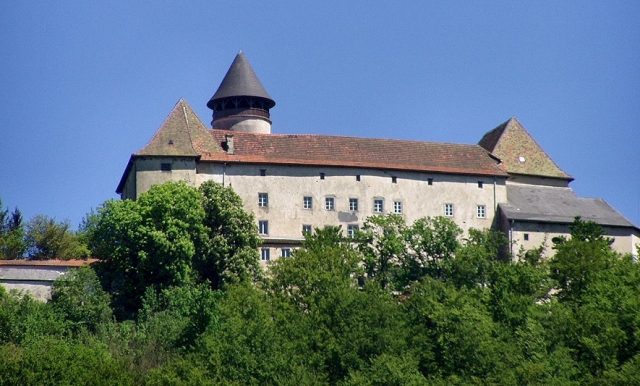
Rannariedl Castle (also: Rannariegl) is a castle complex in Upper Austria. It is located in Rannariedl in the municipality of Neustift im Mühlkreis in the Mühlviertel, high above the Danube. The castle was built around 1240 as a fortified castle. It frequently changed owners. Between 1966 and 1969, the complex underwent renovation. Approximately 200 m above the castle is a well-preserved cannon rondel from the 16th/17th century.
The name of the castle probably comes from the Old German term for uprooted and fallen tree trunks. They were formerly called Ronen or Ron.
Around 1240, Rannariedl was built as a fortified complex. It was a fief of the Bishop of Passau. The reason for its construction was the possibility of controlling and taxing the Danube at this point. The castle was inhabited by the Falkensteiners, who named themselves after the neighboring Falkenstein Castle and were robber knights. In 1301, the Falkensteiners had to mortgage the castle due to financial difficulties. Between 1384 and 1387, the castle was mortgaged to Gundacker von Tannberg. During the Hussite Wars, Reinprecht von Polheim received the property for life, but returned the castle 23 years later.
Due to disputes, Duke Georg of Lower Bavaria wanted to bring the castle under his control in 1484. He could not conquer the castle, which was defended under administrator Nussdorfer. Nevertheless, he received the castle as collateral after legal proceedings, but finally ceded it to Maximilian I in 1506 (Landshut War of Succession). The Habsburgs mortgaged the property to Max Öder in 1512. In the 16th century, the owner changed several times; after Öder came Hans Weisperger von Biberbach, in 1547 Hans Hofmann von Grünpichl, in 1569 Achaz Öder, in 1581 Count Hans von Kevenhüller. During the Turkish threat (1594), it was considered a refuge castle and was well-armed, yet it was conquered and plundered in the Peasants' War of 1595.
In 1620, Count Gottfried von Salburg bought the castle, which remained in family ownership until 1725. Afterwards, it came into the possession of the Clam family before a part of the lordship (seven royal villages) was reacquired by the Passau diocese in 1765. Around 1780, the castle chapel was enlarged, which later became the church of the Rannariedl parish. After the abolition of the secular power of the Passau bishops in 1803, the Court Chamber Office in Vienna became the new owner. In 1824, the castle passed to Maria Anna Prunner. From 1840 to 1877, the Ichzenthaler family, then Stephan Armer von Ammerstetten, owned the castle. In 1879, the Upper Austrian Volkskreditanstalt was the owner, in 1891 Johann Setzer, in 1897 the Hanss family, in 1909 Ludwig Prähofer, in 1912 Mathilde von Urban, and in 1940 the German minister Peter Lukas Reinhold bought the castle.
Between 1945 and 1955, the castle was owned by the Soviet occupation forces. Subsequently, it was owned by the Chamber of Agriculture and later by Lukas Reinhold. In 1966, the wholesale merchant Josef Schwaiger from Munich bought the castle for 5 million Schilling. The renovation of the complex was completed by 1969. In 1975, the company Ledi from Liechtenstein bought the building, with the Wallraf couple as administrators. Mr. Michael Wallraf was the estate manager of the Rannariedl property from 1982 to 1993 and was significantly responsible for a large number of renewals and changes. For example, on his initiative, in cooperation with the municipality of Neustift, the so-called Bastion or Upper Castle was made accessible to the public. Annual concerts ("Music in the Castle") and festivities took place there. Furthermore, the "Troadkasten" (grain storage) in front of the Meierhof was saved from decay with the financial support of the Linz Monument Office. In the extensive reforestation work around Rannariedl Castle and the care and preservation of the forest, he primarily focused on aspects of nature conservation and the latest findings in ecological forestry, such as mixed forests, natural regeneration, or the increase of useful bird species for pest control, to name just a few.
The castle is privately owned and cannot be visited; the cannon rondel located above it is freely accessible.
Construction+
The elevated castle is located not far from the confluence of the Ranna and the Danube. The elongated complex was once surrounded by a strong ring wall with three fortified defensive towers. The oldest part is in the east, the so-called Lower House, which was probably built by the Falkensteiners. In the southeast, the former castle chapel is attached, which served as a parish church from 1783 to 1953. The castle chapel contains a baroque pulpit and statues as well as paintings from the 18th century.
The Upper House, the current main castle, was built in the late 13th century. The residential buildings enclose an inner courtyard with three-story arcades from the 16th century on three sides. On the second floor are two Renaissance-style knight's halls. The left side was only built in the 19th century. In the castle garden stands a fountain with Saint Florian, and at the back stands Saint Nepomuk with the year 1731.
The 19th-century Meierhof (farmstead) and the opposite 18th-century Troadkasten (grain storage) also belong to the castle.
Take Mobile History with you
You are reading this text for free. Premium adds what matters on the road: descriptions read aloud, sites found through your camera, whole regions taken offline.
- Every description, including the ~17,700 Premium sites
- Audio guide: have descriptions read to you on location
- AR finder: see sites through your camera, with distance and bearing
- Unlimited saved sites
14 days free, then from €2.99 a month. Cancel anytime.
Source: Wikipedia · Licence: CC BY-SA 4.0 · Image: http://commons.wikimedia.org/wiki/File:Schloss_Rannariedl.jpg?uselang=de
This description draws on the facts documented in the linked Wikipedia article; Wikipedia content is licensed under CC BY-SA 4.0. Wording and editing: Mobile History.
Location: 48.4810, 13.7721