Museum
Restaurant
Cultural center
CastleRammenau
Rammenau Castle
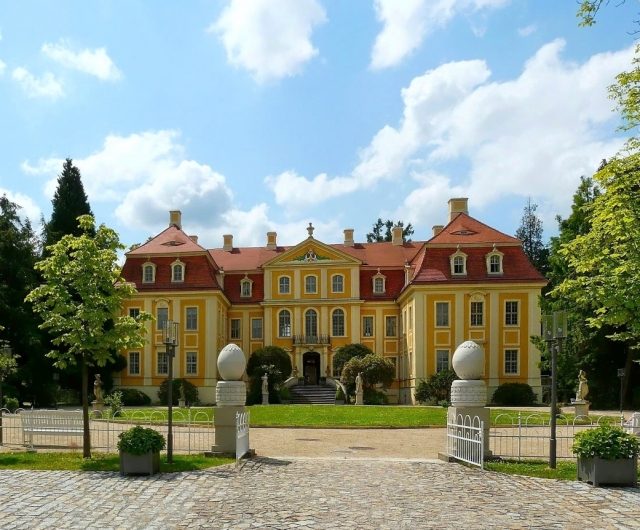
Rammenau Castle in Rammenau near Bischofswerda in the Bautzen district is one of the most beautiful preserved Baroque country castles in Saxony.
The Rammenau Baroque Castle complex is located on the northern edge of the municipality of Rammenau. This lies about 30 kilometers east-northeast of Dresden and approximately 20 kilometers west of Bautzen in the West Lusatian hill and mountain country and belongs to the West Lusatia landscape protection area. Forested hills up to 450 meters high surround the village, where several ponds were created in the Middle Ages. The castle is located near the Oberteich (Upper Pond).
The Rammenau manor was first mentioned in a document in 1597. Its initial owners were von Ponickau, von Staupitz, von Kottwitz, and von Seydewitz. From the latter family, which went bankrupt, Ernst Ferdinand von Knoch, chamberlain to August the Strong, bought the estate in 1717. From 1721 to 1731, he had a two-story Baroque castle completely rebuilt by Johann Christoph Knöffel and a Baroque garden laid out behind it.
In 1744, Franz Josef von Hoffmann bought the castle, which von Knoch had abandoned due to bankruptcy. His nephew, the Electoral Saxon Privy Councillor Johann Albericius von Hoffmann, inherited it in 1749. In 1758, during the Seven Years' War, the castle briefly served as headquarters for the Prussian King Frederick the Great. In 1778, von Hoffmann was elevated to the rank of Imperial Count as "von Hoffmannsegg". His son, the botanist and entomologist Johann Centurius Graf von Hoffmannsegg, sold the Rammenau estate in 1794 to his brother-in-law, the Prussian cavalry captain Friedrich von Kleist. The latter had the interior of the castle altered in the Neoclassical style and the garden transformed into an English landscape park. In 1820, Johann Centurius von Hoffmannsegg bought the castle back as his retirement home.
In 1879, the Royal Chamberlain and Monastery Bailiff in Marienstern, Hans Curt Christoph Ernst von Posern, acquired the estate from the von Hoffmannsegg family. His widow, a born Baroness von Humboldt (1853–1914), married General of the Cavalry Eugen von Kirchbach. After her death, her daughter Margarete Gisela Gabriele Alexandra von Helldorff, née von Posern, took over the castle. During the First World War, the castle was also used as a military hospital. One of the last owners was described in the novella Der grüne Posern by the poet Borries von Münchhausen.
In 1945, the castle was occupied by the Red Army, and the von Helldorff family was dispossessed by the land reform in the Soviet Occupation Zone. From 1951, the Dresden Academy of Fine Arts used rooms in the castle as a summer studio and for educational purposes. In 1961, its use as a museum began with the Fichte Museum, which was expanded in 1967 to include a section on the history of the castle. In 1968, the castle restaurant was opened. In 1972, the DEFA film Aus dem Leben eines Taugenichts (From the Life of a Good-for-Nothing) with Dean Reed was filmed on the castle grounds.
Although initial restoration work began as early as 1948 and continued within the modest framework possible in the GDR, comprehensive renovation could only take place in the 1990s, after the Rammenau complex, including the castle, park, and farmyard, came into the possession of the Free State of Saxony and became a state-owned castle operation.
The Complex+
The castle complex is reached through the two-story gatehouse with a Baroque tower structure. The gatehouse is part of the farm or manor yard, whose single-story buildings (formerly stables and storage) adjoin the gatehouse. The farmyard is concluded by two cavalier houses, which lead to the courtyard of honor, the forecourt of the main building.
The castle is a two-story, three-wing complex with a high mansard roof. The facades facing the courtyard and the garden are structured by central risalits and flat pilasters. Both gables and roofs bear Baroque decorative elements. From both the courtyard and the garden, open staircases lead over terraces into the house. From a reception hall with a cross vault, a three-flight staircase with Baroque forms leads to the upper floor. The reception hall and staircase feature illusionistic architectural painting.
On the ground floor are the castle restaurant and some museum rooms, and on the upper floor are the castle's exhibition rooms, largely restored to their original condition. Due to former interior renovations at various times, there are rooms in the Baroque style (Chinese Room) but predominantly in the Neoclassical style (Pompeian Room, Bulgarian Room, Golden Room). The center of the upper floor is the two-story Hall of Mirrors.
Behind the castle building is a five-hectare park. Since 1962, it bore the name Fichte Park, after the German philosopher born in Rammenau, whose monument it also contains. More recently, however, it is usually just called the Castle Park. In the park, designed as an English garden, in whose design the surrounding agricultural land was integrated through sightlines, rare plants, a pond with water features, a lake, and, including the courtyard of honor, numerous statues and putti can be found.
Usage+
In addition to visiting the castle as a museum demonstrating aristocratic living and lifestyle in Saxony during the Baroque and Neoclassical periods, Rammenau Castle offers numerous other possibilities. Thematic guided tours are conducted. Concerts regularly take place in the Hall of Mirrors and reading events in the Garden Hall.
Events also take place outside the main house, such as special exhibitions in the Cavalier House East or summer concerts in the park. The International Upper Lusatian Linen Days at the end of August have been a gathering of designers and artisans from numerous European countries on the theme "All about Linen" for 14 years. Conferences, business, and private celebrations take place in the rooms of the farmyard as well as the main building.
The gastronomy of the castle restaurant offers special historically oriented culinary events under the theme "Guest at the Chambermaid's".
Take Mobile History with you
You are reading this text for free. Premium adds what matters on the road: descriptions read aloud, sites found through your camera, whole regions taken offline.
- Every description, including the ~17,700 Premium sites
- Audio guide: have descriptions read to you on location
- AR finder: see sites through your camera, with distance and bearing
- Unlimited saved sites
14 days free, then from €2.99 a month. Cancel anytime.
Source: Wikipedia · Licence: CC BY-SA 4.0 · Image: Thomas Eichler
This description draws on the facts documented in the linked Wikipedia article; Wikipedia content is licensed under CC BY-SA 4.0. Wording and editing: Mobile History.
Location: 51.1588, 14.1279