To be privately owned
Castlesterreich Behamberg-Ramingdorf
Ramingdorf Castle
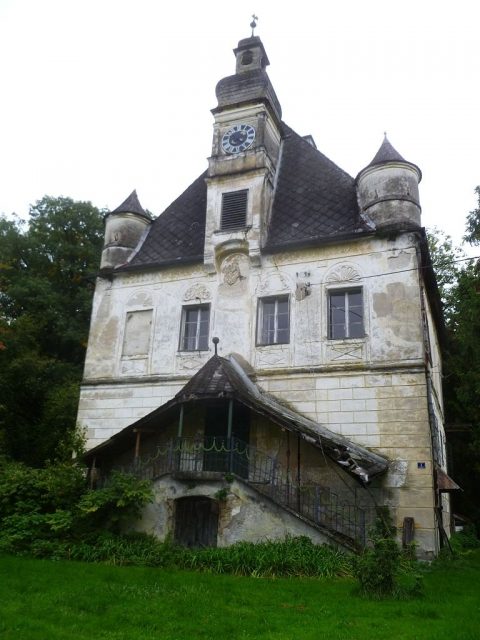
The area around Ramingdorf belonged to the Starhemberg family in the 13th century. They enfeoffed the Hinterholzer family with the court located here. In 1296, the Kreßling family were co-owners for a short time. When the feudal sovereignty passed to the Wallseer family around 1309, the Hinterholzers were allowed to remain in Ramingdorf. Peter Hinterholzer was burgrave of Steyr in 1375/76. In 1504, the family died out. Jakob Hinterholzer had already sold the court five years earlier to Apollonia Prantstetter. Her feudal lords had been the Counts of Schaumberg since 1491. They renounced their rights in 1516, so that Hans Prantstetter, the then mayor of Steyr, could own the court as a free property. In 1567, Wolf Handl (or Händl) bought the manor. He was also a long-serving mayor of Steyr. One of his sons called himself Berthold von Ramingdorf. The Handl family owned the estate for about 200 years. Under them, the castle received its present form. Then they moved to Schloss Vestenthal and sold the small castle to Joachim Ferdinand Mechtl von Engelsberg. The next owners were Franz Adam Maurer von Kronsegg (1793), Joseph von Kalmaßy (1795), Johann Benz (1817) and Johann von Frank (1819). In the same year, the Dorn family followed, who operated a brewery in Ramingdorf. They had the facades renewed after 1830. In the later 19th and 20th centuries, bourgeois and peasant owners alternated. The pretty castle is currently empty. It would deserve a professional restoration.
The former moated castle is located not far from the village's railway station. It is a two-story tower-like building, which was erected in its present form at the beginning of the 17th century. The moat visible on Vischer's engraving from 1672 has now disappeared except for minor remnants. Also no longer present are the wooden bridge leading over the moat, as well as the former ring wall with the round-arched gate. Of the former defensive structures that surrounded the main building, only a square turret on the pond has been preserved. The delicate little castle has changed little since 1672. It shows four window axes on the front and back, and three window axes on each of the two side fronts. The building is covered with a steep hip roof. At its corners, bartizans, equipped with keyholes and conical roofs, indicate a state of readiness for defense that no longer existed at the time the castle was built. The "pepper pots" already had a rather decorative character back then. The high rusticated plinth floor is visually separated from the living floor by a simple cornice. The palmette and rhombus ornamentation above and below the windows dates from the refacading in the second quarter of the 19th century. On the west-facing entrance front, a two-armed open staircase under a sheet metal roof leads to the simple entrance door. Above it is the stucco coat of arms of a former lord of the castle. In the middle of this facade, a square clock tower supported by consoles is attached to the hip roof. It is covered with a baroque onion dome. West of the small castle lies an 18th/19th century farmstead, which, with its outbuildings, is many times larger than the manor house. The farm buildings also include the former brewery. Remnants of the once more extensive park are still present. Approx. 300 m to the west lay the original Ramingdorf Castle, a predecessor building of the castle. It has completely disappeared today.
Take Mobile History with you
You are reading this text for free. Premium adds what matters on the road: descriptions read aloud, sites found through your camera, whole regions taken offline.
- Every description, including the ~17,700 Premium sites
- Audio guide: have descriptions read to you on location
- AR finder: see sites through your camera, with distance and bearing
- Unlimited saved sites
14 days free, then from €2.99 a month. Cancel anytime.
Source: Wikipedia · Licence: CC BY-SA 4.0 · Image: http://commons.wikimedia.org/wiki/File:Schloss_Ramingdorf.jpg?uselang=de
This description draws on the facts documented in the linked Wikipedia article; Wikipedia content is licensed under CC BY-SA 4.0. Wording and editing: Mobile History.
Location: 48.0657, 14.4629