To be privately owned
CastleQuitzin
Quitzin Castle
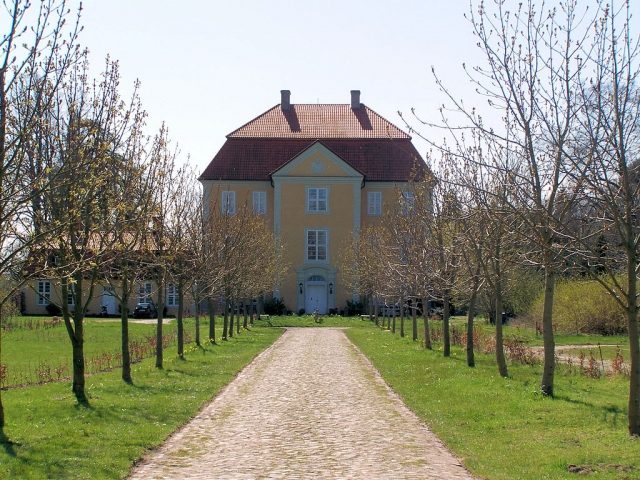
Quitzin (historically also Qwitzin) is a district of the municipality of Splietsdorf in the Vorpommern-Rügen district. The village is located in the Trebel valley, seven kilometers northwest of Grimmen. The former hunting lodge and estate of Quitzin is one of the most important cultural monuments in Vorpommern.
Origin of the Name+
The place name is derived from the old Kučin, which originated from the surname Kuča. Documents show the spellings curiam in Quitsin (1320-23), Quißin (1618) and Quitzin (since 1631).
Historical finds already prove an early settlement of the area. These include settlement ceramics (wall sherds and rims) as well as iron slag from the Roman Imperial period and the Migration Period, and partly grooved Young Slavic ceramics from the Slavic period. From the medieval and modern periods, a lime kiln ruin, a mill ruin, and a former brickworks were identified by evaluating Prussian original survey maps.
An early settlement is also indicated by a ring fort located in the immediate vicinity of the present castle, which was built in the 13th century and surrounded by a moat, as well as the Slavic name Quitzin.
Manor House and Hunting Lodge+
Architecture
The former manor house is a three-story plastered building, which has five by three axes and was built in its core around 1607. From the center of the building, a risalit with a coat-of-arms-decorated triangular gable, built around 1723, protrudes on the courtyard side. The single-story wing buildings also date from this period. All three parts of the building are covered with high mansard roofs. The exterior facade is simply structured by corner quoins and window surrounds. The main entrance is framed by pilasters and a segmental arch. In the main floor, elaborate stucco work can be found on walls and ceilings.
The estate is situated in a large landscape park, which was originally laid out as a baroque garden and merges into the Trebel lowlands.
The tall manor house was built in 1607 in the Brick Renaissance style on foundations and cellars of a predecessor building from the 13th century for the ducal Pomeranian councilor and chancellor Erasmus von Küssow. The manor house was first mentioned around 1457, when Duke Erich II of Pomerania-Wolgast, together with his brother Wartislaw X, gifted the estate to the abbot of the Neuenkamp monastery, where the city of Franzburg is located today.
The manor house was converted into a hunting lodge around 1723 and remodeled in the Baroque style. During the Swedish period in Pomerania, King Charles XII of Sweden was a frequent hunting guest in Quitzin. The estate remained in the possession of the Counts von Küssow until their extinction in 1824. The Teutonic Order litigated from 1824 to 1841 over the inheritance of the last Küssow. In the second quarter of the 19th century, Countess von Küssow had an eccentric classical-style bathhouse built in the park by C.A.P. Menzel, a student of Schinkel and university building inspector in Greifswald, which was unique for Vorpommern and of which only the foundations remain. The Küssow heirs sold Quitzin to Werner von Veltheim in 1908. The von Veltheim family was expropriated in 1937. The estate was settled in the land reform of 1945. After 1945, the building fabric of the hunting lodge suffered severely. After initial use as a refugee camp after the end of World War II, the house was used as a magazine by the GDR Civil Defense from 1971 until the fall of the Berlin Wall, the windows were partly bricked up or fitted with iron grilles, and the mansard roof of the main building was replaced by a flat roof. Decorations on the exterior facade were removed.
Due to the house's importance for the cultural history of Vorpommern, it has been renovated and restored since the 1990s by the new owners, Burghard and Friederike Rübcke von Veltheim, also with the help of the German Foundation for Monument Protection. The 300-year-old plastered building has received a new roof in its original form and is again used as a manor house. The reconstruction of one of the two cavalier houses to the right of the main house is currently still pending.
Former Castle Chapel+
In the estate complex in front of the main house lies the small castle chapel, a plastered brick building erected in 1614, whose core could be of an earlier date. The eastern bay is provided with buttresses. The east gable is executed in half-timbering, whose compartments are plastered. On it is a wooden suspension for the bell, which dates from 1856. The western gable was massively rebuilt in brick in the 19th century. The west and south portals are pointed-arched. The chapel has wooden segmental-arch windows framed by plastered surrounds. During the restoration after 1990, the exterior of the chapel was provided with a shell limestone plaster.
Inside, the building has a cell vault in the choir bay and a plastered wooden barrel vault in the nave. Two rectangular wall niches are located in the east wall.
The interior of the castle chapel includes a sandstone altarpiece from 1616, which was probably the base of a larger retable and bears the coats of arms of the von Küssow and von Blücher families, the then owners. Furthermore, the building contains a pulpit with Renaissance carvings, a crucifix from the 14th century, a lectern from 1714, and an octagonal baptismal font from the second half of the 19th century. The latter was originally in the village church of Rolofshagen. The pews date from the first half of the 18th century.
The churchyard is surrounded by a fieldstone wall. On it is a gravestone from 1746.
The former castle chapel is occasionally still used by the Pomeranian Evangelical Church, for example for weddings and baptismal services.
Take Mobile History with you
You are reading this text for free. Premium adds what matters on the road: descriptions read aloud, sites found through your camera, whole regions taken offline.
- Every description, including the ~17,700 Premium sites
- Audio guide: have descriptions read to you on location
- AR finder: see sites through your camera, with distance and bearing
- Unlimited saved sites
14 days free, then from €2.99 a month. Cancel anytime.
Source: Wikipedia · Licence: CC BY-SA 4.0
This description draws on the facts documented in the linked Wikipedia article; Wikipedia content is licensed under CC BY-SA 4.0. Wording and editing: Mobile History.
Location: 54.1147, 12.9716