Museum
CastleBad Pyrmont
Pyrmont Castle
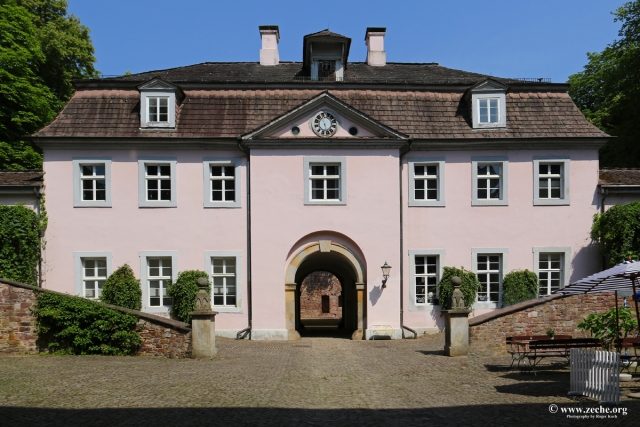
Pyrmont Castle was the residence or summer residence of the Counts of Spiegelberg and the Counts of Waldeck-Pyrmont in what is now Bad Pyrmont. The existing building dates from the 18th century. Today it houses a museum. The castle is part of the Pyrmont Fortress from the 16th century.
Fortress and Renaissance Castle
Count Friedrich VI. of Spiegelberg, as the sovereign of the County of Pyrmont, built a fortress with a castle within it in the Pyrmont valley between 1526 and 1536. He had experience in fortress construction from reinforcing Coppenbrügge Castle with walls and roundels. Pyrmont Fortress consisted of an almost square rampart system with a 40-meter wide moat. The ramparts featured casemates and a stone-built corner bastion, echoing the Italian style of fortification. Access to the fortress was via a wooden bridge and later a drawbridge. Buildings were erected within the ramparts, and a first castle building in the southwestern area.
After the completion of the castle in 1536, Count Friedrich VI, who resided in neighboring Lügde, moved in. Later, the castle building became a side wing of a larger castle that his son Philipp had added in 1557 in the Weser Renaissance style. According to traditional views, it was a three-story building with three stepped gables, similar to the construction style of Hämelschenburg. In addition, a tower was erected for archiving documents. Philipp died before the completion of the Renaissance castle. The construction was completed by his sister's husband, Hermann Simon von Lippe. Subsequently, the Counts of Lippe and the Counts of Gleichen resided at the castle. In 1625, Count Hans Ludwig von Gleichen ceded the County of Pyrmont to the Counts of Waldeck.
During the Thirty Years' War, the succession dispute between the Bishopric of Paderborn and the Counts of Waldeck flared up again. For the Bishopric, troops of General Pappenheim besieged Pyrmont Fortress in 1629. The 400-man garrison surrendered after 10 months. In 1633, Swedish troops recaptured the fortress, which was retaken by the Imperial forces in 1636. After another capture by the Swedes in 1646, they handed over the fortress to the Counts of Waldeck in 1649. The castle was damaged by the sieges. Hastily repaired, it served as a summer residence for the Counts of Waldeck. It was also neglected in the following period and began to decay.
When Count Anton Ulrich von Waldeck-Pyrmont took over the regency in Waldeck and Pyrmont in 1706, he commissioned the master builder Hermann Korb to erect a new castle in the Baroque style. The construction took place between 1706 and 1710 on the plinth floor and other parts of the previous building. Already in 1721, an extension was made by the architect Julius Ludwig Rothweil. A commander's house, two cavalier houses, and a magazine building were constructed. The fortifications were repaired. In addition, the gardens were redesigned in the Baroque style. Further changes followed from 1765 under the building director Franz Friedrich Rothweil. Between 1852 and 1855, some buildings were raised, and the castle acquired its present appearance.
20th Century
During the Second World War, the castle housed a military hospital, as Pyrmont was a hospital town. After the war, the British Red Cross had its headquarters in the castle until 1948. In 1956, the state of Lower Saxony acquired the fortress and castle from the princely family of Waldeck and Pyrmont. A first renovation took place from 1960 to 1962; another followed between 1978 and 1987. Subsequently, the complex was used as an adult education center and as a museum for the history of the city of Pyrmont and the spa. In addition, the castle complex is used for various events.
Take Mobile History with you
You are reading this text for free. Premium adds what matters on the road: descriptions read aloud, sites found through your camera, whole regions taken offline.
- Every description, including the ~17,700 Premium sites
- Audio guide: have descriptions read to you on location
- AR finder: see sites through your camera, with distance and bearing
- Unlimited saved sites
14 days free, then from €2.99 a month. Cancel anytime.
Location: 51.9836, 9.2484